 Add to Chrome
 Add to Firefox
 Add to Edge
MultiSynt/MT: Trillion-Token Multi-Parallel Pre-Training Data Translated Across 36 Languages
Jul 01, 2026
Open web-scale pre-training corpora remain concentrated in English, limiting multilingual LLM development. We introduce MultiSynt/MT, an open synthetic parallel corpus with approximately 4.8 trillion target-language tokens across 36 European languages, produced by translating 100 billion high-quality Nemotron-CC tokens with Tower+ and OPUS-MT/HPLT-MT systems. For many medium- and lower-resource European languages, this is the largest openly available pre-training resource. On a broad multilingual benchmark suite, reference LLMs trained on MultiSynt/MT reach the final score of HPLT 2.0, a native-data baseline, using roughly 72% fewer pre-training tokens, and outperform it by approximately 15% relative at a matched 100B-token training budget. Our analyses also identify evaluation blind spots: standard multiple-choice benchmarks miss translation-quality differences that a fluency-sensitive LLM-as-judge evaluation cleanly recovers on the trained LLMs (with no fluency deficit in MultiSynt itself), and Norwegian idiomatic and culturally grounded tasks remain better served by native data. We release the corpus, including row-aligned translations from multiple systems, to support controlled research on multilingual pre-training data and evaluation.

Structure Retention in Embedding Spaces as a Predictor of Benchmark Performance
May 21, 2026In this paper, we show that high-performing embedding models organize their embedding spaces in a consistent way. We evaluate 25 contemporary embedding models on five MTEB tasks spanning four diverse task categories (retrieval, bitext mining, pair classification, and summarization) in both English and multilingual settings, and reveal that nearest-neighbor overlap and magnitude differences in independent component analysis (ICA) between paired text instances strongly correlate (even up to 0.97) with performance on the given task. Ultimately, we show that embedding tasks display varying degrees of linearity and reliance on retention of local information. Our results further the understanding of embeddings, their relation to model performance, and shed light on possible future training objectives and optimizing conditional embeddings.
Matching Meaning at Scale: Evaluating Semantic Search for 18th-Century Intellectual History through the Case of Locke
May 10, 2026While digitized corpora have transformed the study of intellectual transmission, current methods rely heavily on lexical text reuse detection, capturing verbatim quotations but fundamentally missing paraphrases and complex implicit engagement. This paper evaluates semantic search in 18th-century intellectual history through the reception of John Locke's foundational work. Using expert annotation grounded in a semantic taxonomy, we examine whether an off-the-shelf semantic search pipeline can surface meaning-level correspondences overlooked by lexical methods. Our results demonstrate that semantic search retrieves substantially more implicit receptions than lexical baselines. However, linguistic diagnostics also reveal a "lexical gatekeeping" effect, where retrieval remains partially constrained by surface vocabulary overlap. These findings highlight both the potential and the limitations of semantic retrieval for analyzing the circulation of ideas in large historical corpora. The data is available at https://github.com/COMHIS/locke-sim-data.
Measuring Social Integration Through Participation: Categorizing Organizations and Leisure Activities in the Displaced Karelians Interview Archive using LLMs
Feb 17, 2026Digitized historical archives make it possible to study everyday social life on a large scale, but the information extracted directly from text often does not directly allow one to answer the research questions posed by historians or sociologists in a quantitative manner. We address this problem in a large collection of Finnish World War II Karelian evacuee family interviews. Prior work extracted more than 350K mentions of leisure time activities and organizational memberships from these interviews, yielding 71K unique activity and organization names -- far too many to analyze directly. We develop a categorization framework that captures key aspects of participation (the kind of activity/organization, how social it typically is, how regularly it happens, and how physically demanding it is). We annotate a gold-standard set to allow for a reliable evaluation, and then test whether large language models can apply the same schema at scale. Using a simple voting approach across multiple model runs, we find that an open-weight LLM can closely match expert judgments. Finally, we apply the method to label the 350K entities, producing a structured resource for downstream studies of social integration and related outcomes.
Creating a Historical Migration Dataset from Finnish Church Records, 1800-1920
Jun 09, 2025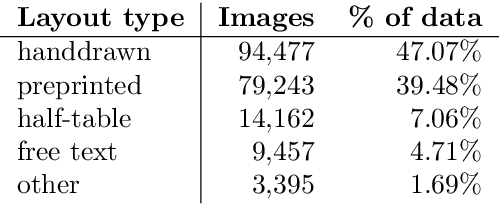
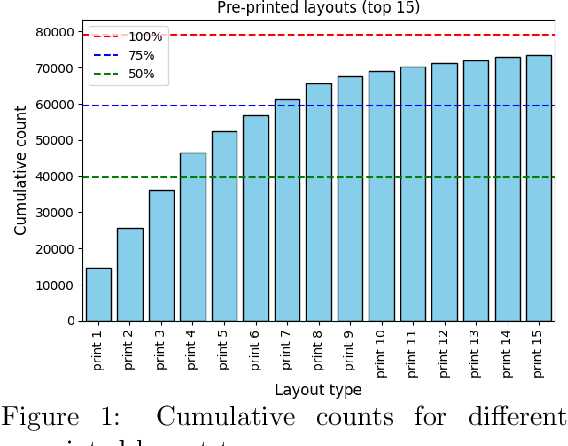
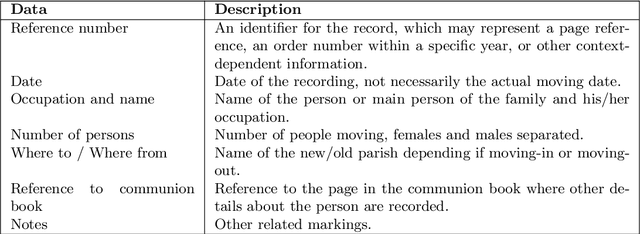
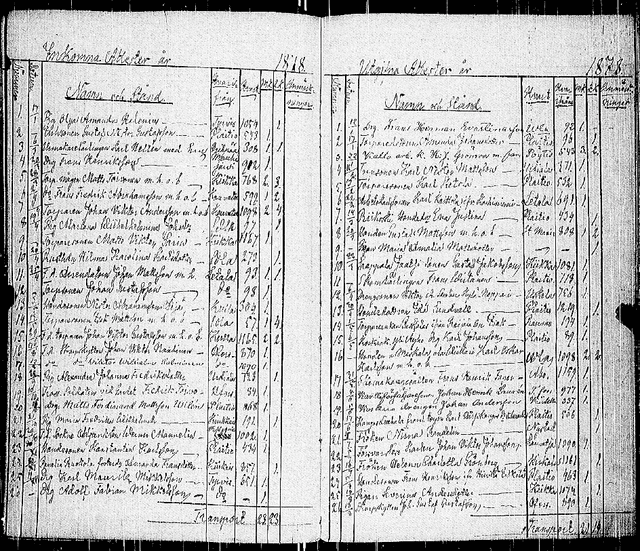
This article presents a large-scale effort to create a structured dataset of internal migration in Finland between 1800 and 1920 using digitized church moving records. These records, maintained by Evangelical-Lutheran parishes, document the migration of individuals and families and offer a valuable source for studying historical demographic patterns. The dataset includes over six million entries extracted from approximately 200,000 images of handwritten migration records. The data extraction process was automated using a deep learning pipeline that included layout analysis, table detection, cell classification, and handwriting recognition. The complete pipeline was applied to all images, resulting in a structured dataset suitable for research. The dataset can be used to study internal migration, urbanization, and family migration, and the spread of disease in preindustrial Finland. A case study from the Elim\"aki parish shows how local migration histories can be reconstructed. The work demonstrates how large volumes of handwritten archival material can be transformed into structured data to support historical and demographic research.
Extracting Social Connections from Finnish Karelian Refugee Interviews Using LLMs
Feb 19, 2025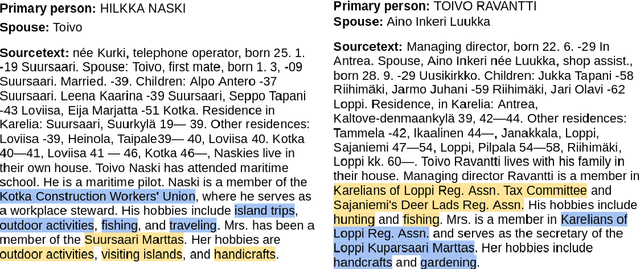
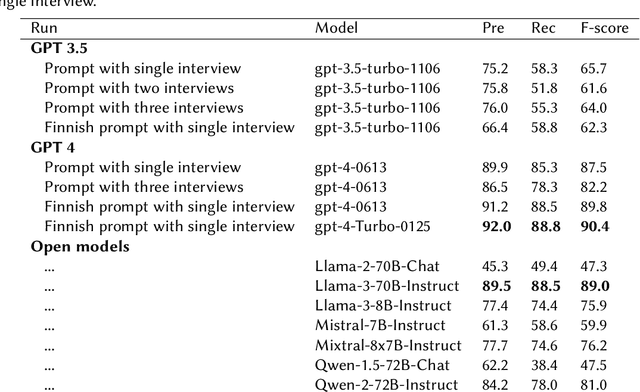
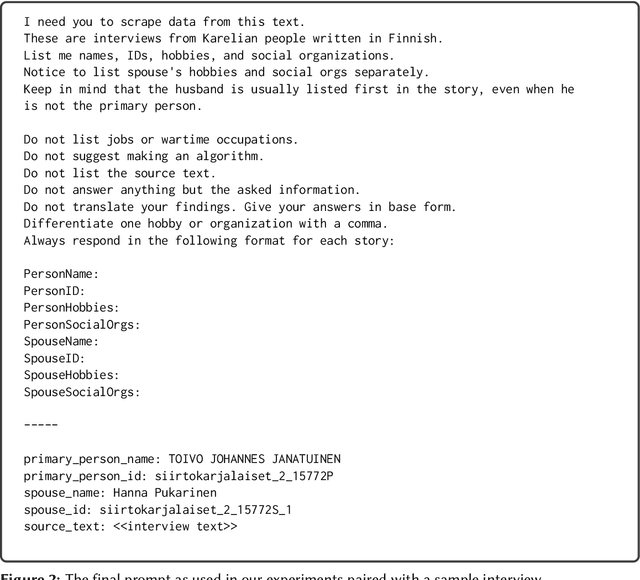
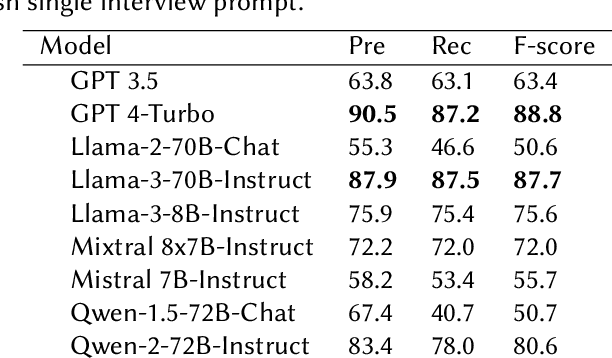
We performed a zero-shot information extraction study on a historical collection of 89,339 brief Finnish-language interviews of refugee families relocated post-WWII from Finnish Eastern Karelia. Our research objective is two-fold. First, we aim to extract social organizations and hobbies from the free text of the interviews, separately for each family member. These can act as a proxy variable indicating the degree of social integration of refugees in their new environment. Second, we aim to evaluate several alternative ways to approach this task, comparing a number of generative models and a supervised learning approach, to gain a broader insight into the relative merits of these different approaches and their applicability in similar studies. We find that the best generative model (GPT-4) is roughly on par with human performance, at an F-score of 88.8%. Interestingly, the best open generative model (Llama-3-70B-Instruct) reaches almost the same performance, at 87.7% F-score, demonstrating that open models are becoming a viable alternative for some practical tasks even on non-English data. Additionally, we test a supervised learning alternative, where we fine-tune a Finnish BERT model (FinBERT) using GPT-4 generated training data. By this method, we achieved an F-score of 84.1% already with 6K interviews up to an F-score of 86.3% with 30k interviews. Such an approach would be particularly appealing in cases where the computational resources are limited, or there is a substantial mass of data to process.
OCR Error Post-Correction with LLMs in Historical Documents: No Free Lunches
Feb 03, 2025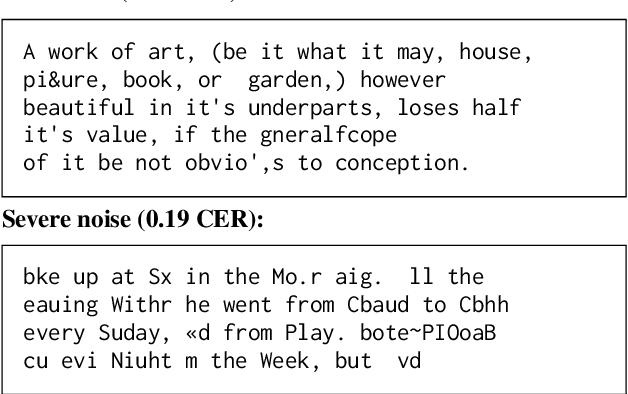

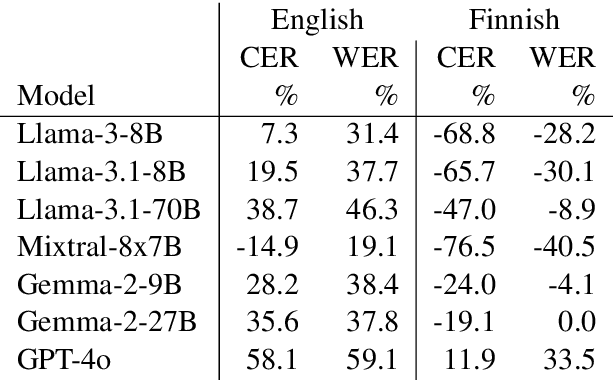
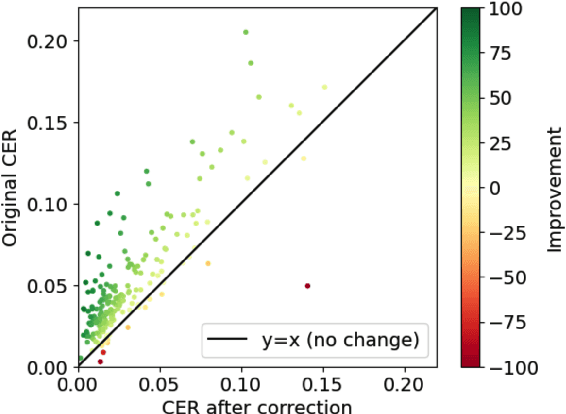
Optical Character Recognition (OCR) systems often introduce errors when transcribing historical documents, leaving room for post-correction to improve text quality. This study evaluates the use of open-weight LLMs for OCR error correction in historical English and Finnish datasets. We explore various strategies, including parameter optimization, quantization, segment length effects, and text continuation methods. Our results demonstrate that while modern LLMs show promise in reducing character error rates (CER) in English, a practically useful performance for Finnish was not reached. Our findings highlight the potential and limitations of LLMs in scaling OCR post-correction for large historical corpora.
FinerWeb-10BT: Refining Web Data with LLM-Based Line-Level Filtering
Jan 13, 2025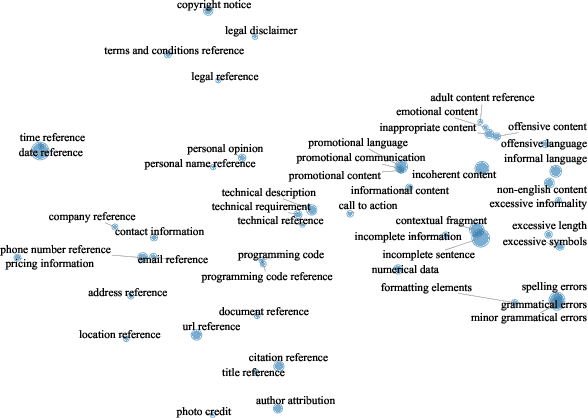
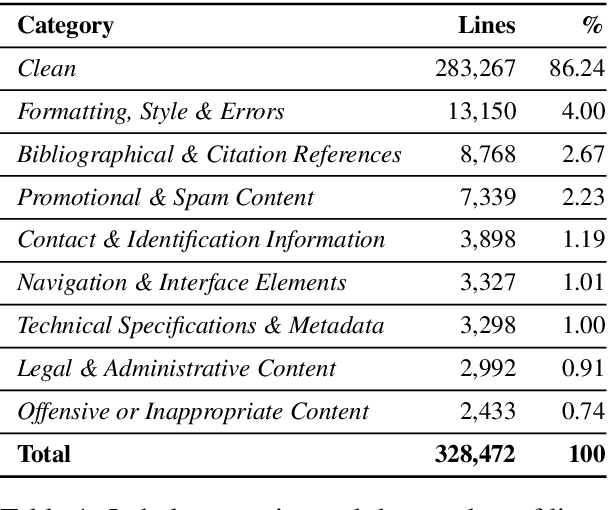
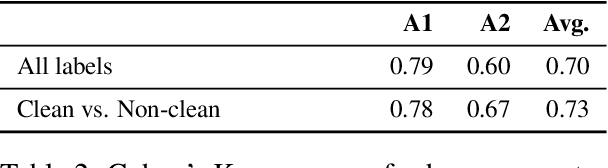
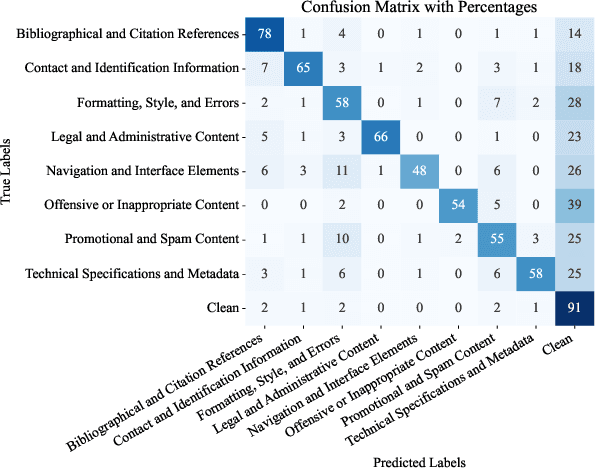
Data quality is crucial for training Large Language Models (LLMs). Traditional heuristic filters often miss low-quality text or mistakenly remove valuable content. In this paper, we introduce an LLM-based line-level filtering method to enhance training data quality. We use GPT-4o mini to label a 20,000-document sample from FineWeb at the line level, allowing the model to create descriptive labels for low-quality lines. These labels are grouped into nine main categories, and we train a DeBERTa-v3 classifier to scale the filtering to a 10B-token subset of FineWeb. To test the impact of our filtering, we train GPT-2 models on both the original and the filtered datasets. The results show that models trained on the filtered data achieve higher accuracy on the HellaSwag benchmark and reach their performance targets faster, even with up to 25\% less data. This demonstrates that LLM-based line-level filtering can significantly improve data quality and training efficiency for LLMs. We release our quality-annotated dataset, FinerWeb-10BT, and the codebase to support further work in this area.
Finnish SQuAD: A Simple Approach to Machine Translation of Span Annotations
Jan 10, 2025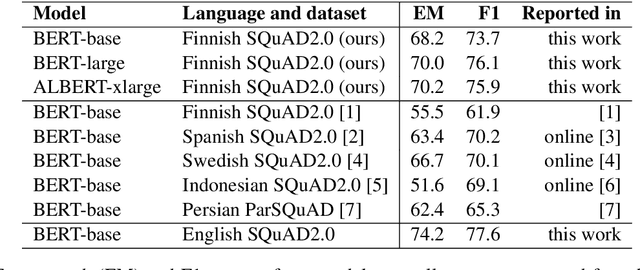
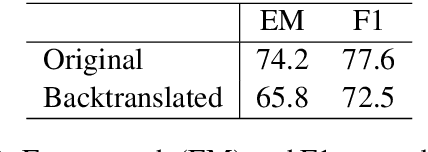
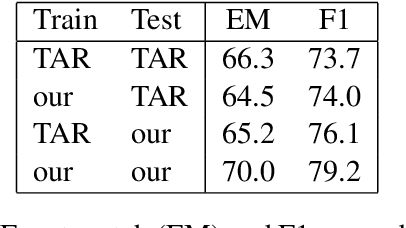
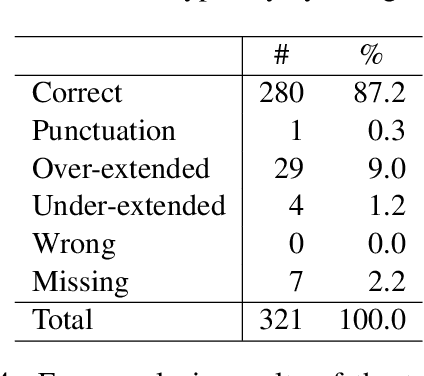
We apply a simple method to machine translate datasets with span-level annotation using the DeepL MT service and its ability to translate formatted documents. Using this method, we produce a Finnish version of the SQuAD2.0 question answering dataset and train QA retriever models on this new dataset. We evaluate the quality of the dataset and more generally the MT method through direct evaluation, indirect comparison to other similar datasets, a backtranslation experiment, as well as through the performance of downstream trained QA models. In all these evaluations, we find that the method of transfer is not only simple to use but produces consistently better translated data. Given its good performance on the SQuAD dataset, it is likely the method can be used to translate other similar span-annotated datasets for other tasks and languages as well. All code and data is available under an open license: data at HuggingFace TurkuNLP/squad_v2_fi, code on GitHub TurkuNLP/squad2-fi, and model at HuggingFace TurkuNLP/bert-base-finnish-cased-squad2.
FinGPT: Large Generative Models for a Small Language
Nov 03, 2023
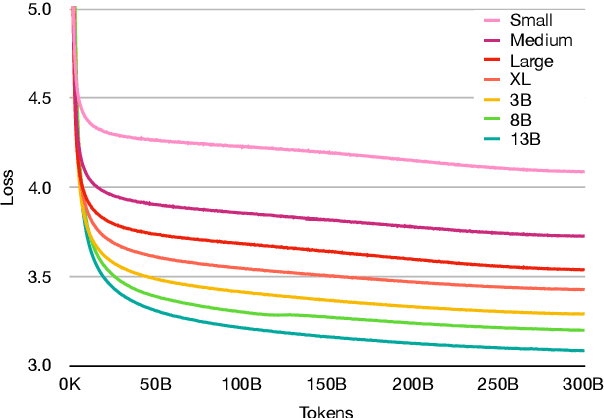


Large language models (LLMs) excel in many tasks in NLP and beyond, but most open models have very limited coverage of smaller languages and LLM work tends to focus on languages where nearly unlimited data is available for pretraining. In this work, we study the challenges of creating LLMs for Finnish, a language spoken by less than 0.1% of the world population. We compile an extensive dataset of Finnish combining web crawls, news, social media and eBooks. We pursue two approaches to pretrain models: 1) we train seven monolingual models from scratch (186M to 13B parameters) dubbed FinGPT, 2) we continue the pretraining of the multilingual BLOOM model on a mix of its original training data and Finnish, resulting in a 176 billion parameter model we call BLUUMI. For model evaluation, we introduce FIN-bench, a version of BIG-bench with Finnish tasks. We also assess other model qualities such as toxicity and bias. Our models and tools are openly available at https://turkunlp.org/gpt3-finnish.