 Add to Chrome
 Add to Firefox
 Add to Edge
Measuring Social Integration Through Participation: Categorizing Organizations and Leisure Activities in the Displaced Karelians Interview Archive using LLMs
Feb 17, 2026
Digitized historical archives make it possible to study everyday social life on a large scale, but the information extracted directly from text often does not directly allow one to answer the research questions posed by historians or sociologists in a quantitative manner. We address this problem in a large collection of Finnish World War II Karelian evacuee family interviews. Prior work extracted more than 350K mentions of leisure time activities and organizational memberships from these interviews, yielding 71K unique activity and organization names -- far too many to analyze directly. We develop a categorization framework that captures key aspects of participation (the kind of activity/organization, how social it typically is, how regularly it happens, and how physically demanding it is). We annotate a gold-standard set to allow for a reliable evaluation, and then test whether large language models can apply the same schema at scale. Using a simple voting approach across multiple model runs, we find that an open-weight LLM can closely match expert judgments. Finally, we apply the method to label the 350K entities, producing a structured resource for downstream studies of social integration and related outcomes.

Extracting Social Connections from Finnish Karelian Refugee Interviews Using LLMs
Feb 19, 2025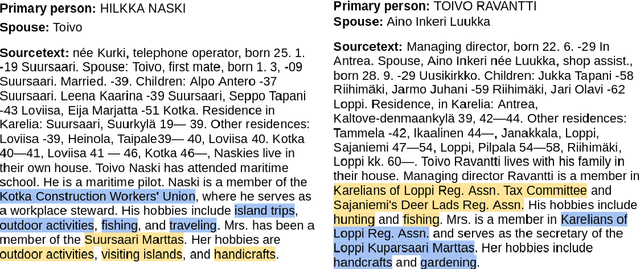
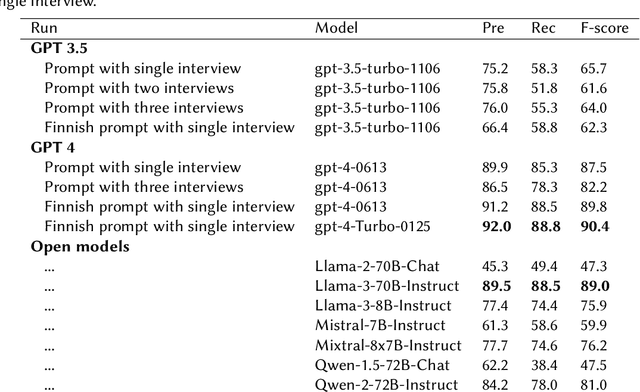
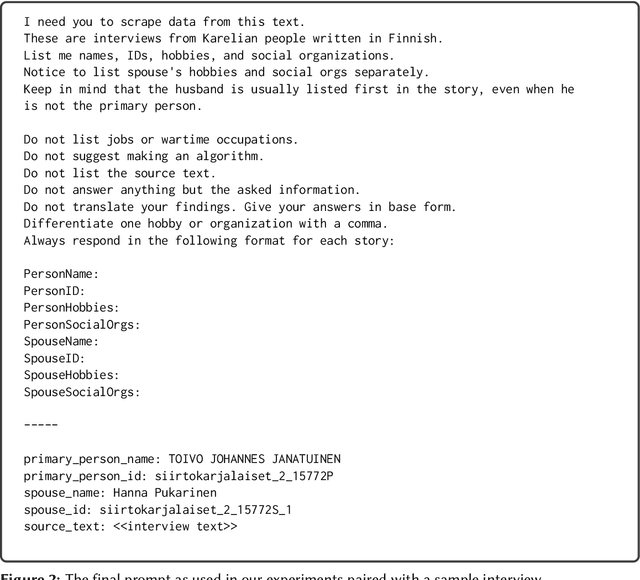
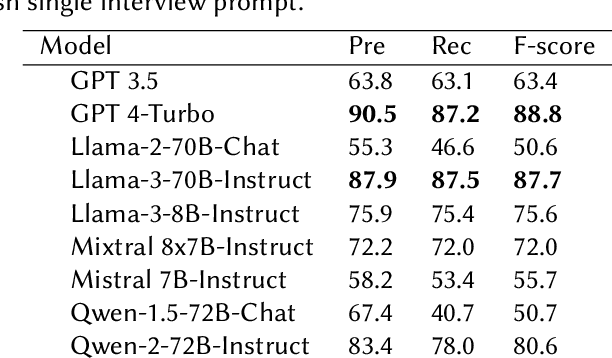
We performed a zero-shot information extraction study on a historical collection of 89,339 brief Finnish-language interviews of refugee families relocated post-WWII from Finnish Eastern Karelia. Our research objective is two-fold. First, we aim to extract social organizations and hobbies from the free text of the interviews, separately for each family member. These can act as a proxy variable indicating the degree of social integration of refugees in their new environment. Second, we aim to evaluate several alternative ways to approach this task, comparing a number of generative models and a supervised learning approach, to gain a broader insight into the relative merits of these different approaches and their applicability in similar studies. We find that the best generative model (GPT-4) is roughly on par with human performance, at an F-score of 88.8%. Interestingly, the best open generative model (Llama-3-70B-Instruct) reaches almost the same performance, at 87.7% F-score, demonstrating that open models are becoming a viable alternative for some practical tasks even on non-English data. Additionally, we test a supervised learning alternative, where we fine-tune a Finnish BERT model (FinBERT) using GPT-4 generated training data. By this method, we achieved an F-score of 84.1% already with 6K interviews up to an F-score of 86.3% with 30k interviews. Such an approach would be particularly appealing in cases where the computational resources are limited, or there is a substantial mass of data to process.