 Add to Chrome
 Add to Firefox
 Add to Edge
NBA_Streaming: A Large-Scale Benchmark for Fine-Grained Basketball Commentary Generation in Continuous Streams
Aug 10, 2026
Live basketball commentary generation requires determining when an event is sufficiently observable and describing it before subsequent events unfold. However, existing methods are primarily designed for pre-segmented clips or complete videos, making them unsuitable for continuous streams. Existing datasets also provide limited supervision for player identities, fine-grained actions, event attributes, and coherent event chains, restricting the factual richness of generated commentary. To address these limitations, we introduce NBA_Streaming, a large-scale benchmark for online fine-grained basketball commentary generation. It contains 307 hours of basketball broadcasts and approximately 35K temporally aligned events, with annotations of event boundaries, player identities, fine-grained actions, event chains, and natural-language commentary. By moving from isolated clips to continuous streams, NBA_Streaming enables unified evaluation of event localization, response reliability, factual grounding, and commentary quality under causal constraints. We further propose a causal two-stage framework that combines completion-first localization with ball-centric semantic grounding, enabling the system to identify complete events from observed streams and organize scene, event, identity, and action cues for commentary generation. Extensive experiments reveal the difficulty of NBA_Streaming, where existing baselines struggle with online timing, factual grounding, and fine-grained description. Our framework consistently improves over strong alternatives, while the remaining gap highlights NBA_Streaming as a valuable benchmark for streaming sports video understanding and generation.

AgentCyberRange: Benchmarking Frontier AI Systems in Realistic Cyber Ranges
Jun 12, 2026Frontier AI systems are increasingly capable of cybersecurity tasks, including codebase inspection, vulnerability detection, and exploitation. However, evaluating their offensive capabilities remains constrained by limited access to open, reproducible, multi-host cyber ranges. Existing public benchmarks capture isolated skills such as CTF solving, vulnerability reproduction, and exploit generation, but often abstract away realistic intrusion workflows: discovering exposed services, gaining a foothold, collecting internal information, and expanding compromise across hosts. This gap makes it difficult to observe emerging risks early, because frontier AI systems are rarely evaluated under realistic attack conditions. We introduce AgentCyberRange, the first open, multi-range infrastructure for measuring autonomous cyber attack capability in realistic cyber ranges. It combines 110 vulnerabilities across 15 real web applications and 8 enterprise-like cyber ranges with 156 internal hosts, plus Cage, a toolchain for execution, orchestration, result collection, and verification. The benchmark covers two core stages: web exploitation, where agents explore exposed applications and validate vulnerabilities, and post exploitation, where agents turn an initial foothold into broader internal compromise. We evaluate six frontier AI systems under matched prompts and budgets. GPT-5.5 with Codex performs best, solving 16.1% of web exploitation tasks and 31.7% of post-exploitation tasks; with more concrete hints, these rates increase to 33.0% and 46.3%. We also observe out-of-benchmark findings, including unknown vulnerabilities in popular projects, and payload mutation that bypasses host defenses. These results show that open cyber-range evaluation is necessary for observing emerging offensive capabilities under realistic and reproducible conditions.
Hardware Architecture Design of Model-Based Image Reconstruction Towards Palm-size Photoacoustic Tomography
Aug 12, 2024

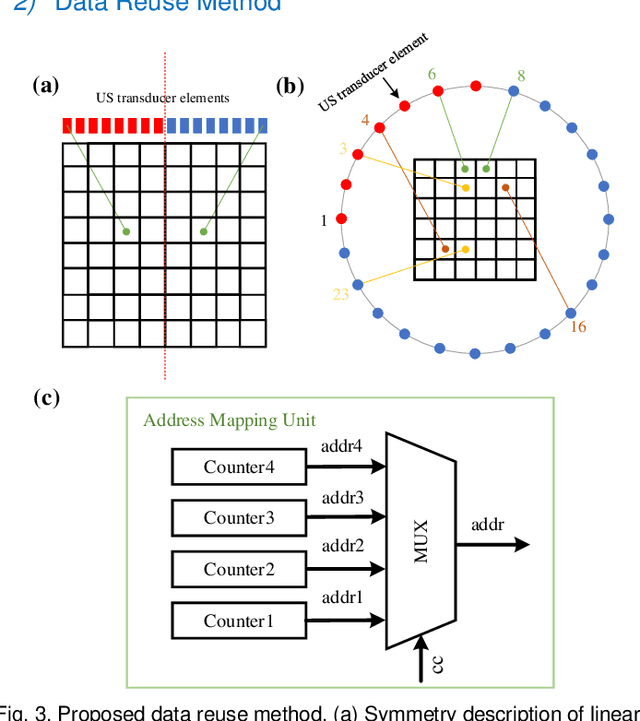

Photoacoustic (PA) imaging technology combines the advantages of optical imaging and ultrasound imaging, showing great potential in biomedical applications. Many preclinical studies and clinical applications urgently require fast, high-quality, low-cost and portable imaging system. Translating advanced image reconstruction algorithms into hardware implementations is highly desired. However, existing iterative PA image reconstructions, although exhibit higher accuracy than delay-and-sum algorithm, suffer from high computational cost. In this paper, we introduce a model-based hardware acceleration architecture based on superposed Wave (s-Wave) for palm-size PA tomography (palm-PAT), aiming at enhancing both the speed and performance of image reconstruction at a much lower system cost. To achieve this, we propose an innovative data reuse method that significantly reduces hardware storage resource consumption. We conducted experiments by FPGA implementation of the algorithm, using both phantoms and in vivo human finger data to verify the feasibility of the proposed method. The results demonstrate that our proposed architecture can substantially reduce system cost while maintaining high imaging performance. The hardware-accelerated implementation of the model-based algorithm achieves a speedup of up to approximately 270 times compared to the CPU, while the corresponding energy efficiency ratio is improved by more than 2700 times.