 Add to Chrome
 Add to Firefox
 Add to Edge
From Words to Worlds: Benchmarking Cross-Cultural Cultural Understanding in Machine Translation
Mar 18, 2026
Culture-expressions, such as idioms, slang, and culture-specific items (CSIs), are pervasive in natural language and encode meanings that go beyond literal linguistic form. Accurately translating such expressions remains challenging for machine translation systems. Despite this, existing benchmarks remain fragmented and do not provide a systematic framework for evaluating translation performance on culture-loaded expressions. To address this gap, we introduce CulT-Eval, a benchmark designed to evaluate how models handle different types of culturally grounded expressions. CulT-Eval comprises over 7,959 carefully curated instances spanning multiple types of culturally grounded expressions, with a comprehensive error taxonomy covering culturally grounded expressions. Through extensive evaluation of large language models and detailed analysis, we identify recurring and systematic failure modes that are not adequately captured by existing automatic metrics. Accordingly, we propose a complementary evaluation metric that targets culturally induced meaning deviations overlooked by standard MT metrics. The results indicate that current models struggle to preserve culturally grounded meaning and to capture the cultural and contextual nuances essential for accurate translation. Our benchmark and code are available at https://anonymous.4open.science/r/CulT-Eval-E75D/.

Projected Stochastic Gradient Descent with Quantum Annealed Binary Gradients
Oct 23, 2023


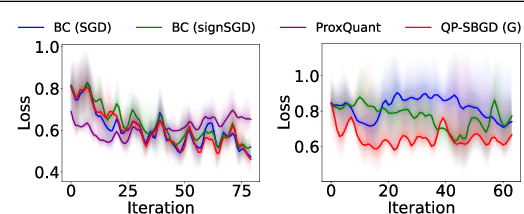
We present, QP-SBGD, a novel layer-wise stochastic optimiser tailored towards training neural networks with binary weights, known as binary neural networks (BNNs), on quantum hardware. BNNs reduce the computational requirements and energy consumption of deep learning models with minimal loss in accuracy. However, training them in practice remains to be an open challenge. Most known BNN-optimisers either rely on projected updates or binarise weights post-training. Instead, QP-SBGD approximately maps the gradient onto binary variables, by solving a quadratic constrained binary optimisation. Under practically reasonable assumptions, we show that this update rule converges with a rate of $\mathcal{O}(1 / \sqrt{T})$. Moreover, we show how the $\mathcal{NP}$-hard projection can be effectively executed on an adiabatic quantum annealer, harnessing recent advancements in quantum computation. We also introduce a projected version of this update rule and prove that if a fixed point exists in the binary variable space, the modified updates will converge to it. Last but not least, our algorithm is implemented layer-wise, making it suitable to train larger networks on resource-limited quantum hardware. Through extensive evaluations, we show that QP-SBGD outperforms or is on par with competitive and well-established baselines such as BinaryConnect, signSGD and ProxQuant when optimising the Rosenbrock function, training BNNs as well as binary graph neural networks.