 Add to Chrome
 Add to Firefox
 Add to Edge
Reg-TTR, Test-Time Refinement for Fast, Robust and Accurate Image Registration
Jan 27, 2026
Traditional image registration methods are robust but slow due to their iterative nature. While deep learning has accelerated inference, it often struggles with domain shifts. Emerging registration foundation models offer a balance of speed and robustness, yet typically cannot match the peak accuracy of specialized models trained on specific datasets. To mitigate this limitation, we propose Reg-TTR, a test-time refinement framework that synergizes the complementary strengths of both deep learning and conventional registration techniques. By refining the predictions of pre-trained models at inference, our method delivers significantly improved registration accuracy at a modest computational cost, requiring only 21% additional inference time (0.56s). We evaluate Reg-TTR on two distinct tasks and show that it achieves state-of-the-art (SOTA) performance while maintaining inference speeds close to previous deep learning methods. As foundation models continue to emerge, our framework offers an efficient strategy to narrow the performance gap between registration foundation models and SOTA methods trained on specialized datasets. The source code will be publicly available following the acceptance of this work.

FMIR, a foundation model-based Image Registration Framework for Robust Image Registration
Jan 24, 2026Deep learning has revolutionized medical image registration by achieving unprecedented speeds, yet its clinical application is hindered by a limited ability to generalize beyond the training domain, a critical weakness given the typically small scale of medical datasets. In this paper, we introduce FMIR, a foundation model-based registration framework that overcomes this limitation.Combining a foundation model-based feature encoder for extracting anatomical structures with a general registration head, and trained with a channel regularization strategy on just a single dataset, FMIR achieves state-of-the-art(SOTA) in-domain performance while maintaining robust registration on out-of-domain images.Our approach demonstrates a viable path toward building generalizable medical imaging foundation models with limited resources. The code is available at https://github.com/Monday0328/FMIR.git.
Ideal Registration? Segmentation is All You Need
Sep 19, 2025Deep learning has revolutionized image registration by its ability to handle diverse tasks while achieving significant speed advantages over conventional approaches. Current approaches, however, often employ globally uniform smoothness constraints that fail to accommodate the complex, regionally varying deformations characteristic of anatomical motion. To address this limitation, we propose SegReg, a Segmentation-driven Registration framework that implements anatomically adaptive regularization by exploiting region-specific deformation patterns. Our SegReg first decomposes input moving and fixed images into anatomically coherent subregions through segmentation. These localized domains are then processed by the same registration backbone to compute optimized partial deformation fields, which are subsequently integrated into a global deformation field. SegReg achieves near-perfect structural alignment (98.23% Dice on critical anatomies) using ground-truth segmentation, and outperforms existing methods by 2-12% across three clinical registration scenarios (cardiac, abdominal, and lung images) even with automatic segmentation. Our SegReg demonstrates a near-linear dependence of registration accuracy on segmentation quality, transforming the registration challenge into a segmentation problem. The source code will be released upon manuscript acceptance.
Reconsider the Template Mesh in Deep Learning-based Mesh Reconstruction
May 21, 2025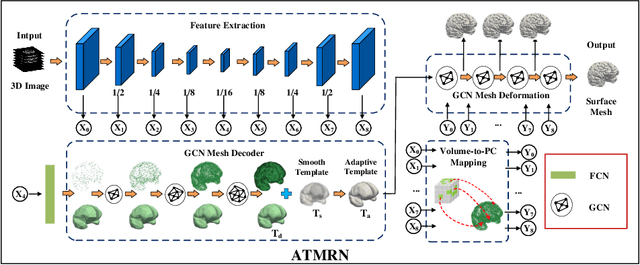
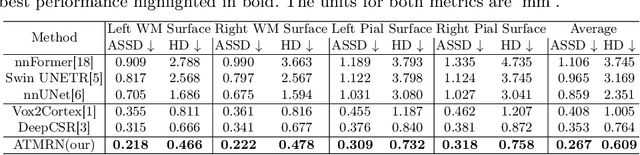
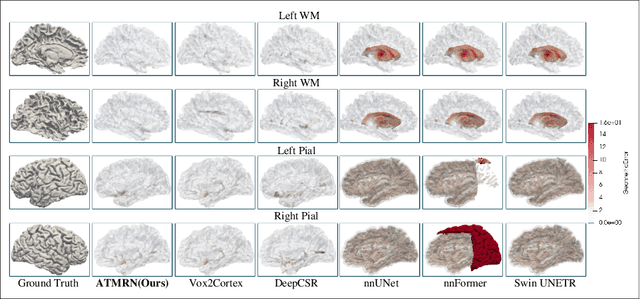
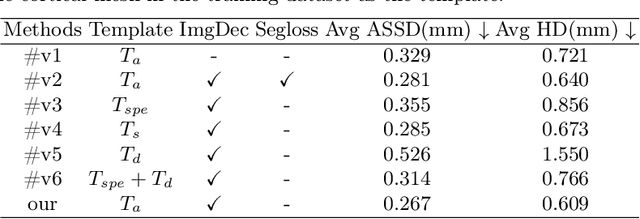
Mesh reconstruction is a cornerstone process across various applications, including in-silico trials, digital twins, surgical planning, and navigation. Recent advancements in deep learning have notably enhanced mesh reconstruction speeds. Yet, traditional methods predominantly rely on deforming a standardised template mesh for individual subjects, which overlooks the unique anatomical variations between them, and may compromise the fidelity of the reconstructions. In this paper, we propose an adaptive-template-based mesh reconstruction network (ATMRN), which generates adaptive templates from the given images for the subsequent deformation, moving beyond the constraints of a singular, fixed template. Our approach, validated on cortical magnetic resonance (MR) images from the OASIS dataset, sets a new benchmark in voxel-to-cortex mesh reconstruction, achieving an average symmetric surface distance of 0.267mm across four cortical structures. Our proposed method is generic and can be easily transferred to other image modalities and anatomical structures.