 Add to Chrome
 Add to Firefox
 Add to Edge
Agent Skill Evaluation and Evolution: Frameworks and Benchmarks
Jun 09, 2026
The growth of agent skills has transformed how agentic systems are built, evaluated, and deployed. As skill libraries continue to scale, rigorous evaluation becomes critical to ensuring their utility, quality, and safety in real-world applications. Consequently, the field is undergoing an emerging paradigm shift from isolated skill creation to automated, evaluation-driven skill evolution. In this survey, we systematically examine the landscape of skill evolution and evaluation beyond foundational skill creation. We categorize evolution into four distinct paradigms, spanning execution feedback, trajectory distillation, compression, and reinforcement learning, showing how each element contributes to improving skill utility and reliability. We also provide an analysis of six skill-centric benchmark categories, identifying structural gaps in benchmark coverage, trade-offs, and metric richness to advance skill research. Finally, we identify open directions for building skill ecosystems that are generalizable, efficient, and verifiably safe. The project URL is https://github.com/Cassie07/AgentSkill_Survey

Spatial-aware Speaker Diarization for Multi-channel Multi-party Meeting
Sep 24, 2022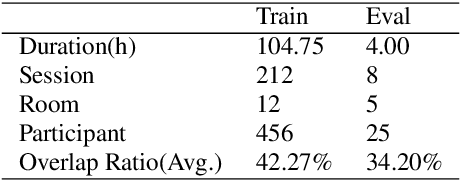
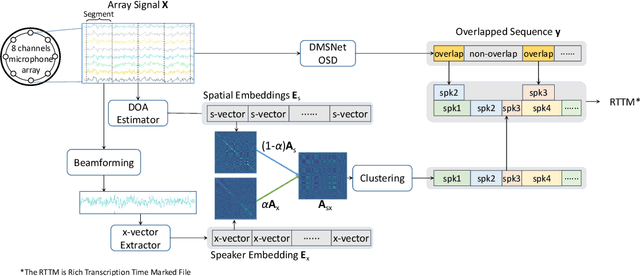
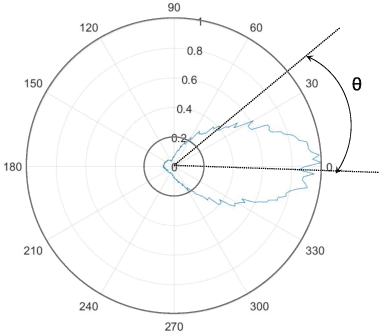
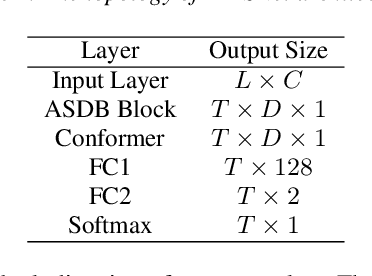
This paper describes a spatial-aware speaker diarization system for the multi-channel multi-party meeting. The diarization system obtains direction information of speaker by microphone array. Speaker spatial embedding is generated by xvector and s-vector derived from superdirective beamforming (SDB) which makes the embedding more robust. Specifically, we propose a novel multi-channel sequence-to-sequence neural network architecture named discriminative multi-stream neural network (DMSNet) which consists of attention superdirective beamforming (ASDB) block and Conformer encoder. The proposed ASDB is a self-adapted channel-wise block that extracts the latent spatial features of array audios by modeling interdependencies between channels. We explore DMSNet to address overlapped speech problem on multi-channel audio and achieve 93.53% accuracy on evaluation set. By performing DMSNet based overlapped speech detection (OSD) module, the diarization error rate (DER) of cluster-based diarization system decrease significantly from 13.45% to 7.64%.
The xmuspeech system for multi-channel multi-party meeting transcription challenge
Feb 11, 2022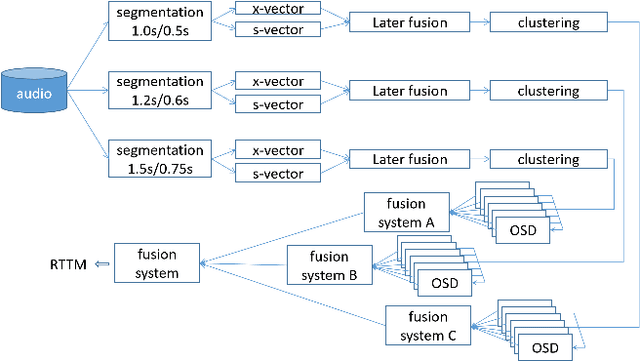

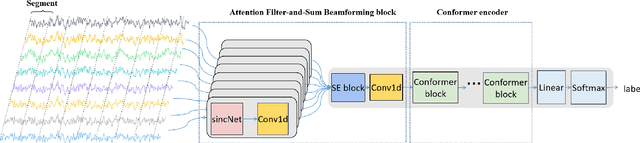
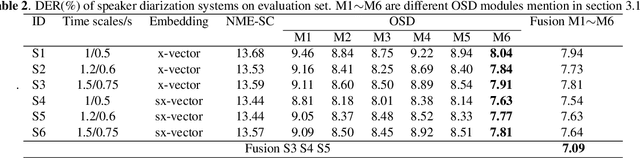
This paper describes the system developed by the XMUSPEECH team for the Multi-channel Multi-party Meeting Transcription Challenge (M2MeT). For the speaker diarization task, we propose a multi-channel speaker diarization system that obtains spatial information of speaker by Difference of Arrival (DOA) technology. Speaker-spatial embedding is generated by x-vector and s-vector derived from Filter-and-Sum Beamforming (FSB) which makes the embedding more robust. Specifically, we propose a novel multi-channel sequence-to-sequence neural network architecture named Discriminative Multi-stream Neural Network (DMSNet) which consists of Attention Filter-and-Sum block (AFSB) and Conformer encoder. We explore DMSNet to address overlapped speech problem on multi-channel audio. Compared with LSTM based OSD module, we achieve a decreases of 10.1% in Detection Error Rate(DetER). By performing DMSNet based OSD module, the DER of cluster-based diarization system decrease significantly form 13.44% to 7.63%. Our best fusion system achieves 7.09% and 9.80% of the diarization error rate (DER) on evaluation set and test set.