 Add to Chrome
 Add to Firefox
 Add to Edge
Amortized Probabilistic Retrieval of Atmospheric CO2 from OCO-2 Spectra Using Deep Learning with Laplace Approximations and Normalizing Flows
Jun 16, 2026
Space-based monitoring of atmospheric carbon dioxide (CO2) is essential for constraining the global carbon budget. NASA's Orbiting Carbon Observatory-2 (OCO-2) estimates column-averaged dry-air mole fractions of CO2 (XCO2) using high-resolution spectra. However, current operational retrieval algorithms are computationally expensive and do not properly quantify uncertainties. We present a novel deep learning framework that addresses these challenges. Due to the difficulties of ground-truth data for real satellite observations, we develop and validate our approach using a high-fidelity simulation dataset. This dataset, created to support OCO-2 uncertainty quantification (UQ), incorporates realistic forward model errors. Our architecture encodes spectral bands using a multi-branch neural network and estimates posteriors of the full CO2 column or desired summaries thereof using two scalable UQ methods: Laplace approximations and normalizing flows. Our approach has five key advantages relative to operational "full-physics" solvers: (1) Amortization: Inference is orders of magnitude faster, enabling real-time processing of massive data streams; (2) Model error robustness: By training on simulations that explicitly include model discrepancies, our method accounts for systematic errors often neglected by standard inversions; (3) Point estimate accuracy: We achieve superior predictive accuracy compared to baseline methods; (4) Improved UQ: The probabilistic outputs yield better-calibrated uncertainty estimates; and (5) Non-Gaussian posteriors: When utilizing normalizing flows, our framework successfully models complex, asymmetric posterior distributions, overcoming the limitations of the Gaussian assumption. These results suggest that simulation-based deep learning is a viable path toward next-generation operational processing systems.

SimpleCall: A Lightweight Image Restoration Agent in Label-Free Environments with MLLM Perceptual Feedback
Dec 21, 2025Complex image restoration aims to recover high-quality images from inputs affected by multiple degradations such as blur, noise, rain, and compression artifacts. Recent restoration agents, powered by vision-language models and large language models, offer promising restoration capabilities but suffer from significant efficiency bottlenecks due to reflection, rollback, and iterative tool searching. Moreover, their performance heavily depends on degradation recognition models that require extensive annotations for training, limiting their applicability in label-free environments. To address these limitations, we propose a policy optimization-based restoration framework that learns an lightweight agent to determine tool-calling sequences. The agent operates in a sequential decision process, selecting the most appropriate restoration operation at each step to maximize final image quality. To enable training within label-free environments, we introduce a novel reward mechanism driven by multimodal large language models, which act as human-aligned evaluator and provide perceptual feedback for policy improvement. Once trained, our agent executes a deterministic restoration plans without redundant tool invocations, significantly accelerating inference while maintaining high restoration quality. Extensive experiments show that despite using no supervision, our method matches SOTA performance on full-reference metrics and surpasses existing approaches on no-reference metrics across diverse degradation scenarios.
Probabilistic Skip Connections for Deterministic Uncertainty Quantification in Deep Neural Networks
Jan 08, 2025


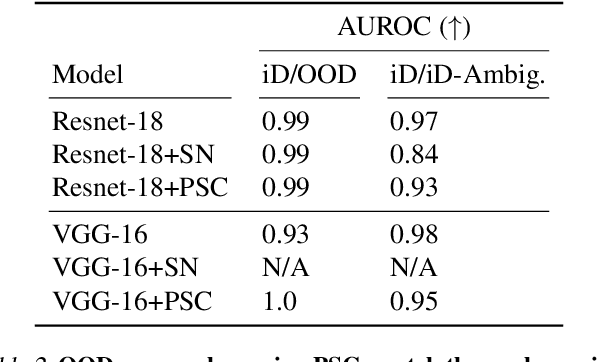
Deterministic uncertainty quantification (UQ) in deep learning aims to estimate uncertainty with a single pass through a network by leveraging outputs from the network's feature extractor. Existing methods require that the feature extractor be both sensitive and smooth, ensuring meaningful input changes produce meaningful changes in feature vectors. Smoothness enables generalization, while sensitivity prevents feature collapse, where distinct inputs are mapped to identical feature vectors. To meet these requirements, current deterministic methods often retrain networks with spectral normalization. Instead of modifying training, we propose using measures of neural collapse to identify an existing intermediate layer that is both sensitive and smooth. We then fit a probabilistic model to the feature vector of this intermediate layer, which we call a probabilistic skip connection (PSC). Through empirical analysis, we explore the impact of spectral normalization on neural collapse and demonstrate that PSCs can effectively disentangle aleatoric and epistemic uncertainty. Additionally, we show that PSCs achieve uncertainty quantification and out-of-distribution (OOD) detection performance that matches or exceeds existing single-pass methods requiring training modifications. By retrofitting existing models, PSCs enable high-quality UQ and OOD capabilities without retraining.
Vecchia Gaussian Process Ensembles on Internal Representations of Deep Neural Networks
May 26, 2023For regression tasks, standard Gaussian processes (GPs) provide natural uncertainty quantification, while deep neural networks (DNNs) excel at representation learning. We propose to synergistically combine these two approaches in a hybrid method consisting of an ensemble of GPs built on the output of hidden layers of a DNN. GP scalability is achieved via Vecchia approximations that exploit nearest-neighbor conditional independence. The resulting deep Vecchia ensemble not only imbues the DNN with uncertainty quantification but can also provide more accurate and robust predictions. We demonstrate the utility of our model on several datasets and carry out experiments to understand the inner workings of the proposed method.
Variational sparse inverse Cholesky approximation for latent Gaussian processes via double Kullback-Leibler minimization
Jan 30, 2023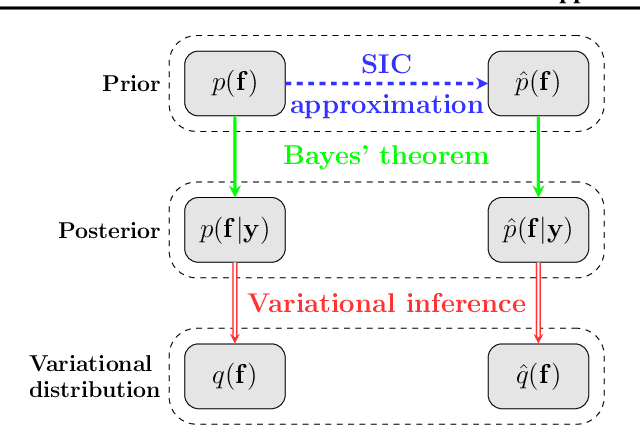

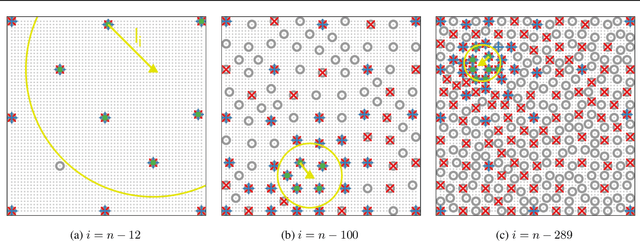
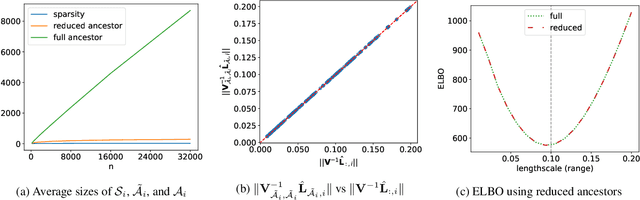
To achieve scalable and accurate inference for latent Gaussian processes, we propose a variational approximation based on a family of Gaussian distributions whose covariance matrices have sparse inverse Cholesky (SIC) factors. We combine this variational approximation of the posterior with a similar and efficient SIC-restricted Kullback-Leibler-optimal approximation of the prior. We then focus on a particular SIC ordering and nearest-neighbor-based sparsity pattern resulting in highly accurate prior and posterior approximations. For this setting, our variational approximation can be computed via stochastic gradient descent in polylogarithmic time per iteration. We provide numerical comparisons showing that the proposed double-Kullback-Leibler-optimal Gaussian-process approximation (DKLGP) can sometimes be vastly more accurate than alternative approaches such as inducing-point and mean-field approximations at similar computational complexity.
Scalable Bayesian Optimization Using Vecchia Approximations of Gaussian Processes
Mar 02, 2022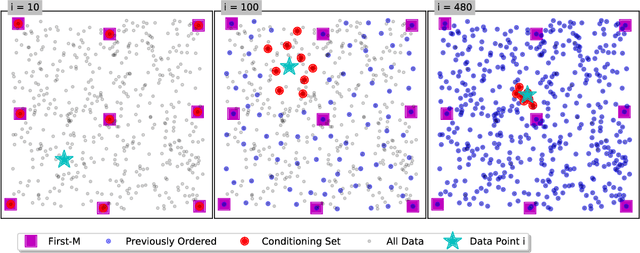
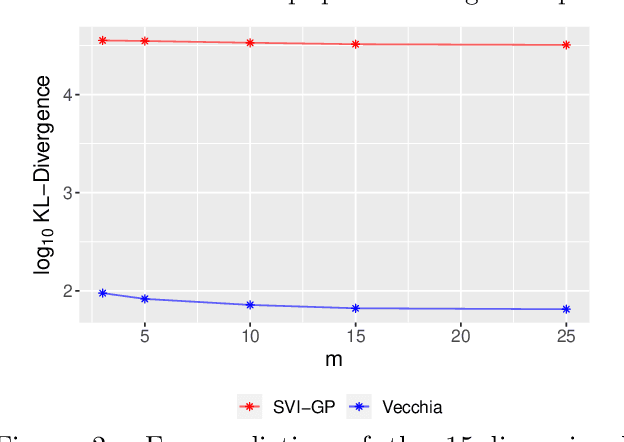
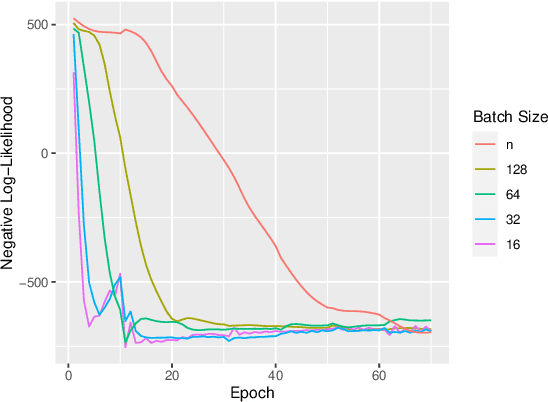
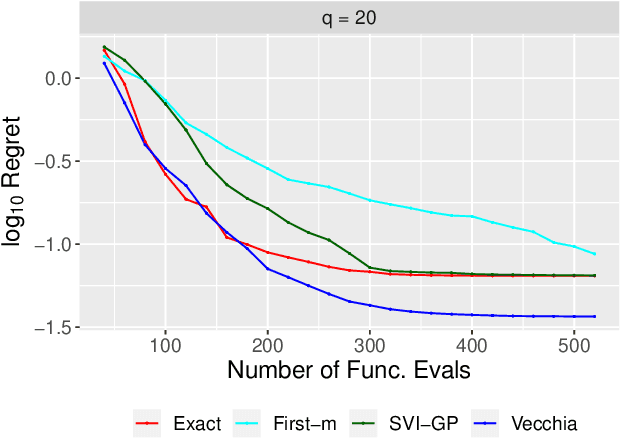
Bayesian optimization is a technique for optimizing black-box target functions. At the core of Bayesian optimization is a surrogate model that predicts the output of the target function at previously unseen inputs to facilitate the selection of promising input values. Gaussian processes (GPs) are commonly used as surrogate models but are known to scale poorly with the number of observations. We adapt the Vecchia approximation, a popular GP approximation from spatial statistics, to enable scalable high-dimensional Bayesian optimization. We develop several improvements and extensions, including training warped GPs using mini-batch gradient descent, approximate neighbor search, and selecting multiple input values in parallel. We focus on the use of our warped Vecchia GP in trust-region Bayesian optimization via Thompson sampling. On several test functions and on two reinforcement-learning problems, our methods compared favorably to the state of the art.