 Add to Chrome
 Add to Firefox
 Add to Edge
Efficient Rationale-based Retrieval: On-policy Distillation from Generative Rerankers based on JEPA
Apr 25, 2026
Unlike traditional fact-based retrieval, rationale-based retrieval typically necessitates cross-encoding of query-document pairs using large language models, incurring substantial computational costs. To address this limitation, we propose Rabtriever, which independently encodes queries and documents, while providing comparable cross query-document comprehension capabilities to rerankers. We start from training a LLM-based generative reranker, which puts the document prior to the query and prompts the LLM to generate the relevance score by log probabilities. We then employ it as the teacher of an on-policy distillation framework, with Rabtriever as the student to reconstruct the teacher's contextual-aware query embedding. To achieve this effect, Rabtriever is first initialized from the teacher, with parameters frozen. The Joint-Embedding Predictive Architecture (JEPA) paradigm is then adopted, which integrates a lightweight, trainable predictor between LLM layers and heads, projecting the query embedding into a new hidden space, with the document embedding as the latent vector. JEPA then minimizes the distribution difference between this projected embedding and the teacher embedding. To strengthen the sampling efficiency of on-policy distillation, we also add an auxiliary loss on the reverse KL of LLM logits, to reshape the student's logit distribution. Rabtriever optimizes the teacher's quadratic complexity on the document length to linear, verified both theoretically and empirically. Experiments show that Rabtriever outperforms different retriever baselines across diverse rationale-based tasks, including empathetic conversations and robotic manipulations, with minor accuracy degradation from the reranker. Rabtriever also generalizes well on traditional retrieval benchmarks such as MS MARCO and BEIR, with comparable performance to the best retriever baseline.

Large Language Model Can Be a Foundation for Hidden Rationale-Based Retrieval
Dec 21, 2024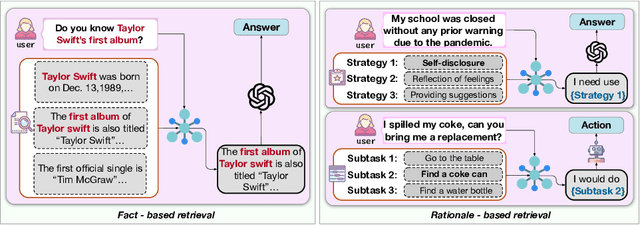
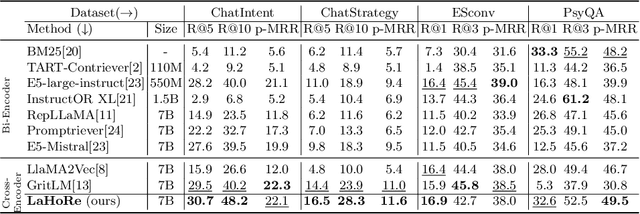
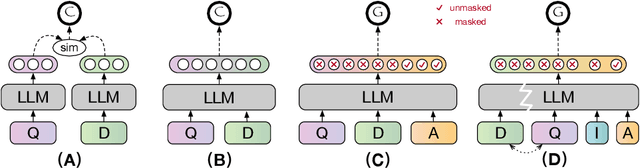
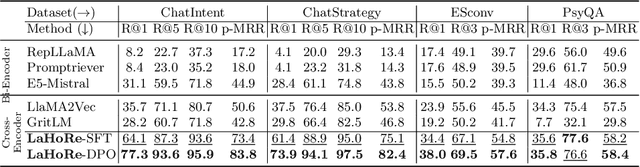
Despite the recent advancement in Retrieval-Augmented Generation (RAG) systems, most retrieval methodologies are often developed for factual retrieval, which assumes query and positive documents are semantically similar. In this paper, we instead propose and study a more challenging type of retrieval task, called hidden rationale retrieval, in which query and document are not similar but can be inferred by reasoning chains, logic relationships, or empirical experiences. To address such problems, an instruction-tuned Large language model (LLM) with a cross-encoder architecture could be a reasonable choice. To further strengthen pioneering LLM-based retrievers, we design a special instruction that transforms the retrieval task into a generative task by prompting LLM to answer a binary-choice question. The model can be fine-tuned with direct preference optimization (DPO). The framework is also optimized for computational efficiency with no performance degradation. We name this retrieval framework by RaHoRe and verify its zero-shot and fine-tuned performance superiority on Emotional Support Conversation (ESC), compared with previous retrieval works. Our study suggests the potential to employ LLM as a foundation for a wider scope of retrieval tasks. Our codes, models, and datasets are available on https://github.com/flyfree5/LaHoRe.