 Add to Chrome
 Add to Firefox
 Add to Edge
Vision Verification Enhanced Fusion of VLMs for Efficient Visual Reasoning
Mar 13, 2026
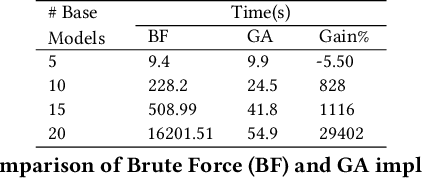
With the growing number and diversity of Vision-Language Models (VLMs), many works explore language-based ensemble, collaboration, and routing techniques across multiple VLMs to improve multi-model reasoning. In contrast, we address the diverse model selection using both vision and language modalities. We introduce focal error diversity to capture complementary reasoning across VLMs and a CKA-based focal diversity metric (CKA-focal) to measure disagreement in their visual embeddings. On the constructed ensemble surface from a pool of candidate VLMs, we applied a Genetic Algorithm to effectively prune out those component VLMs that do not add value to the fusion performance. We identify the best combination for each task as well as fuse the outputs of each VLMs in the model pool, and show that heterogeneous models can capture epistemic uncertainty dynamically and mitigate hallucinations. Our V3Fusion approach is capable of producing dual focal-diversity fused predictions with high performance for vision-language reasoning, even when there is no majority consensus or the majority of VLMs make incorrect predictions. Extensive experiments validate V3Fusion on four popular VLM benchmarks (A-OKVQA, MMMU, MMMU-Pro, and OCR-VQA). The results show that V3Fusion outperforms the best-performing VLM on MMMU by 8.09% and MMMU-Pro by 4.87% gain in accuracy. For generative tasks, V3Fusion outperforms Intern-VL2-8b and Qwen2.5-VL-7b, the top-2 VLM performers on both A-OKVQA and OCR-VQA. Our code and datasets are available at https://github.com/sftekin/v3fusion.

Robust Few-Shot Ensemble Learning with Focal Diversity-Based Pruning
Apr 05, 2024

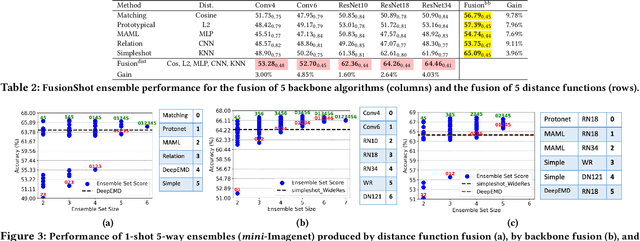
This paper presents FusionShot, a focal diversity optimized few-shot ensemble learning approach for boosting the robustness and generalization performance of pre-trained few-shot models. The paper makes three original contributions. First, we explore the unique characteristics of few-shot learning to ensemble multiple few-shot (FS) models by creating three alternative fusion channels. Second, we introduce the concept of focal error diversity to learn the most efficient ensemble teaming strategy, rather than assuming that an ensemble of a larger number of base models will outperform those sub-ensembles of smaller size. We develop a focal-diversity ensemble pruning method to effectively prune out the candidate ensembles with low ensemble error diversity and recommend top-$K$ FS ensembles with the highest focal error diversity. Finally, we capture the complex non-linear patterns of ensemble few-shot predictions by designing the learn-to-combine algorithm, which can learn the diverse weight assignments for robust ensemble fusion over different member models. Extensive experiments on representative few-shot benchmarks show that the top-K ensembles recommended by FusionShot can outperform the representative SOTA few-shot models on novel tasks (different distributions and unknown at training), and can prevail over existing few-shot learners in both cross-domain settings and adversarial settings. For reproducibility purposes, FusionShot trained models, results, and code are made available at https://github.com/sftekin/fusionshot