 Add to Chrome
 Add to Firefox
 Add to Edge
Open-H-Embodiment: A Large-Scale Dataset for Enabling Foundation Models in Medical Robotics
Apr 22, 2026
Autonomous medical robots hold promise to improve patient outcomes, reduce provider workload, democratize access to care, and enable superhuman precision. However, autonomous medical robotics has been limited by a fundamental data problem: existing medical robotic datasets are small, single-embodiment, and rarely shared openly, restricting the development of foundation models that the field needs to advance. We introduce Open-H-Embodiment, the largest open dataset of medical robotic video with synchronized kinematics to date, spanning more than 49 institutions and multiple robotic platforms including the CMR Versius, Intuitive Surgical's da Vinci, da Vinci Research Kit (dVRK), Rob Surgical BiTrack, Virtual Incision's MIRA, Moon Surgical Maestro, and a variety of custom systems, spanning surgical manipulation, robotic ultrasound, and endoscopy procedures. We demonstrate the research enabled by this dataset through two foundation models. GR00T-H is the first open foundation vision-language-action model for medical robotics, which is the only evaluated model to achieve full end-to-end task completion on a structured suturing benchmark (25% of trials vs. 0% for all others) and achieves 64% average success across a 29-step ex vivo suturing sequence. We also train Cosmos-H-Surgical-Simulator, the first action-conditioned world model to enable multi-embodiment surgical simulation from a single checkpoint, spanning nine robotic platforms and supporting in silico policy evaluation and synthetic data generation for the medical domain. These results suggest that open, large-scale medical robot data collection can serve as critical infrastructure for the research community, enabling advances in robot learning, world modeling, and beyond.

arg-VU: Affordance Reasoning with Physics-Aware 3D Geometry for Visual Understanding in Robotic Surgery
Mar 26, 2026Affordance reasoning provides a principled link between perception and action, yet remains underexplored in surgical robotics, where tissues are highly deformable, compliant, and dynamically coupled with tool motion. We present arg-VU, a physics-aware affordance reasoning framework that integrates temporally consistent geometry tracking with constraint-induced mechanical modeling for surgical visual understanding. Surgical scenes are reconstructed using 3D Gaussian Splatting (3DGS) and converted into a temporally tracked surface representation. Extended Position-Based Dynamics (XPBD) embeds local deformation constraints and produces representative geometry points (RGPs) whose constraint sensitivities define anisotropic stiffness metrics capturing the local constraint-manifold geometry. Robotic tool poses in SE(3) are incorporated to compute rigidly induced displacements at RGPs, from which we derive two complementary measures: a physics-aware compliance energy that evaluates mechanical feasibility with respect to local deformation constraints, and a positional agreement score that captures motion alignment (as kinematic motion baseline). Experiments on surgical video datasets show that arg-VU yields more stable, physically consistent, and interpretable affordance predictions than kinematic baselines. These results demonstrate that physics-aware geometric representations enable reliable affordance reasoning for deformable surgical environments and support embodied robotic interaction.
Toward Aligning Human and Robot Actions via Multi-Modal Demonstration Learning
Apr 14, 2025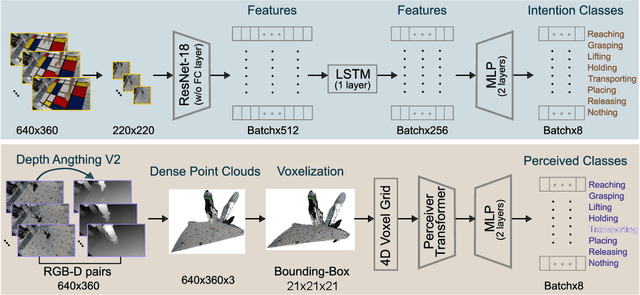
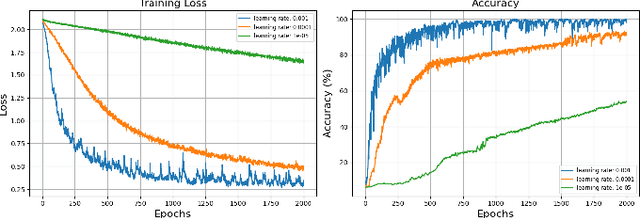
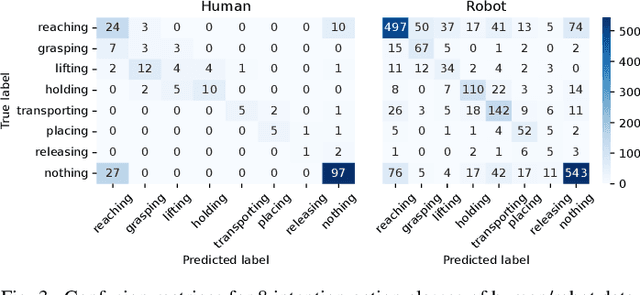
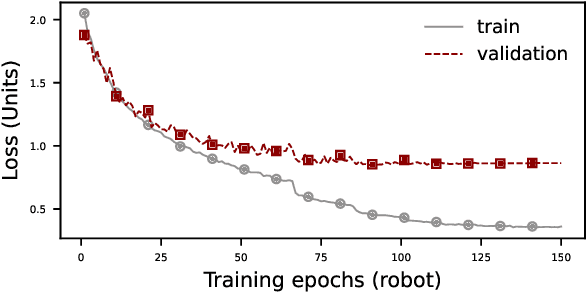
Understanding action correspondence between humans and robots is essential for evaluating alignment in decision-making, particularly in human-robot collaboration and imitation learning within unstructured environments. We propose a multimodal demonstration learning framework that explicitly models human demonstrations from RGB video with robot demonstrations in voxelized RGB-D space. Focusing on the "pick and place" task from the RH20T dataset, we utilize data from 5 users across 10 diverse scenes. Our approach combines ResNet-based visual encoding for human intention modeling and a Perceiver Transformer for voxel-based robot action prediction. After 2000 training epochs, the human model reaches 71.67% accuracy, and the robot model achieves 71.8% accuracy, demonstrating the framework's potential for aligning complex, multimodal human and robot behaviors in manipulation tasks.