 Add to Chrome
 Add to Firefox
 Add to Edge
Causal Attribution via Activation Patching
Mar 13, 2026
Attribution methods for Vision Transformers (ViTs) aim to identify image regions that influence model predictions, but producing faithful and well-localized attributions remains challenging. Existing gradient-based and perturbation-based techniques often fail to isolate the causal contribution of internal representations associated with individual image patches. The key challenge is that class-relevant evidence is formed through interactions between patch tokens across layers, and input-level perturbations can be poor proxies for patch importance, since they may fail to reconstruct the internal evidence actually used by the model. We propose Causal Attribution via Activation Patching (CAAP), which estimates the contribution of individual image patches to the ViT's prediction by directly intervening on internal activations rather than using learned masks or synthetic perturbation patterns. For each patch, CAAP inserts the corresponding source-image activations into a neutral target context over an intermediate range of layers and uses the resulting target-class score as the attribution signal. The resulting attribution map reflects the causal effect of patch-associated internal representations on the model's prediction. The causal intervention serves as a principled measure of patch influence by capturing class-relevant evidence after initial representation formation, while avoiding late-layer global mixing that can reduce spatial specificity. Across multiple ViT backbones and standard metrics, CAAP significantly outperforms existing methods and produces more faithful and localized attributions.

LibraGrad: Balancing Gradient Flow for Universally Better Vision Transformer Attributions
Nov 24, 2024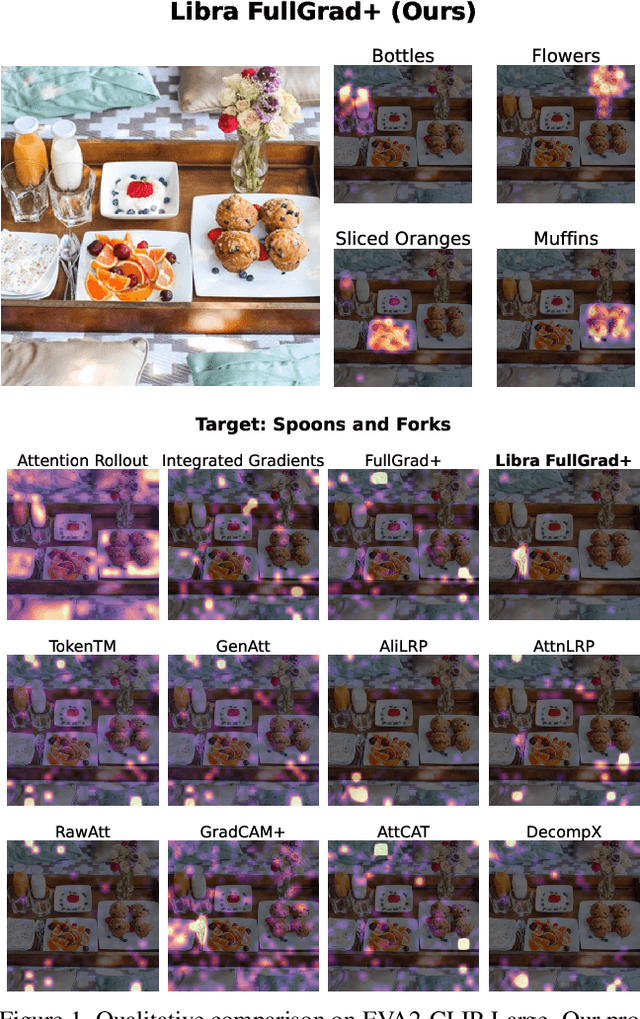
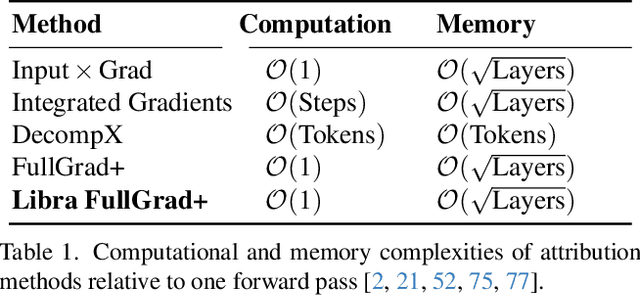
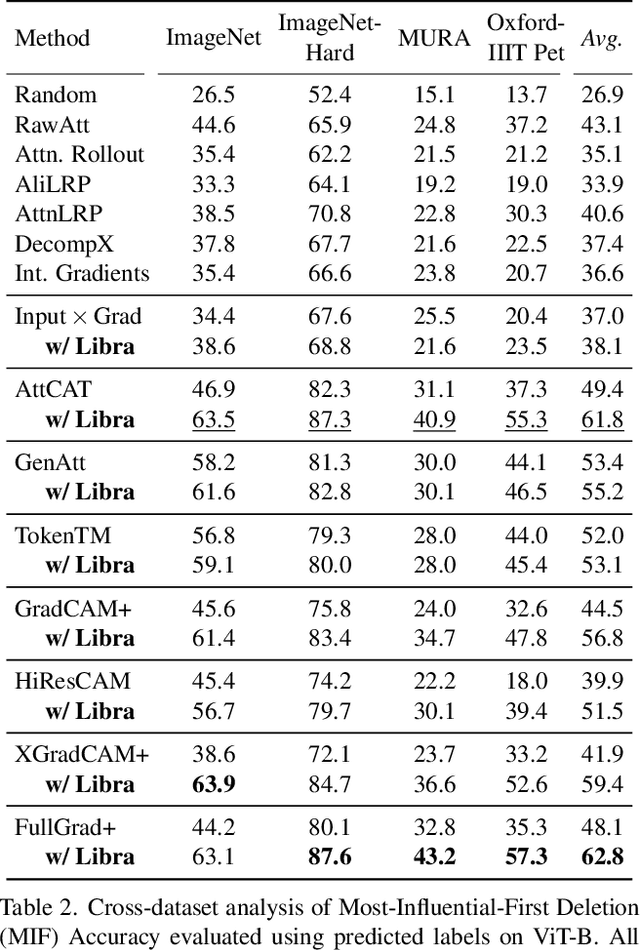
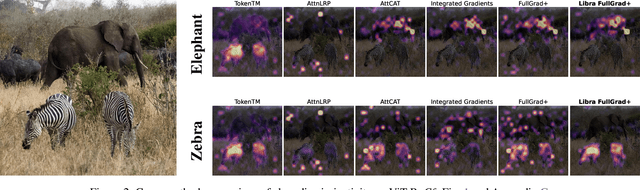
Why do gradient-based explanations struggle with Transformers, and how can we improve them? We identify gradient flow imbalances in Transformers that violate FullGrad-completeness, a critical property for attribution faithfulness that CNNs naturally possess. To address this issue, we introduce LibraGrad -- a theoretically grounded post-hoc approach that corrects gradient imbalances through pruning and scaling of backward paths, without changing the forward pass or adding computational overhead. We evaluate LibraGrad using three metric families: Faithfulness, which quantifies prediction changes under perturbations of the most and least relevant features; Completeness Error, which measures attribution conservation relative to model outputs; and Segmentation AP, which assesses alignment with human perception. Extensive experiments across 8 architectures, 4 model sizes, and 4 datasets show that LibraGrad universally enhances gradient-based methods, outperforming existing white-box methods -- including Transformer-specific approaches -- across all metrics. We demonstrate superior qualitative results through two complementary evaluations: precise text-prompted region highlighting on CLIP models and accurate class discrimination between co-occurring animals on ImageNet-finetuned models -- two settings on which existing methods often struggle. LibraGrad is effective even on the attention-free MLP-Mixer architecture, indicating potential for extension to other modern architectures. Our code is freely available at https://github.com/NightMachinery/LibraGrad.