 Add to Chrome
 Add to Firefox
 Add to Edge
Multi-Scale Dequant: Eliminating Dequantization Bottleneck via Activation Decomposition for Efficient LLM Inference
May 13, 2026
Quantization is essential for efficient large language model (LLM) inference, yet the dequantization step-converting low-bit weights back to high-precision for matrix multiplication has become a critical bottleneck on modern AI accelerators. On architectures with decoupled compute units (e.g., Ascend NPUs), dequantization operations can consume more cycles than the matrix multiplication itself, leaving the high-throughput tensor cores underutilized. This paper presents Multi-Scale Dequant (MSD), a quantization framework that removes weight/KV dequantization from the GEMM critical path. Instead of lifting low-bit weights to BF16 precision, MSD decomposes high-precision BF16 activations into multiple low-precision components, each of which can be multiplied directly with quantized weights via native hardware-accelerated GEMM. This approach shifts the computational paradigm from precision conversion to multi-scale approximation, avoiding INT8-to-BF16 weight conversion before GEMM. We instantiate MSD for two weight formats and derive tight error bounds for each. For INT8 weights (W4A16), two-pass INT8 decomposition achieves near 16 effective bits. For MXFP4 weights (W4A16), two-pass MXFP4 decomposition yields near 6.6 effective bits with error bound 1/64 per block surpassing single-pass MXFP8(5.24 bits) while maintaining the same effective GEMM compute time. We further derive closed-form latency and HBM traffic models showing that MSD avoids the Vector-Cube pipeline stall caused by dequantization and reduces KV cache HBM traffic by up to 2.5 times in attention. Numerical simulations on matrix multiplication and Flash Attention kernels confirm that MSD does not degrade accuracy compared to dequantization baselines, and in many settings achieves lower L2 error.

Serving Large Language Models on Huawei CloudMatrix384
Jun 15, 2025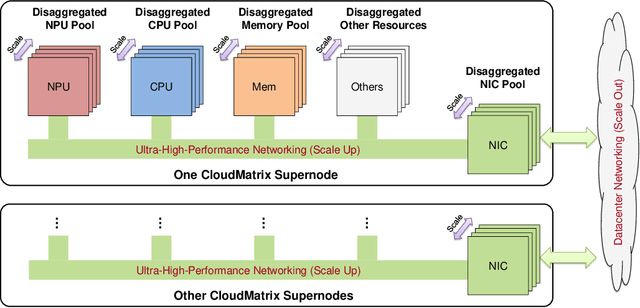
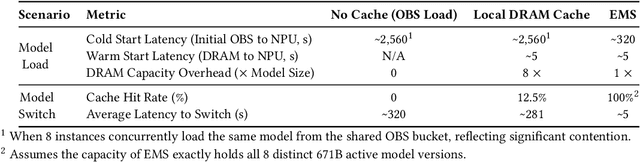
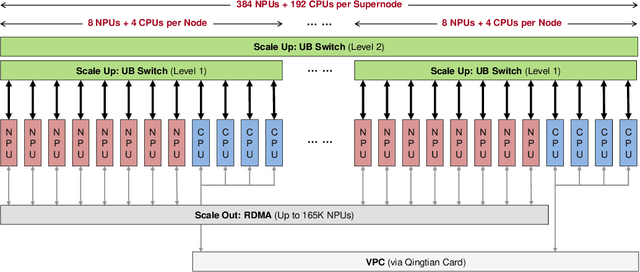
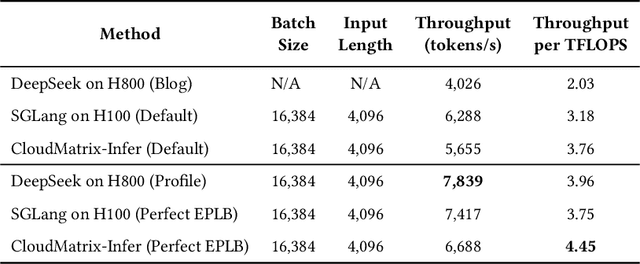
The rapid evolution of large language models (LLMs), driven by growing parameter scales, adoption of mixture-of-experts (MoE) architectures, and expanding context lengths, imposes unprecedented demands on AI infrastructure. Traditional AI clusters face limitations in compute intensity, memory bandwidth, inter-chip communication, and latency, compounded by variable workloads and strict service-level objectives. Addressing these issues requires fundamentally redesigned hardware-software integration. This paper introduces Huawei CloudMatrix, a next-generation AI datacenter architecture, realized in the production-grade CloudMatrix384 supernode. It integrates 384 Ascend 910C NPUs and 192 Kunpeng CPUs interconnected via an ultra-high-bandwidth Unified Bus (UB) network, enabling direct all-to-all communication and dynamic pooling of resources. These features optimize performance for communication-intensive operations, such as large-scale MoE expert parallelism and distributed key-value cache access. To fully leverage CloudMatrix384, we propose CloudMatrix-Infer, an advanced LLM serving solution incorporating three core innovations: a peer-to-peer serving architecture that independently scales prefill, decode, and caching; a large-scale expert parallelism strategy supporting EP320 via efficient UB-based token dispatch; and hardware-aware optimizations including specialized operators, microbatch-based pipelining, and INT8 quantization. Evaluation with the DeepSeek-R1 model shows CloudMatrix-Infer achieves state-of-the-art efficiency: prefill throughput of 6,688 tokens/s per NPU and decode throughput of 1,943 tokens/s per NPU (<50 ms TPOT). It effectively balances throughput and latency, sustaining 538 tokens/s even under stringent 15 ms latency constraints, while INT8 quantization maintains model accuracy across benchmarks.