 Add to Chrome
 Add to Firefox
 Add to Edge
Melo: A Production LLM-Powered Music Recommendation Agent
Jul 26, 2026
We describe Melo, an LLM-powered music recommendation agent deployed on NetEase Cloud Music. Melo is structured as a deterministic five-node state graph over heterogeneous tools, with a prompt- and state-machine-driven orchestration policy rather than a fine-tuned controller. At industrial scale, the bottleneck is not how smart the brain is but how the system detects and recovers from the mistakes that brain makes. Two production failure modes drove the design: entity hallucination, where the agent commits to interpretations unsupported by the live catalog or user-behavior index, and long-tail degradation, where over-constrained requests collapse to generic popular fallbacks. We address them with two complementary mechanisms. Inference-time entity grounding repurposes the production search index as a verification primitive that gates entity decisions before they propagate downstream. Reflective retry verbalizes failure reasons from a broken tool chain and feeds them into the next planning step, so the system can relax or revise constraints rather than fall back blindly. A one-month online A/B test across NetEase Cloud Music's playlist surfaces reports an over 2 pp lift in a primary playlist retention metric and a lift of over one minute in a core playlist engagement metric. Offline ablation isolates a 7.8 pp reduction in entity misidentification from the three-layer grounding stack on our evaluation set, and a triggered-session analysis on our evaluation set shows reflective retry firing on 5.8% of sessions with 59% process-level recovery. Our deployment experience suggests that progress on LLM-powered music recommendation at this scale depends as much on the named, ablatable runtime machinery that catches and corrects the brain's mistakes as on the brain itself: a hypothesis we offer for the community to test.

Graph Clustering with Cross-View Feature Propagation
Aug 12, 2024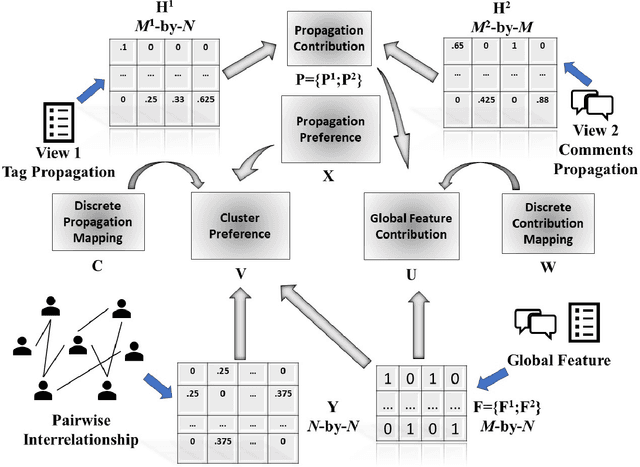
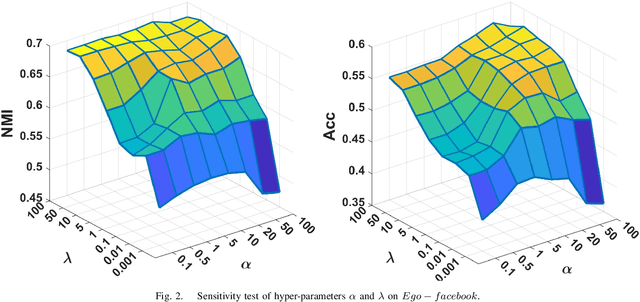
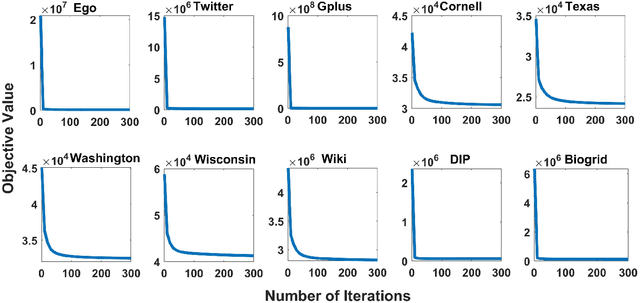
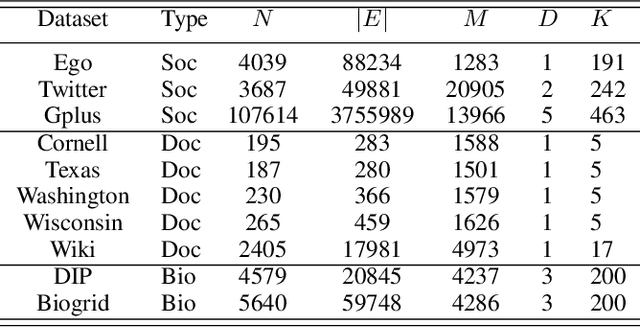
Graph clustering is a fundamental and challenging learning task, which is conventionally approached by grouping similar vertices based on edge structure and feature similarity.In contrast to previous methods, in this paper, we investigate how multi-view feature propagation can influence cluster discovery in graph data.To this end, we present Graph Clustering With Cross-View Feature Propagation (GCCFP), a novel method that leverages multi-view feature propagation to enhance cluster identification in graph data.GCCFP employs a unified objective function that utilizes graph topology and multi-view vertex features to determine vertex cluster membership, regularized by a module that supports key latent feature propagation. We derive an iterative algorithm to optimize this function, prove model convergence within a finite number of iterations, and analyze its computational complexity. Our experiments on various real-world graphs demonstrate the superior clustering performance of GCCFP compared to well-established methods, manifesting its effectiveness across different scenarios.
A Novel Spatiotemporal Coupling Graph Convolutional Network
Aug 09, 2024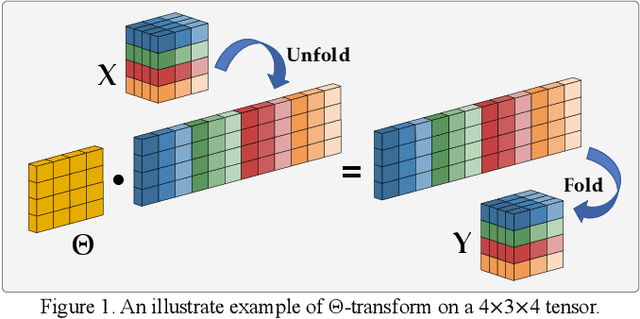
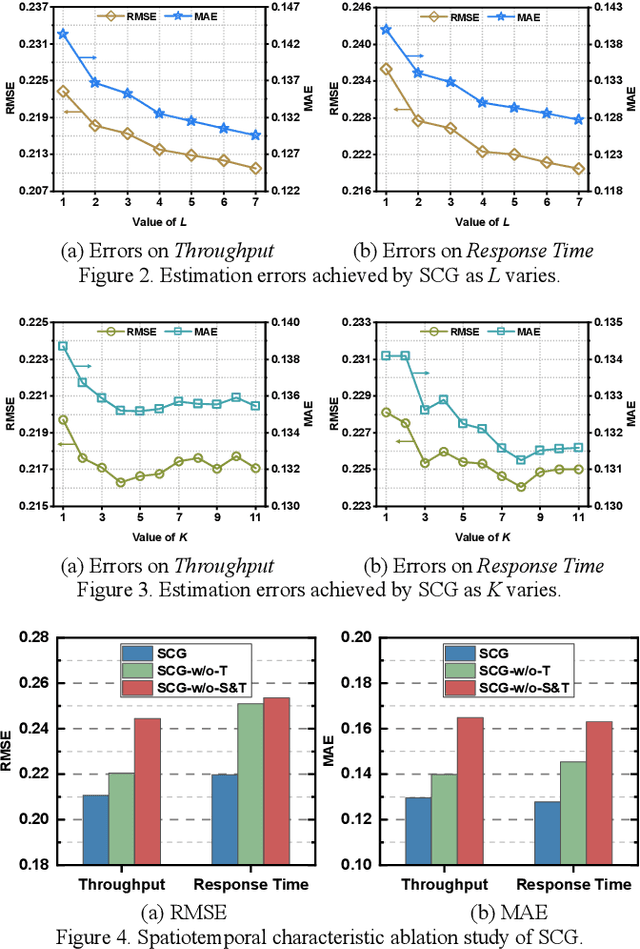

Dynamic Quality-of-Service (QoS) data capturing temporal variations in user-service interactions, are essential source for service selection and user behavior understanding. Approaches based on Latent Feature Analysis (LFA) have shown to be beneficial for discovering effective temporal patterns in QoS data. However, existing methods cannot well model the spatiality and temporality implied in dynamic interactions in a unified form, causing abundant accuracy loss for missing QoS estimation. To address the problem, this paper presents a novel Graph Convolutional Networks (GCNs)-based dynamic QoS estimator namely Spatiotemporal Coupling GCN (SCG) model with the three-fold ideas as below. First, SCG builds its dynamic graph convolution rules by incorporating generalized tensor product framework, for unified modeling of spatial and temporal patterns. Second, SCG combines the heterogeneous GCN layer with tensor factorization, for effective representation learning on bipartite user-service graphs. Third, it further simplifies the dynamic GCN structure to lower the training difficulties. Extensive experiments have been conducted on two large-scale widely-adopted QoS datasets describing throughput and response time. The results demonstrate that SCG realizes higher QoS estimation accuracy compared with the state-of-the-arts, illustrating it can learn powerful representations to users and cloud services.