 Add to Chrome
 Add to Firefox
 Add to Edge
AI Native Games: A Survey and Roadmap
Jul 01, 2026
Generative AI now enables games to produce dialogue, quests, characters, images, and worlds at runtime. Yet generation alone does not make a game AI-native, nor does it guarantee playability. This paper defines AI-native games by whether runtime generative AI is constitutive of the core loop: if the AI component were removed or trivially replaced, the central form of play would collapse or become fundamentally different. This counterfactual criterion separates AI-native games from AI-augmented games, boundary artifacts, chatbots, tavern-style role-play, procedural content generation, and AI-assisted production. Using this definition, we screen candidate artifacts and analyze 53 publicly available AI-native games and prototypes. We introduce a dual-axis G/N taxonomy: the G-axis captures player-facing game type, while the N-axis captures the dominant AI mechanic that makes generative AI indispensable to play. The corpus is concentrated around language-forward designs, especially narrative adventure, epistemic interaction, and generative narrative, while categories such as semantic adjudication, multi-agent simulation, generative construction, and relationship/companion play remain less represented. We argue that the central design problem is organizing semantic openness into stable gameplay. AI-native design depends on mechanical invariants: goals, rules, state, feedback, pacing, and player agency that make open-ended AI outputs interpretable and consequential. We conclude with a roadmap for controllable generation, AI-as-mechanic design, multimodal and multi-agent systems, inference economics, evaluation, safety, and regulation.

CSP4SDG: Constraint and Information-Theory Based Role Identification in Social Deduction Games with LLM-Enhanced Inference
Nov 09, 2025In Social Deduction Games (SDGs) such as Avalon, Mafia, and Werewolf, players conceal their identities and deliberately mislead others, making hidden-role inference a central and demanding task. Accurate role identification, which forms the basis of an agent's belief state, is therefore the keystone for both human and AI performance. We introduce CSP4SDG, a probabilistic, constraint-satisfaction framework that analyses gameplay objectively. Game events and dialogue are mapped to four linguistically-agnostic constraint classes-evidence, phenomena, assertions, and hypotheses. Hard constraints prune impossible role assignments, while weighted soft constraints score the remainder; information-gain weighting links each hypothesis to its expected value under entropy reduction, and a simple closed-form scoring rule guarantees that truthful assertions converge to classical hard logic with minimum error. The resulting posterior over roles is fully interpretable and updates in real time. Experiments on three public datasets show that CSP4SDG (i) outperforms LLM-based baselines in every inference scenario, and (ii) boosts LLMs when supplied as an auxiliary "reasoning tool." Our study validates that principled probabilistic reasoning with information theory is a scalable alternative-or complement-to heavy-weight neural models for SDGs.
Deduction Game Framework and Information Set Entropy Search
Jul 30, 2024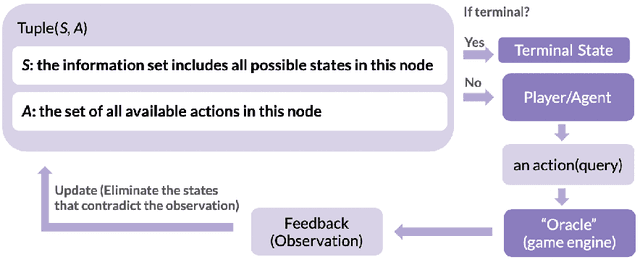
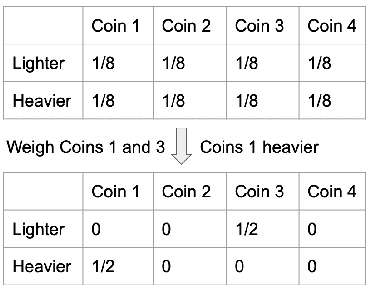
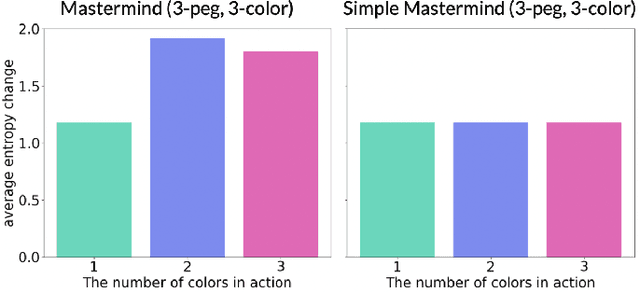
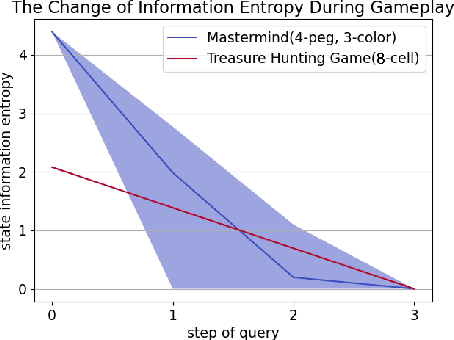
We present a game framework tailored for deduction games, enabling structured analysis from the perspective of Shannon entropy variations. Additionally, we introduce a new forward search algorithm, Information Set Entropy Search (ISES), which effectively solves many single-player deduction games. The ISES algorithm, augmented with sampling techniques, allows agents to make decisions within controlled computational resources and time constraints. Experimental results on eight games within our framework demonstrate the significant superiority of our method over the Single Observer Information Set Monte Carlo Tree Search(SO-ISMCTS) algorithm under limited decision time constraints. The entropy variation of game states in our framework enables explainable decision-making, which can also be used to analyze the appeal of deduction games and provide insights for game designers.