 Add to Chrome
 Add to Firefox
 Add to Edge
Rethinking Vector Field Learning for Generative Segmentation
Mar 19, 2026
Taming diffusion models for generative segmentation has attracted increasing attention. While existing approaches primarily focus on architectural tweaks or training heuristics, there remains a limited understanding of the intrinsic mismatch between continuous flow matching objectives and discrete perception tasks. In this work, we revisit diffusion segmentation from the perspective of vector field learning. We identify two key limitations of the commonly used flow matching objective: gradient vanishing and trajectory traversing, which result in slow convergence and poor class separation. To tackle these issues, we propose a principled vector field reshaping strategy that augments the learned velocity field with a detached distance-aware correction term. This correction introduces both attractive and repulsive interactions, enhancing gradient magnitudes near centroids while preserving the original diffusion training framework. Furthermore, we design a computationally efficient, quasi-random category encoding scheme inspired by Kronecker sequences, which integrates seamlessly with an end-to-end pixel neural field framework for pixel-level semantic alignment. Extensive experiments consistently demonstrate significant improvements over vanilla flow matching approaches, substantially narrowing the performance gap between generative segmentation and strong discriminative specialists.

T-CorresNet: Template Guided 3D Point Cloud Completion with Correspondence Pooling Query Generation Strategy
Jul 06, 2024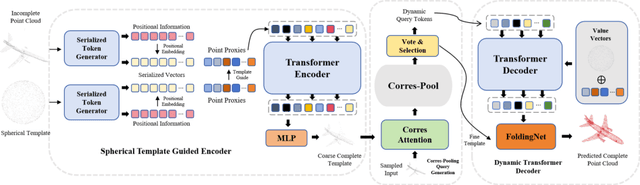
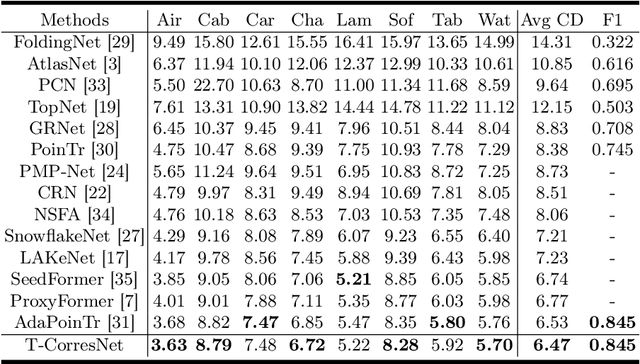
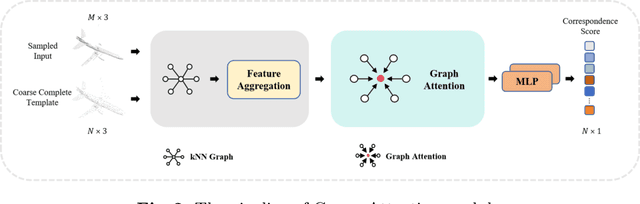
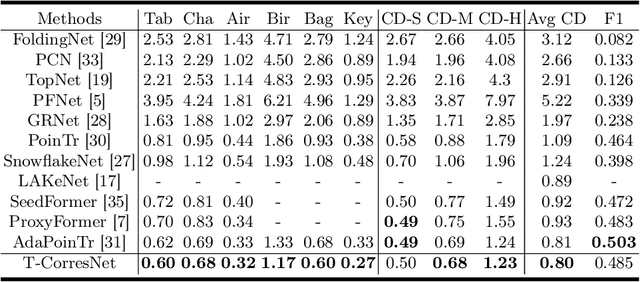
Point clouds are commonly used in various practical applications such as autonomous driving and the manufacturing industry. However, these point clouds often suffer from incompleteness due to limited perspectives, scanner resolution and occlusion. Therefore the prediction of missing parts performs a crucial task. In this paper, we propose a novel method for point cloud completion. We utilize a spherical template to guide the generation of the coarse complete template and generate the dynamic query tokens through a correspondence pooling (Corres-Pooling) query generator. Specifically, we first generate the coarse complete template by embedding a Gaussian spherical template into the partial input and transforming the template to best match the input. Then we use the Corres-Pooling query generator to refine the coarse template and generate dynamic query tokens which could be used to predict the complete point proxies. Finally, we generate the complete point cloud with a FoldingNet following the coarse-to-fine paradigm, according to the fine template and the predicted point proxies. Experimental results demonstrate that our T-CorresNet outperforms the state-of-the-art methods on several benchmarks. Our Codes are available at https://github.com/df-boy/T-CorresNet.