 Add to Chrome
 Add to Firefox
 Add to Edge
A Height-Constrained 2-Point Minimal Solver for Pose Estimation from Active LED Markers with Event Cameras
Aug 10, 2026
In many autonomous applications requiring real-time localization, active marker-based systems are preferred due to their low latency and ease of deployment compared to computationally demanding feature-based methods. Event~\mbox{cameras} offer high temporal resolution and minimal delay and are commonly used with active LED markers for robust real-time localization. Existing methods typically rely on Perspective-n-Point (PnP) solvers for pose estimation. However, structured marker layouts can be challenging to deploy in space-constrained scenarios, while partial self-motion information (e.g., gravity direction and altitude) is readily available from onboard sensors. We derive a robust and accurate minimal solver that estimates camera pose from only two LED markers by incorporating known tilt angle and camera height measured by an onboard sensor, such as an IMU or an altimeter. The proposed formulation uniquely determines the camera pose through both a closed-form and a linear least-squares solution. We further analyze degenerate configurations and characterize the conditions under which height information does not contribute to rotation estimation. For evaluation, we developed an event-based active marker system to collect real-world data with ground truth from a motion capture system. Experiments on both synthetic and real data demonstrate improved accuracy over the state-of-the-art P2P solver and competitive performance relative to P3P.

A Survey on Event-based Optical Marker Systems
Apr 29, 2025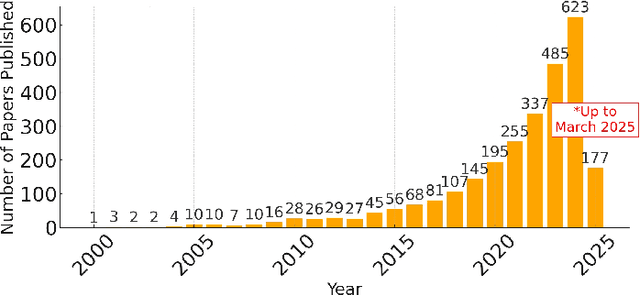
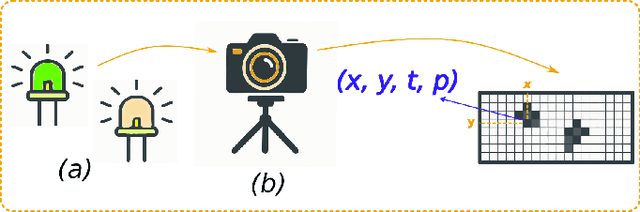
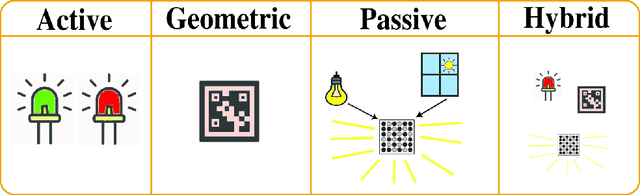
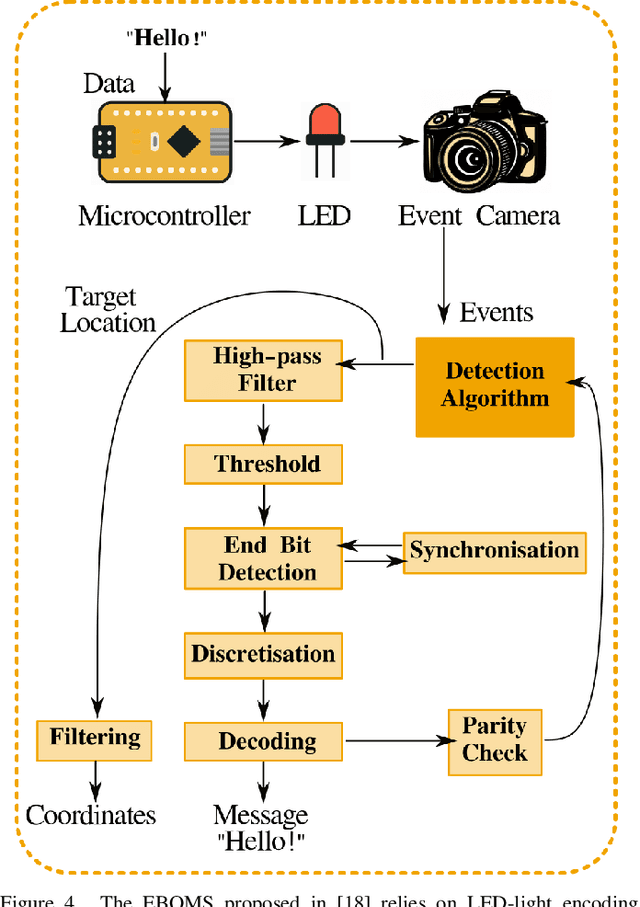
The advent of event-based cameras, with their low latency, high dynamic range, and reduced power consumption, marked a significant change in robotic vision and machine perception. In particular, the combination of these neuromorphic sensors with widely-available passive or active optical markers (e.g. AprilTags, arrays of blinking LEDs), has recently opened up a wide field of possibilities. This survey paper provides a comprehensive review on Event-Based Optical Marker Systems (EBOMS). We analyze the basic principles and technologies on which these systems are based, with a special focus on their asynchronous operation and robustness against adverse lighting conditions. We also describe the most relevant applications of EBOMS, including object detection and tracking, pose estimation, and optical communication. The article concludes with a discussion of possible future research directions in this rapidly-emerging and multidisciplinary field.