 Add to Chrome
 Add to Firefox
 Add to Edge
ArbiGraph: Arbitrarily Scalable Verifiable Task Graphs for Evaluating Context Management
Jul 22, 2026
We introduce ARBIGRAPH, a benchmark generator for evaluating whether tool-assisted language agents can retain, update, compose, and discard task-relevant context across extended reasoning workflows. ARBIGRAPH represents each task as a natural-language problem with an executable Python solver, and composes tasks through typed intermediate states, instantiated here as scalar and list values. This design enables controllable task graphs whose length, dependency structure, distractor count, and value type can be varied while preserving exact automatic verification. We instantiate ARBIGRAPH with math, GSM-style word-problems, and Python-tracing task categories, and evaluate a Qwen3.5-27B tool-assisted agent across four topologies. The results show high accuracy on isolated tasks but substantial degradation on more complex dependent tasks: accuracy drops by up to 33.3% on branching chains of dependent math tasks. This shows that ARBIGRAPH exposes failures that are not visible from single-task evaluation alone. Our code, generated datasets, and evaluation results are available at https://github.com/pavelgolikov/ArbiGraph.git

Modification-Considering Value Learning for Reward Hacking Mitigation in RL
Jun 27, 2026Reinforcement learning agents can exploit misspecified reward signals to achieve high apparent returns while failing on the intended objective, a failure mode known as reward hacking. Existing practical defenses typically constrain policy updates to stay near a known safe reference, creating a tension between suppressing hacking and permitting legitimate improvement. We propose Modification-Considering Value Learning (MCVL), which operationalizes the theoretical idea of current utility optimization for standard value-based RL. MCVL wraps an off-policy learner and treats each incoming transition as a candidate modification: it forecasts two training paths, one that includes the transition and one that does not, and scores both with a frozen bootstrapped-return estimator derived from a learned reward model and value function. The transition is admitted only if inclusion does not decrease the score. We formalize conditions under which this filtering is both safe and permissive, and instantiate MCVL with DDQN and TD3. Across four safety-relevant gridworlds and three modified MuJoCo continuous-control tasks with diverse hacking mechanisms, MCVL mitigates reward hacking while continuing to improve the intended objective. Project website: ktolnos.github.io/mcvl/.
Update-Free On-Policy Steering via Verifiers
Mar 10, 2026In recent years, Behavior Cloning (BC) has become one of the most prevalent methods for enabling robots to mimic human demonstrations. However, despite their successes, BC policies are often brittle and struggle with precise manipulation. To overcome these issues, we propose UF-OPS, an Update-Free On-Policy Steering method that enables the robot to predict the success likelihood of its actions and adapt its strategy at execution time. We accomplish this by training verifier functions using policy rollout data obtained during an initial evaluation of the policy. These verifiers are subsequently used to steer the base policy toward actions with a higher likelihood of success. Our method improves the performance of black-box diffusion policy, without changing the base parameters, making it light-weight and flexible. We present results from both simulation and real-world data and achieve an average 49% improvement in success rate over the base policy across 5 real tasks.
Test-Time Graph Search for Goal-Conditioned Reinforcement Learning
Oct 08, 2025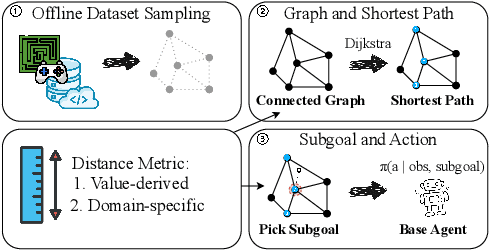
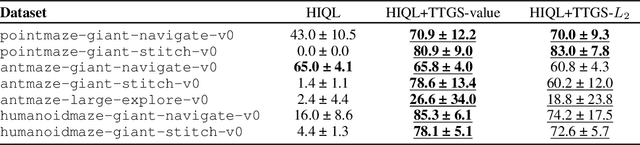
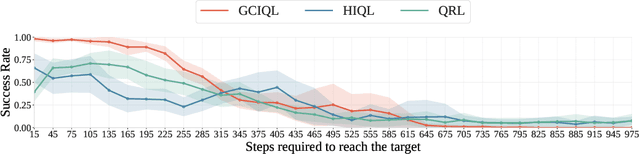
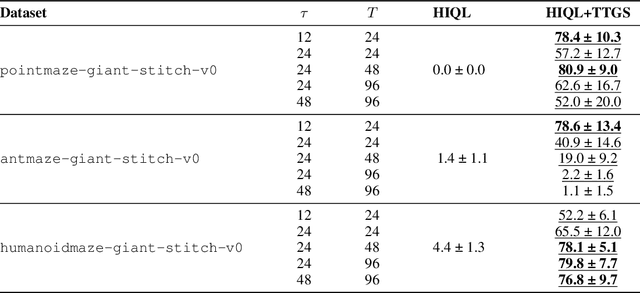
Offline goal-conditioned reinforcement learning (GCRL) trains policies that reach user-specified goals at test time, providing a simple, unsupervised, domain-agnostic way to extract diverse behaviors from unlabeled, reward-free datasets. Nonetheless, long-horizon decision making remains difficult for GCRL agents due to temporal credit assignment and error accumulation, and the offline setting amplifies these effects. To alleviate this issue, we introduce Test-Time Graph Search (TTGS), a lightweight planning approach to solve the GCRL task. TTGS accepts any state-space distance or cost signal, builds a weighted graph over dataset states, and performs fast search to assemble a sequence of subgoals that a frozen policy executes. When the base learner is value-based, the distance is derived directly from the learned goal-conditioned value function, so no handcrafted metric is needed. TTGS requires no changes to training, no additional supervision, no online interaction, and no privileged information, and it runs entirely at inference. On the OGBench benchmark, TTGS improves success rates of multiple base learners on challenging locomotion tasks, demonstrating the benefit of simple metric-guided test-time planning for offline GCRL.