 Add to Chrome
 Add to Firefox
 Add to Edge
Enginuity: A Dataset and Benchmark for Vision-Language Understanding of Engineering Diagrams
Jun 02, 2026
Engineering diagrams pose a distinct challenge for vision-language models: unlike natural images or general documents, they encode information through dense spatial layouts, domain-specific symbols, and cross-references between visual callouts and structured parts tables. Despite their centrality to service, repair, and design workflows, there is no public benchmark for measuring VLM capabilities in this domain; existing datasets primarily focus on flowcharts, scientific figures, or business documents. To address this gap, we introduce Enginuity, the first open dataset and benchmark for evaluating VLMs on complex engineering diagrams. We define two tasks over a corpus of U.S. military service and repair manuals: structured parts-table extraction (Task 1) and free-form visual diagram question answering (VQA)(Task 2) for benchmarking. We evaluate four frontier VLMs (GPT-5.2 Chat, Claude Opus 4.7, Gemma 4, Qwen3-VL-32B-Instruct) under zero-shot and chain-of-thought prompting. On Task 1, models reach Recall@all of 0.61-0.87 but Token F1pen of only 0.03-0.18, exposing a systematic gap between part identification and description fidelity. Task 2 reveals a consistent factual-reasoning gap across all models. A supporting analysis shows that token-overlap metrics under-report model capability on technical descriptions by 2-6x relative to semantic similarity, motivating LLM-as-judge calibration for domain-specific evaluation. We release the dataset, annotations, evaluation harness, and per-sample model outputs to support a reproducible study of VLM capability on engineering content.

Enhancing Operational Safety via Agentic Dialogue Hazard Identification Analysis
Jun 02, 2026Operational safety in high-stakes domains such as industrial process control, autonomous, and safety-critical systems, demand reliable hazard identification. While large language models (LLMs) have shown promise in automating safety analysis tasks, single-turn, monolithic inference is brittle: it lacks the self-correction, deliberation, and contextual refinement that safety engineers apply iteratively. In this paper, we introduce HAZDIAL, a framework that investigates whether structured agentic dialogue-multi-agent, multi-turn interactions improves the quality of NLP- based hazard identification over single-pass baselines. We systematically compare two dialogue modalities: adversarial debate and constructive discussion, and propose an algorithm-based agentic interaction optimization. We evaluate all configurations against a curated golden dataset using standard classification metrics (accuracy, precision, recall, F1) and novel dialogue metrics. This work advances the intersection of dialogue systems, multi-agent reasoning, and AI safety, providing an empirical evidence for dialogue-driven hazard analysis.
BLUEPRINT Rebuilding a Legacy: Multimodal Retrieval for Complex Engineering Drawings and Documents
Feb 12, 2026Decades of engineering drawings and technical records remain locked in legacy archives with inconsistent or missing metadata, making retrieval difficult and often manual. We present Blueprint, a layout-aware multimodal retrieval system designed for large-scale engineering repositories. Blueprint detects canonical drawing regions, applies region-restricted VLM-based OCR, normalizes identifiers (e.g., DWG, part, facility), and fuses lexical and dense retrieval with a lightweight region-level reranker. Deployed on ~770k unlabeled files, it automatically produces structured metadata suitable for cross-facility search. We evaluate Blueprint on a 5k-file benchmark with 350 expert-curated queries using pooled, graded (0/1/2) relevance judgments. Blueprint delivers a 10.1% absolute gain in Success@3 and an 18.9% relative improvement in nDCG@3 over the strongest vision-language baseline}, consistently outperforming across vision, text, and multimodal intents. Oracle ablations reveal substantial headroom under perfect region detection and OCR. We release all queries, runs, annotations, and code to facilitate reproducible evaluation on legacy engineering archives.
Enginuity: Building an Open Multi-Domain Dataset of Complex Engineering Diagrams
Jan 19, 2026We propose Enginuity - the first open, large-scale, multi-domain engineering diagram dataset with comprehensive structural annotations designed for automated diagram parsing. By capturing hierarchical component relationships, connections, and semantic elements across diverse engineering domains, our proposed dataset would enable multimodal large language models to address critical downstream tasks including structured diagram parsing, cross-modal information retrieval, and AI-assisted engineering simulation. Enginuity would be transformative for AI for Scientific Discovery by enabling artificial intelligence systems to comprehend and manipulate the visual-structural knowledge embedded in engineering diagrams, breaking down a fundamental barrier that currently prevents AI from fully participating in scientific workflows where diagram interpretation, technical drawing analysis, and visual reasoning are essential for hypothesis generation, experimental design, and discovery.
HARNESS: Human-Agent Risk Navigation and Event Safety System for Proactive Hazard Forecasting in High-Risk DOE Environments
Nov 13, 2025Operational safety at mission-critical work sites is a top priority given the complex and hazardous nature of daily tasks. This paper presents the Human-Agent Risk Navigation and Event Safety System (HARNESS), a modular AI framework designed to forecast hazardous events and analyze operational risks in U.S. Department of Energy (DOE) environments. HARNESS integrates Large Language Models (LLMs) with structured work data, historical event retrieval, and risk analysis to proactively identify potential hazards. A human-in-the-loop mechanism allows subject matter experts (SMEs) to refine predictions, creating an adaptive learning loop that enhances performance over time. By combining SME collaboration with iterative agentic reasoning, HARNESS improves the reliability and efficiency of predictive safety systems. Preliminary deployment shows promising results, with future work focusing on quantitative evaluation of accuracy, SME agreement, and decision latency reduction.
Simultaneous Reward Distillation and Preference Learning: Get You a Language Model Who Can Do Both
Oct 11, 2024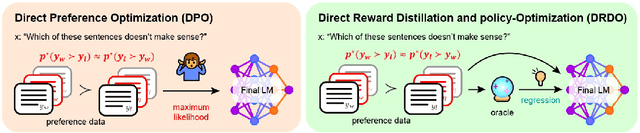
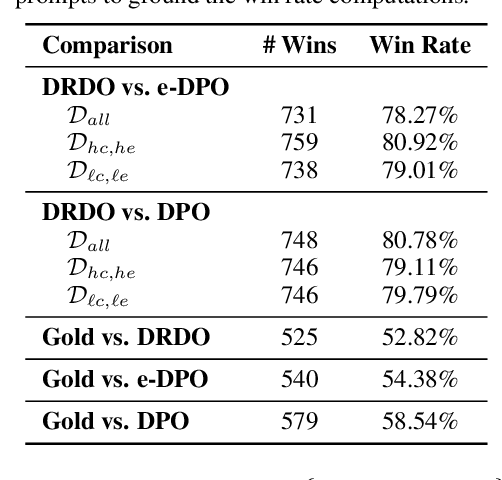
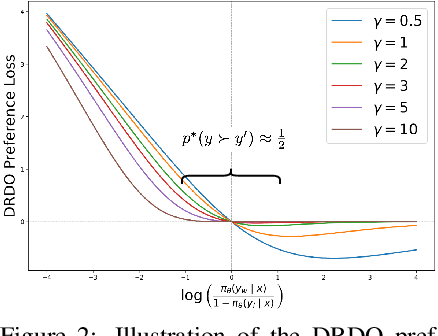
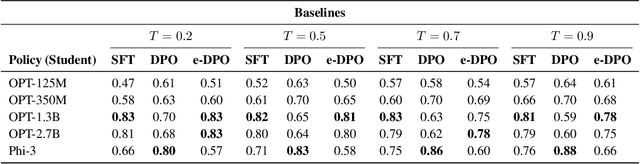
Reward modeling of human preferences is one of the cornerstones of building usable generative large language models (LLMs). While traditional RLHF-based alignment methods explicitly maximize the expected rewards from a separate reward model, more recent supervised alignment methods like Direct Preference Optimization (DPO) circumvent this phase to avoid problems including model drift and reward overfitting. Although popular due to its simplicity, DPO and similar direct alignment methods can still lead to degenerate policies, and rely heavily on the Bradley-Terry-based preference formulation to model reward differences between pairs of candidate outputs. This formulation is challenged by non-deterministic or noisy preference labels, for example human scoring of two candidate outputs is of low confidence. In this paper, we introduce DRDO (Direct Reward Distillation and policy-Optimization), a supervised knowledge distillation-based preference alignment method that simultaneously models rewards and preferences to avoid such degeneracy. DRDO directly mimics rewards assigned by an oracle while learning human preferences from a novel preference likelihood formulation. Our experimental results on the Ultrafeedback and TL;DR datasets demonstrate that policies trained using DRDO surpass previous methods such as DPO and e-DPO in terms of expected rewards and are more robust, on average, to noisy preference signals as well as out-of-distribution (OOD) settings.