 Add to Chrome
 Add to Firefox
 Add to Edge
Multi-Camera Self-Calibration in Sports Motion Capture: Leveraging Human and Stick Poses
Apr 19, 2026
Multi-camera systems are widely employed in sports to capture the 3D motion of athletes and equipment, yet calibrating their extrinsic parameters remains costly and labor-intensive. We introduce an efficient, tool-free method for multi-camera extrinsic calibration tailored to sports involving stick-like implements (e.g., golf clubs, bats, hockey sticks). Our approach jointly exploits two complementary cues from synchronized multi-camera videos: (i) human body keypoints with unknown metric scale and (ii) a rigid stick-like implement of known length. We formulate a three-stage optimization pipeline that refines camera extrinsics, reconstructs human and stick trajectories, and resolves global scale via the stick-length constraint. Our method achieves accurate extrinsic calibration without dedicated calibration tools. To benchmark this task, we present the first dataset for multi-camera self-calibration in stick-based sports, consisting of synthetic sequences across four sports categories with 3 to 10 cameras. Comprehensive experiments demonstrate that our method delivers SOTA performance, achieving low rotation and translation errors. Our project page: https://fandulu.github.io/sport_stick_multi_cam_calib/.

TRACE: Real-Time Multimodal Common Ground Tracking in Situated Collaborative Dialogues
Mar 12, 2025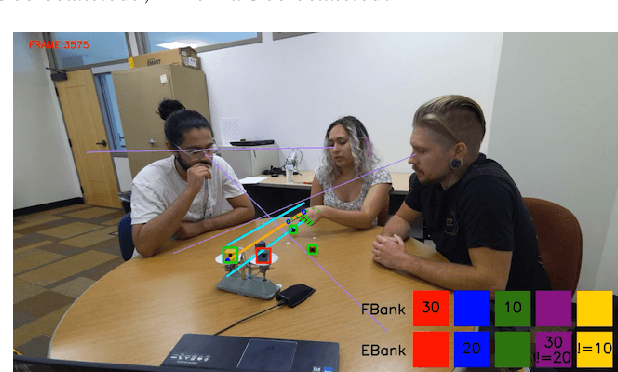
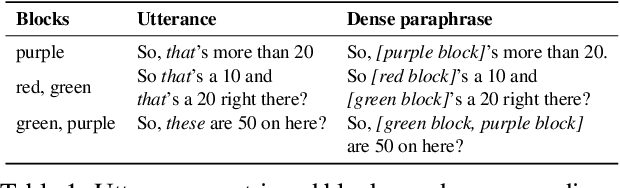
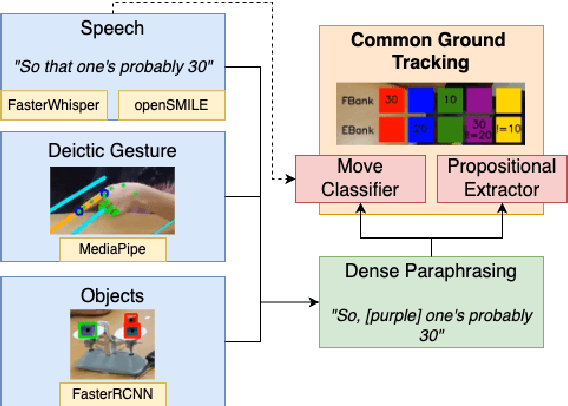
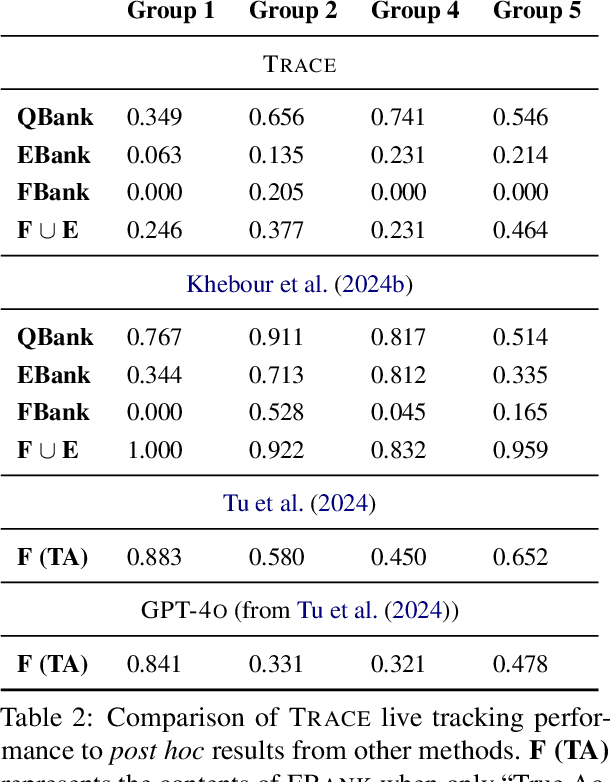
We present TRACE, a novel system for live *common ground* tracking in situated collaborative tasks. With a focus on fast, real-time performance, TRACE tracks the speech, actions, gestures, and visual attention of participants, uses these multimodal inputs to determine the set of task-relevant propositions that have been raised as the dialogue progresses, and tracks the group's epistemic position and beliefs toward them as the task unfolds. Amid increased interest in AI systems that can mediate collaborations, TRACE represents an important step forward for agents that can engage with multiparty, multimodal discourse.
Simultaneous Reward Distillation and Preference Learning: Get You a Language Model Who Can Do Both
Oct 11, 2024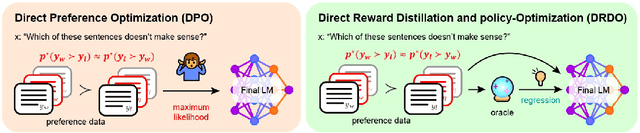
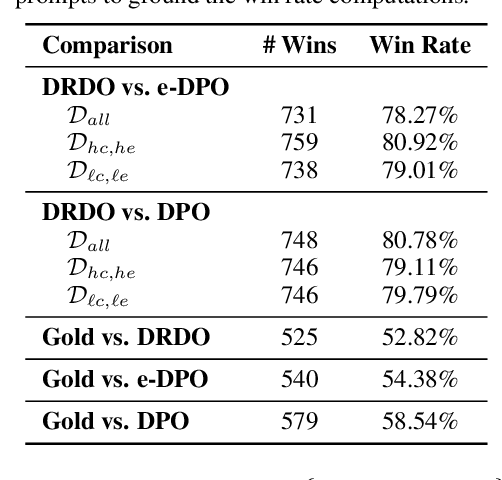
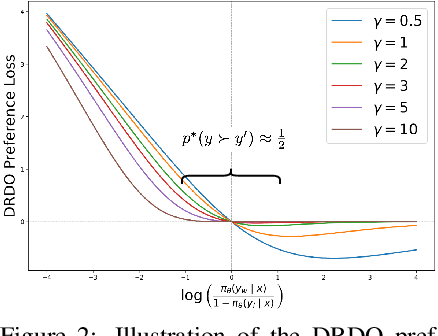
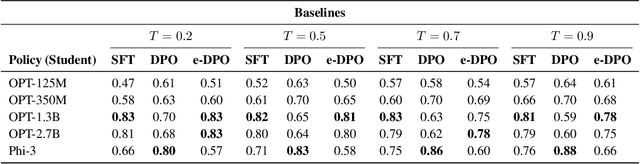
Reward modeling of human preferences is one of the cornerstones of building usable generative large language models (LLMs). While traditional RLHF-based alignment methods explicitly maximize the expected rewards from a separate reward model, more recent supervised alignment methods like Direct Preference Optimization (DPO) circumvent this phase to avoid problems including model drift and reward overfitting. Although popular due to its simplicity, DPO and similar direct alignment methods can still lead to degenerate policies, and rely heavily on the Bradley-Terry-based preference formulation to model reward differences between pairs of candidate outputs. This formulation is challenged by non-deterministic or noisy preference labels, for example human scoring of two candidate outputs is of low confidence. In this paper, we introduce DRDO (Direct Reward Distillation and policy-Optimization), a supervised knowledge distillation-based preference alignment method that simultaneously models rewards and preferences to avoid such degeneracy. DRDO directly mimics rewards assigned by an oracle while learning human preferences from a novel preference likelihood formulation. Our experimental results on the Ultrafeedback and TL;DR datasets demonstrate that policies trained using DRDO surpass previous methods such as DPO and e-DPO in terms of expected rewards and are more robust, on average, to noisy preference signals as well as out-of-distribution (OOD) settings.