 Add to Chrome
 Add to Firefox
 Add to Edge
Do LLMs Know a Good Hypothesis When They See One? Logit-Based Energy Scoring Outperforms Prompted LLM-as-Judge for Scientific Hypothesis Ranking
Aug 18, 2026
Large language models (LLMs) are increasingly used for scientific hypothesis generation. However, evaluating generated hypotheses remains a challenge for trustworthy AI-enabled scientific workflows. Existing approaches often use LLMs as judges or rely on semantic similarity, which can favor familiar ideas over novel ones. We propose a logit-based energy scoring method that evaluates hypotheses using a language model's intrinsic confidence rather than comparative judgment. We benchmarked seven language models on 1,323 papers across 12 disciplines. Each paper was paired with its hypothesis and fifteen incorrect alternatives. Intrinsic scoring reached 33.0% Hit@1 pooled across both scorers, compared with 16.6% for prompted listwise ranking. The strongest configuration, a 1-billion-parameter model using logit-based energy scoring, reached 53.1%, though this was the maximum across 14 model-by-scorer combinations selected post hoc. Overall, intrinsic model confidence shows potential for scientific hypothesis evaluation. This study also motivates future research on confidence-based methods for trustworthy AI-enabled scientific discovery.

Visualizing Graph-to-Answer Mechanism Recovery in Materials-Science Hypothesis Generation
Aug 04, 2026AI co-scientists can generate fluent materials-science hypotheses, but fluency does not show that an answer preserves a scientifically meaningful mechanism. We present a graph-to-answer mechanism-tracing case study for Graph-PRefLexOR-8B, a Qwen3-8B model adapted to expose distinct stages for brainstorming, graph construction, pattern extraction, and synthesis. We organize semantic backtracking, graph corruption, activation-based recovery measurements, and layer-by-token-region grids into a visual diagnostic workflow for inspecting this pathway. Across 100 open-ended materials-science questions, final answers remain closest to the model's own structured stages, especially synthesis. Under graph corruption, a full sweep over 37 residual-stream checkpoints, the embedding output and 36 transformer blocks, shows little mechanism recovery in the earlier transition region at layers 7--10, recovery instead concentrates in late synthesis and answer-start regions around layers 30 and 36. The workflow is intended to help scientists and model developers identify where a generated hypothesis loses or regains mechanism support before it is passed to downstream experimental planning.
Enhancing Operational Safety via Agentic Dialogue Hazard Identification Analysis
Jun 02, 2026Operational safety in high-stakes domains such as industrial process control, autonomous, and safety-critical systems, demand reliable hazard identification. While large language models (LLMs) have shown promise in automating safety analysis tasks, single-turn, monolithic inference is brittle: it lacks the self-correction, deliberation, and contextual refinement that safety engineers apply iteratively. In this paper, we introduce HAZDIAL, a framework that investigates whether structured agentic dialogue-multi-agent, multi-turn interactions improves the quality of NLP- based hazard identification over single-pass baselines. We systematically compare two dialogue modalities: adversarial debate and constructive discussion, and propose an algorithm-based agentic interaction optimization. We evaluate all configurations against a curated golden dataset using standard classification metrics (accuracy, precision, recall, F1) and novel dialogue metrics. This work advances the intersection of dialogue systems, multi-agent reasoning, and AI safety, providing an empirical evidence for dialogue-driven hazard analysis.
The Compressive Knowledge Graph Hypothesis: Which Graph Facts Matter for Scientific Hypothesis Generation?
May 28, 2026Knowledge graphs (KGs) can provide structured scientific context to language models, but it remains unclear which graph facts actually shape the generated hypotheses. We study KG-guided hypothesis generation for battery materials across Mistral-7B, Llama-3.1-70B, and Gemini 2.5 Flash. We perturb local KGs by varying density, ontology richness, topology, and control structure, and evaluate outputs with both provided-graph and fixed-reference metrics. Across models, KG utility is selective and model-dependent: graph context changes outputs, but no-KG outputs also recover substantial graph content from model priors. Compact top-k subgraphs often approximate full-KG behavior, including when claimed-outcome triples are held out. At the same time, compression is not unique to one semantic ranking rule, random and topology-based subsets can also recover much of the signal. These results support a redundancy-aware Compressive KG hypothesis: useful KG signal is often recoverable from compact, scientifically structured subgraphs rather than requiring the full local graph.
BLUEPRINT Rebuilding a Legacy: Multimodal Retrieval for Complex Engineering Drawings and Documents
Feb 12, 2026Decades of engineering drawings and technical records remain locked in legacy archives with inconsistent or missing metadata, making retrieval difficult and often manual. We present Blueprint, a layout-aware multimodal retrieval system designed for large-scale engineering repositories. Blueprint detects canonical drawing regions, applies region-restricted VLM-based OCR, normalizes identifiers (e.g., DWG, part, facility), and fuses lexical and dense retrieval with a lightweight region-level reranker. Deployed on ~770k unlabeled files, it automatically produces structured metadata suitable for cross-facility search. We evaluate Blueprint on a 5k-file benchmark with 350 expert-curated queries using pooled, graded (0/1/2) relevance judgments. Blueprint delivers a 10.1% absolute gain in Success@3 and an 18.9% relative improvement in nDCG@3 over the strongest vision-language baseline}, consistently outperforming across vision, text, and multimodal intents. Oracle ablations reveal substantial headroom under perfect region detection and OCR. We release all queries, runs, annotations, and code to facilitate reproducible evaluation on legacy engineering archives.
COBRA: Catastrophic Bit-flip Reliability Analysis of State-Space Models
Dec 22, 2025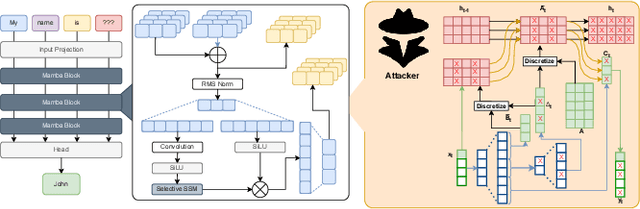
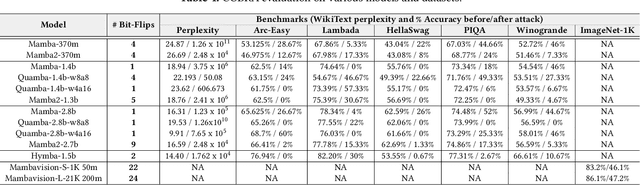
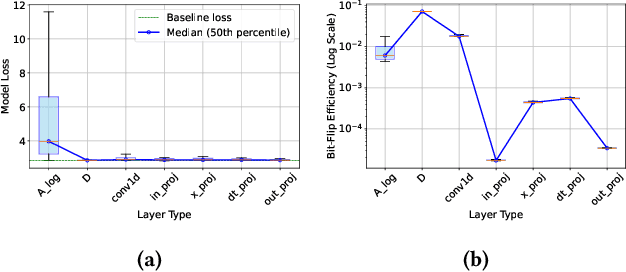
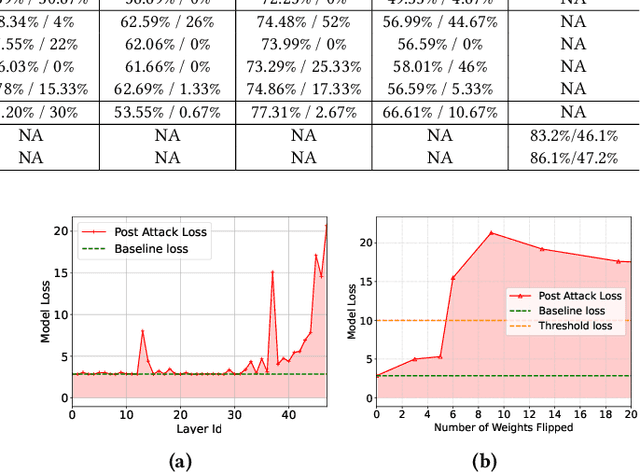
State-space models (SSMs), exemplified by the Mamba architecture, have recently emerged as state-of-the-art sequence-modeling frameworks, offering linear-time scalability together with strong performance in long-context settings. Owing to their unique combination of efficiency, scalability, and expressive capacity, SSMs have become compelling alternatives to transformer-based models, which suffer from the quadratic computational and memory costs of attention mechanisms. As SSMs are increasingly deployed in real-world applications, it is critical to assess their susceptibility to both software- and hardware-level threats to ensure secure and reliable operation. Among such threats, hardware-induced bit-flip attacks (BFAs) pose a particularly severe risk by corrupting model parameters through memory faults, thereby undermining model accuracy and functional integrity. To investigate this vulnerability, we introduce RAMBO, the first BFA framework specifically designed to target Mamba-based architectures. Through experiments on the Mamba-1.4b model with LAMBADA benchmark, a cloze-style word-prediction task, we demonstrate that flipping merely a single critical bit can catastrophically reduce accuracy from 74.64% to 0% and increase perplexity from 18.94 to 3.75 x 10^6. These results demonstrate the pronounced fragility of SSMs to adversarial perturbations.
HARNESS: Human-Agent Risk Navigation and Event Safety System for Proactive Hazard Forecasting in High-Risk DOE Environments
Nov 13, 2025Operational safety at mission-critical work sites is a top priority given the complex and hazardous nature of daily tasks. This paper presents the Human-Agent Risk Navigation and Event Safety System (HARNESS), a modular AI framework designed to forecast hazardous events and analyze operational risks in U.S. Department of Energy (DOE) environments. HARNESS integrates Large Language Models (LLMs) with structured work data, historical event retrieval, and risk analysis to proactively identify potential hazards. A human-in-the-loop mechanism allows subject matter experts (SMEs) to refine predictions, creating an adaptive learning loop that enhances performance over time. By combining SME collaboration with iterative agentic reasoning, HARNESS improves the reliability and efficiency of predictive safety systems. Preliminary deployment shows promising results, with future work focusing on quantitative evaluation of accuracy, SME agreement, and decision latency reduction.
ORCHID: Orchestrated Retrieval-Augmented Classification with Human-in-the-Loop Intelligent Decision-Making for High-Risk Property
Nov 07, 2025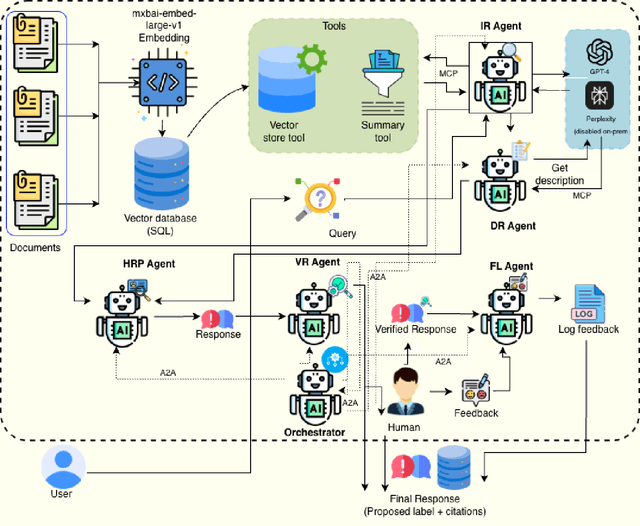
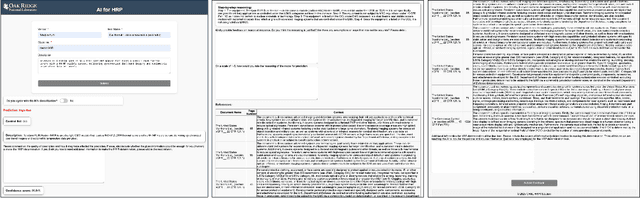
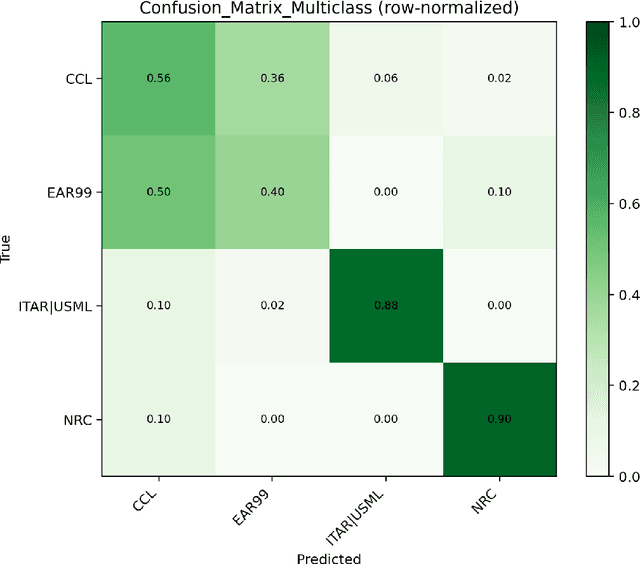
High-Risk Property (HRP) classification is critical at U.S. Department of Energy (DOE) sites, where inventories include sensitive and often dual-use equipment. Compliance must track evolving rules designated by various export control policies to make transparent and auditable decisions. Traditional expert-only workflows are time-consuming, backlog-prone, and struggle to keep pace with shifting regulatory boundaries. We demo ORCHID, a modular agentic system for HRP classification that pairs retrieval-augmented generation (RAG) with human oversight to produce policy-based outputs that can be audited. Small cooperating agents, retrieval, description refiner, classifier, validator, and feedback logger, coordinate via agent-to-agent messaging and invoke tools through the Model Context Protocol (MCP) for model-agnostic on-premise operation. The interface follows an Item to Evidence to Decision loop with step-by-step reasoning, on-policy citations, and append-only audit bundles (run-cards, prompts, evidence). In preliminary tests on real HRP cases, ORCHID improves accuracy and traceability over a non-agentic baseline while deferring uncertain items to Subject Matter Experts (SMEs). The demonstration shows single item submission, grounded citations, SME feedback capture, and exportable audit artifacts, illustrating a practical path to trustworthy LLM assistance in sensitive DOE compliance workflows.
AttentionBreaker: Adaptive Evolutionary Optimization for Unmasking Vulnerabilities in LLMs through Bit-Flip Attacks
Nov 21, 2024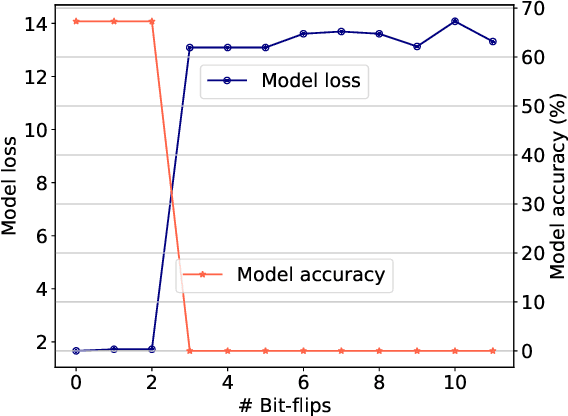
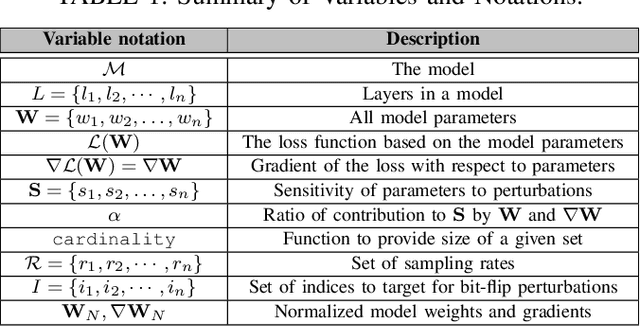
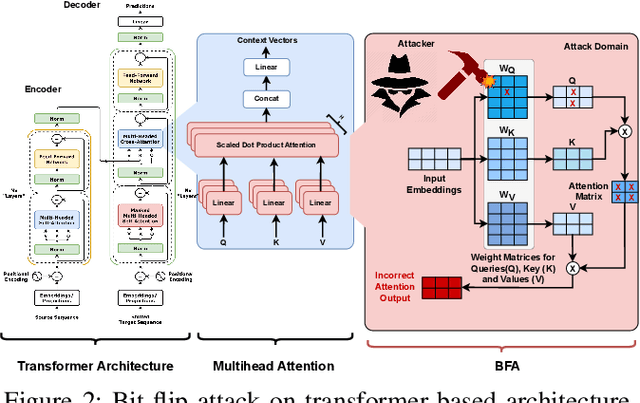
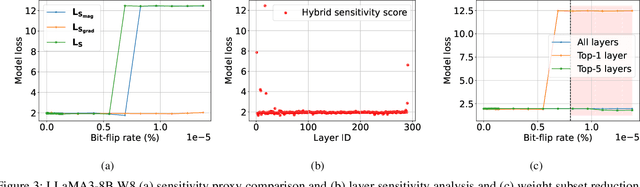
Large Language Models (LLMs) have revolutionized natural language processing (NLP), excelling in tasks like text generation and summarization. However, their increasing adoption in mission-critical applications raises concerns about hardware-based threats, particularly bit-flip attacks (BFAs). BFAs, enabled by fault injection methods such as Rowhammer, target model parameters in memory, compromising both integrity and performance. Identifying critical parameters for BFAs in the vast parameter space of LLMs poses significant challenges. While prior research suggests transformer-based architectures are inherently more robust to BFAs compared to traditional deep neural networks, we challenge this assumption. For the first time, we demonstrate that as few as three bit-flips can cause catastrophic performance degradation in an LLM with billions of parameters. Current BFA techniques are inadequate for exploiting this vulnerability due to the difficulty of efficiently identifying critical parameters within the immense parameter space. To address this, we propose AttentionBreaker, a novel framework tailored for LLMs that enables efficient traversal of the parameter space to identify critical parameters. Additionally, we introduce GenBFA, an evolutionary optimization strategy designed to refine the search further, isolating the most critical bits for an efficient and effective attack. Empirical results reveal the profound vulnerability of LLMs to AttentionBreaker. For example, merely three bit-flips (4.129 x 10^-9% of total parameters) in the LLaMA3-8B-Instruct 8-bit quantized (W8) model result in a complete performance collapse: accuracy on MMLU tasks drops from 67.3% to 0%, and Wikitext perplexity skyrockets from 12.6 to 4.72 x 10^5. These findings underscore the effectiveness of AttentionBreaker in uncovering and exploiting critical vulnerabilities within LLM architectures.