 Add to Chrome
 Add to Firefox
 Add to Edge
Multi-Resolution Tactile Imitation Learning for Contact-Rich Robotic Manipulation
Jun 04, 2026
Touch sensing is beneficial for solving a wide variety of manipulation tasks. While there exists a wide range of tactile sensors with different properties, exploiting the fusion of multiple heterogeneous tactile sensors to improve manipulation learning remains underexplored. We present Multi-Resolution Tactile Sensing (MiTaS), a representation framework that leverages multiple tactile sensors operating at different temporal resolutions in order to solve complex contact-rich manipulation tasks. We propose a novel architecture using modality-specific convolutional stems and transformer-based fusion that effectively fuses information from an RGB camera stream, a vision-based GelSight Mini sensor and a high-frequency event-based Evetac sensor. This multi-sensor representation then conditions a flow-matching policy for solving downstream tasks. Experimental results across five contact-rich manipulation tasks demonstrate the effectiveness of multi-resolution tactile features in imitation learning. MiTaS achieves an average success rate of 80 %, while vision-only (31 %) and visual-tactile (54 %) baselines cannot solve the task reliably. Co-training a visuo-tactile model with multi-tactile data boosts performance by over 10 \% in certain tasks, without having access to the Evetac sensor during policy evaluation. A detailed sensor-reading and attention analysis reveals the importance of different sensors throughout task execution, validating our multi-resolution tactile sensing approach. Project Page: http://mitas-touch.github.io.

Neuromorphic BrailleNet: Accurate and Generalizable Braille Reading Beyond Single Characters through Event-Based Optical Tactile Sensing
Jan 27, 2026Conventional robotic Braille readers typically rely on discrete, character-by-character scanning, limiting reading speed and disrupting natural flow. Vision-based alternatives often require substantial computation, introduce latency, and degrade in real-world conditions. In this work, we present a high accuracy, real-time pipeline for continuous Braille recognition using Evetac, an open-source neuromorphic event-based tactile sensor. Unlike frame-based vision systems, the neuromorphic tactile modality directly encodes dynamic contact events during continuous sliding, closely emulating human finger-scanning strategies. Our approach combines spatiotemporal segmentation with a lightweight ResNet-based classifier to process sparse event streams, enabling robust character recognition across varying indentation depths and scanning speeds. The proposed system achieves near-perfect accuracy (>=98%) at standard depths, generalizes across multiple Braille board layouts, and maintains strong performance under fast scanning. On a physical Braille board containing daily-living vocabulary, the system attains over 90% word-level accuracy, demonstrating robustness to temporal compression effects that challenge conventional methods. These results position neuromorphic tactile sensing as a scalable, low latency solution for robotic Braille reading, with broader implications for tactile perception in assistive and robotic applications.
Evetac: An Event-based Optical Tactile Sensor for Robotic Manipulation
Dec 02, 2023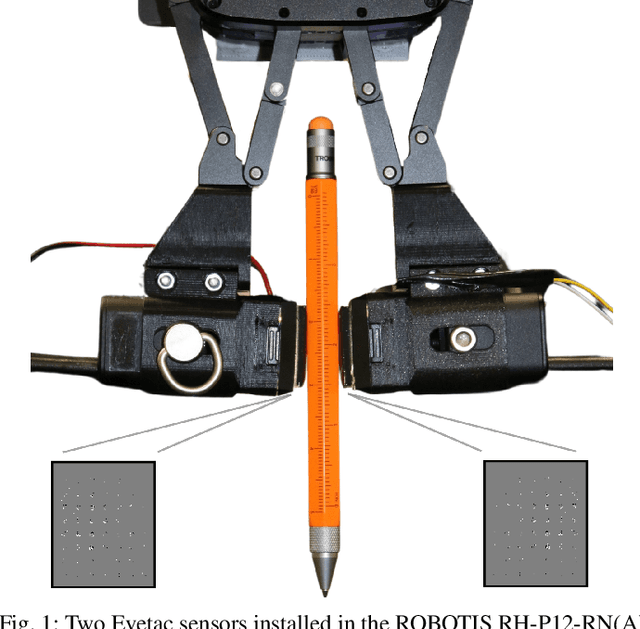
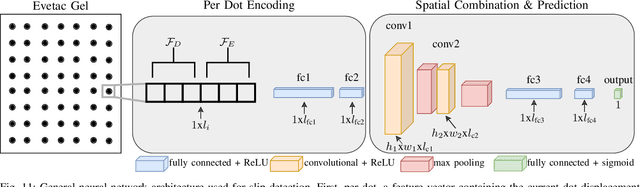
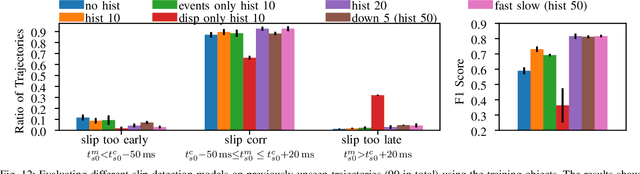
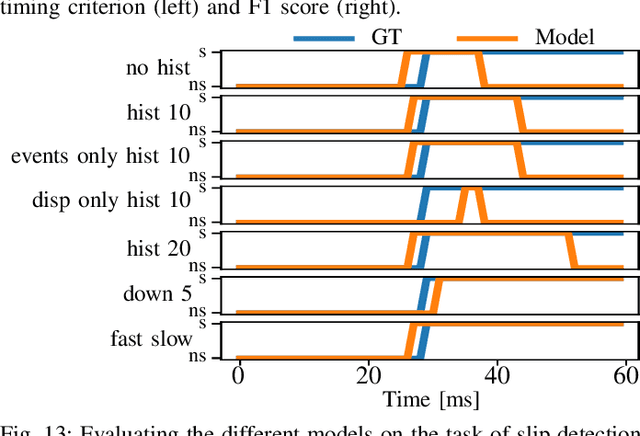
Optical tactile sensors have recently become popular. They provide high spatial resolution, but struggle to offer fine temporal resolutions. To overcome this shortcoming, we study the idea of replacing the RGB camera with an event-based camera and introduce a new event-based optical tactile sensor called Evetac. Along with hardware design, we develop touch processing algorithms to process its measurements online at 1000 Hz. We devise an efficient algorithm to track the elastomer's deformation through the imprinted markers despite the sensor's sparse output. Benchmarking experiments demonstrate Evetac's capabilities of sensing vibrations up to 498 Hz, reconstructing shear forces, and significantly reducing data rates compared to RGB optical tactile sensors. Moreover, Evetac's output and the marker tracking provide meaningful features for learning data-driven slip detection and prediction models. The learned models form the basis for a robust and adaptive closed-loop grasp controller capable of handling a wide range of objects. We believe that fast and efficient event-based tactile sensors like Evetac will be essential for bringing human-like manipulation capabilities to robotics. The sensor design is open-sourced at https://sites.google.com/view/evetac .