 Add to Chrome
 Add to Firefox
 Add to Edge
Redefining Instance Matching: A Unified Framework for Part-Aware Matching in Panoptic Segmentation Evaluation
May 29, 2026
The Panoptic Quality (PQ) metric is the standard for jointly evaluating instance and semantic segmentation. However, its original definition relies on a One-to-One matching between predicted and ground truth segments, which is only straightforward when the IoU threshold exceeds 0.5. Below 0.5, multiple matching strategies emerge in a poorly explored problem space. We systematically elucidate this space by recasting segment matching as a constrained bipartite assignment problem. Independently bounding the prediction- and ground-truth-side degrees yields four matching strategies: One-to-One, Many-to-One, One-to-Many, and Many-to-Many. We show that the first three are well-defined within the PQ framework, while Many-to-Many falls outside it. These strategies become relevant when instances are fragmented, adjacent objects are difficult to delineate, or annotations are noisy. Central to our framework is a vertex-based accounting of TP, FN, and FP, anchored to ground truth and predicted segments rather than to matching edges. We further show that the framework extends naturally to part-aware panoptic segmentation, and we explore part-aware evaluation on biomedical data. Across configurable case studies we report how different combinations of thresholds and matching strategies behave in practice. We release a unified open-source package built on Panoptica. It exposes Voronoi-based region-wise analysis, part-aware evaluation, and Area Under Threshold Curve computations as configurable options.

HistDiST: Histopathological Diffusion-based Stain Transfer
May 11, 2025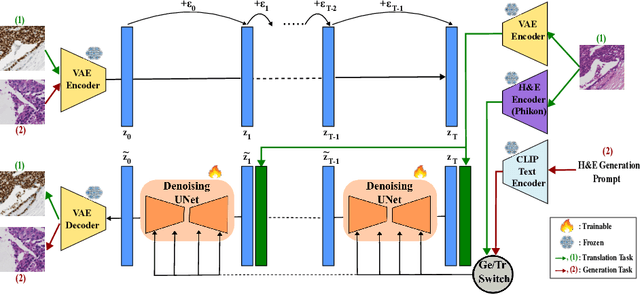
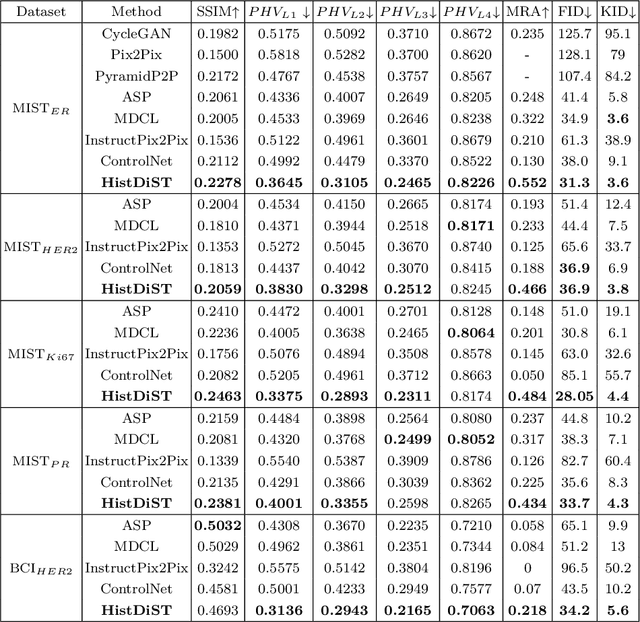
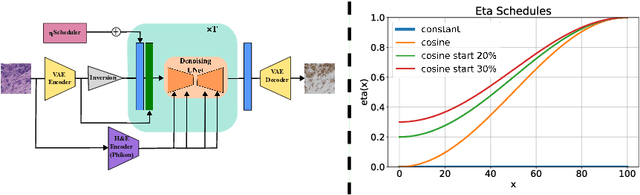
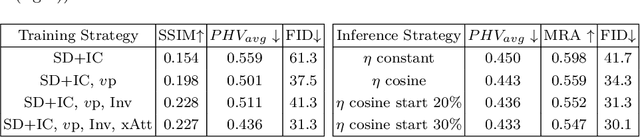
Hematoxylin and Eosin (H&E) staining is the cornerstone of histopathology but lacks molecular specificity. While Immunohistochemistry (IHC) provides molecular insights, it is costly and complex, motivating H&E-to-IHC translation as a cost-effective alternative. Existing translation methods are mainly GAN-based, often struggling with training instability and limited structural fidelity, while diffusion-based approaches remain underexplored. We propose HistDiST, a Latent Diffusion Model (LDM) based framework for high-fidelity H&E-to-IHC translation. HistDiST introduces a dual-conditioning strategy, utilizing Phikon-extracted morphological embeddings alongside VAE-encoded H&E representations to ensure pathology-relevant context and structural consistency. To overcome brightness biases, we incorporate a rescaled noise schedule, v-prediction, and trailing timesteps, enforcing a zero-SNR condition at the final timestep. During inference, DDIM inversion preserves the morphological structure, while an eta-cosine noise schedule introduces controlled stochasticity, balancing structural consistency and molecular fidelity. Moreover, we propose Molecular Retrieval Accuracy (MRA), a novel pathology-aware metric leveraging GigaPath embeddings to assess molecular relevance. Extensive evaluations on MIST and BCI datasets demonstrate that HistDiST significantly outperforms existing methods, achieving a 28% improvement in MRA on the H&E-to-Ki67 translation task, highlighting its effectiveness in capturing true IHC semantics.