 Add to Chrome
 Add to Firefox
 Add to Edge
DALPHIN: Benchmarking Digital Pathology AI Copilots Against Pathologists on an Open Multicentric Dataset
May 05, 2026
Foundation models with visual question answering capabilities for digital pathology are emerging. Such unprecedented technology requires independent benchmarking to assess its potential in assisting pathologists in routine diagnostics. We created DALPHIN, the first multicentric open benchmark for pathology AI copilots, comprising 1236 images from 300 cases, spanning 130 rare to common diagnoses, 6 countries, and 14 subspecialties. The DALPHIN design and dataset are introduced alongside a human performance benchmark of 31 pathologists from 10 countries with varying expertise. We report results for two general-purpose (GPT-5, Gemini 2.5 Pro) and one pathology-specific copilot (PathChat+) for sequential and independent answer generation. We observed no statistically significant difference from expert-level performance in four of six tasks for PathChat, 2/6 tasks for Gemini, and 1/6 tasks for GPT. DALPHIN is publicly released with sequestered, indirectly accessible ground truth to foster robust and enduring benchmarking. Data, methods, and the evaluation platform are accessible through dalphin.grand-challenge.org.

Deep Learning From Routine Histology Improves Risk Stratification for Biochemical Recurrence in Prostate Cancer
Mar 15, 2026Accurate prediction of biochemical recurrence (BCR) after radical prostatectomy is critical for guiding adjuvant treatment and surveillance decisions in prostate cancer. However, existing clinicopathological risk models reduce complex morphology to relatively coarse descriptors, leaving substantial prognostic information embedded in routine histopathology underexplored. We present a deep learning-based biomarker that predicts continuous, patient-specific risk of BCR directly from H&E-stained whole-slide prostatectomy specimens. Trained end-to-end on time-to-event outcomes and evaluated across four independent international cohorts, our model demonstrates robust generalization across institutions and patient populations. When integrated with the CAPRA-S clinical risk score, the deep learning risk score consistently improved discrimination for BCR, increasing concordance indices from 0.725-0.772 to 0.749-0.788 across cohorts. To support clinical interpretability, outcome-grounded analyses revealed subtle histomorphological patterns associated with recurrence risk that are not captured by conventional clinicopathological risk scores. This multicohort study demonstrates that deep learning applied to routine prostate histopathology can deliver reproducible and clinically generalizable biomarkers that augment postoperative risk stratification, with potential to support personalized management of prostate cancer in real-world clinical settings.
A Multicentric Dataset for Training and Benchmarking Breast Cancer Segmentation in H&E Slides
Oct 02, 2025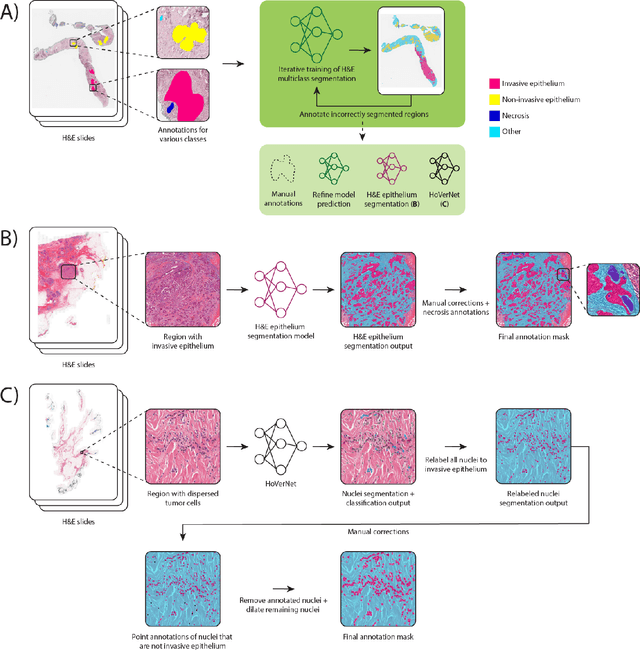
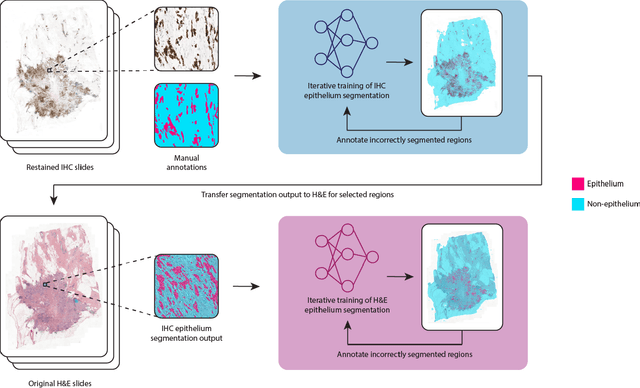
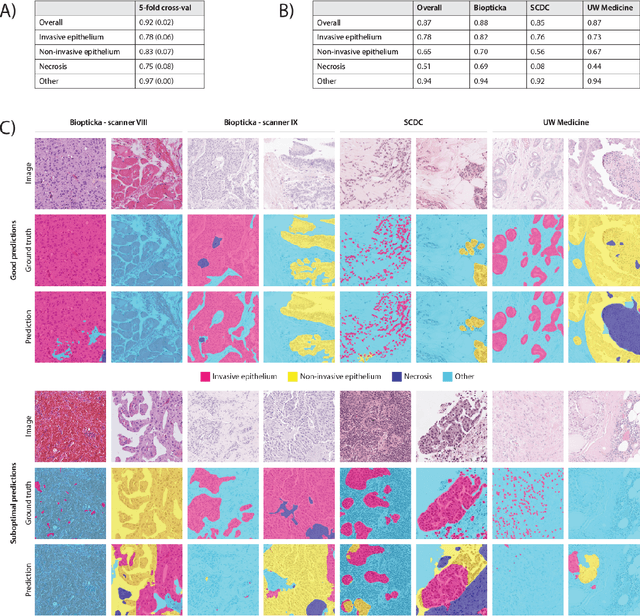
Automated semantic segmentation of whole-slide images (WSIs) stained with hematoxylin and eosin (H&E) is essential for large-scale artificial intelligence-based biomarker analysis in breast cancer. However, existing public datasets for breast cancer segmentation lack the morphological diversity needed to support model generalizability and robust biomarker validation across heterogeneous patient cohorts. We introduce BrEast cancEr hisTopathoLogy sEgmentation (BEETLE), a dataset for multiclass semantic segmentation of H&E-stained breast cancer WSIs. It consists of 587 biopsies and resections from three collaborating clinical centers and two public datasets, digitized using seven scanners, and covers all molecular subtypes and histological grades. Using diverse annotation strategies, we collected annotations across four classes - invasive epithelium, non-invasive epithelium, necrosis, and other - with particular focus on morphologies underrepresented in existing datasets, such as ductal carcinoma in situ and dispersed lobular tumor cells. The dataset's diversity and relevance to the rapidly growing field of automated biomarker quantification in breast cancer ensure its high potential for reuse. Finally, we provide a well-curated, multicentric external evaluation set to enable standardized benchmarking of breast cancer segmentation models.