 Add to Chrome
 Add to Firefox
 Add to Edge
Deep Learning From Routine Histology Improves Risk Stratification for Biochemical Recurrence in Prostate Cancer
Mar 15, 2026
Accurate prediction of biochemical recurrence (BCR) after radical prostatectomy is critical for guiding adjuvant treatment and surveillance decisions in prostate cancer. However, existing clinicopathological risk models reduce complex morphology to relatively coarse descriptors, leaving substantial prognostic information embedded in routine histopathology underexplored. We present a deep learning-based biomarker that predicts continuous, patient-specific risk of BCR directly from H&E-stained whole-slide prostatectomy specimens. Trained end-to-end on time-to-event outcomes and evaluated across four independent international cohorts, our model demonstrates robust generalization across institutions and patient populations. When integrated with the CAPRA-S clinical risk score, the deep learning risk score consistently improved discrimination for BCR, increasing concordance indices from 0.725-0.772 to 0.749-0.788 across cohorts. To support clinical interpretability, outcome-grounded analyses revealed subtle histomorphological patterns associated with recurrence risk that are not captured by conventional clinicopathological risk scores. This multicohort study demonstrates that deep learning applied to routine prostate histopathology can deliver reproducible and clinically generalizable biomarkers that augment postoperative risk stratification, with potential to support personalized management of prostate cancer in real-world clinical settings.

Learning Nuclei Representations with Masked Image Modelling
Jun 29, 2023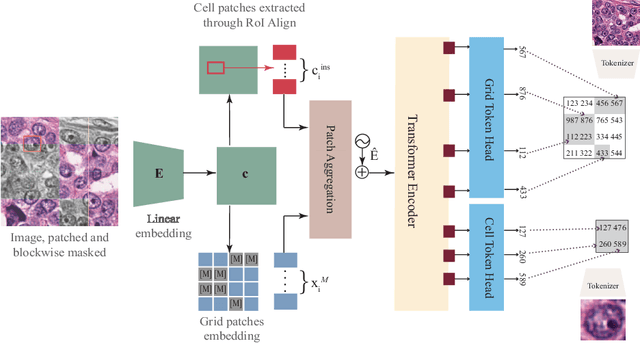
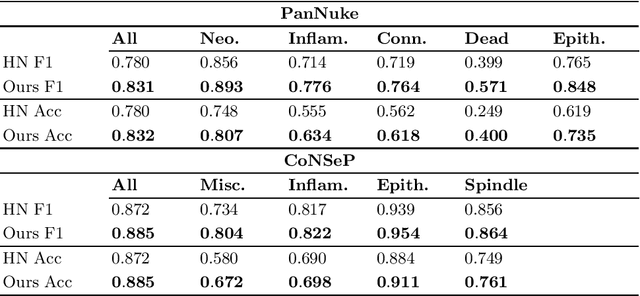
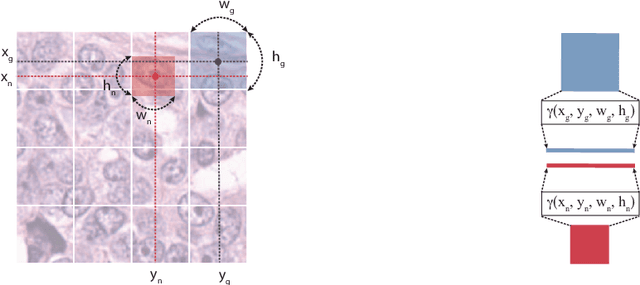
Masked image modelling (MIM) is a powerful self-supervised representation learning paradigm, whose potential has not been widely demonstrated in medical image analysis. In this work, we show the capacity of MIM to capture rich semantic representations of Haemotoxylin & Eosin (H&E)-stained images at the nuclear level. Inspired by Bidirectional Encoder representation from Image Transformers (BEiT), we split the images into smaller patches and generate corresponding discrete visual tokens. In addition to the regular grid-based patches, typically used in visual Transformers, we introduce patches of individual cell nuclei. We propose positional encoding of the irregular distribution of these structures within an image. We pre-train the model in a self-supervised manner on H&E-stained whole-slide images of diffuse large B-cell lymphoma, where cell nuclei have been segmented. The pre-training objective is to recover the original discrete visual tokens of the masked image on the one hand, and to reconstruct the visual tokens of the masked object instances on the other. Coupling these two pre-training tasks allows us to build powerful, context-aware representations of nuclei. Our model generalizes well and can be fine-tuned on downstream classification tasks, achieving improved cell classification accuracy on PanNuke dataset by more than 5% compared to current instance segmentation methods.