 Add to Chrome
 Add to Firefox
 Add to Edge
SeGPruner: Semantic-Geometric Visual Token Pruner for 3D Question Answering
Mar 31, 2026
Vision-language models (VLMs) have been widely adopted for 3D question answering (3D QA). In typical pipelines, visual tokens extracted from multiple viewpoints are concatenated with language tokens and jointly processed by a large language model (LLM) for inference. However, aggregating multi-view observations inevitably introduces severe token redundancy, leading to an overly large visual token set that significantly hinders inference efficiency under constrained token budgets. Visual token pruning has emerged as a prevalent strategy to address this issue. Nevertheless, most existing pruners are primarily tailored to 2D inputs or rely on indirect geometric cues, which limits their ability to explicitly retain semantically critical objects and maintain sufficient spatial coverage for robust 3D reasoning. In this paper, we propose SeGPruner, a semantic-aware and geometry-guided token reduction framework for efficient 3D QA with multi-view images. Specifically, SeGPruner first preserves semantically salient tokens through an attention-based importance module (Saliency-aware Token Selector), ensuring that object-critical evidence is retained. It then complements these tokens with spatially diverse ones via a geometry-guided selector (Geometry-aware Token Diversifier), which jointly considers semantic relevance and 3D geometric distance. This cooperation between saliency preservation and geometry-guided diversification balances object-level evidence and global scene coverage under aggressive token reduction. Extensive experiments on ScanQA and OpenEQA demonstrate that SeGPruner substantially improves inference efficiency, reducing the visual token budget by 91% and inference latency by 86%, while maintaining competitive performance in 3D reasoning tasks.

3CAD: A Large-Scale Real-World 3C Product Dataset for Unsupervised Anomaly
Feb 09, 2025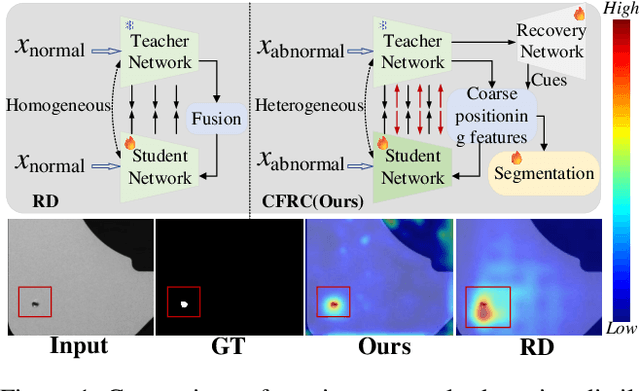
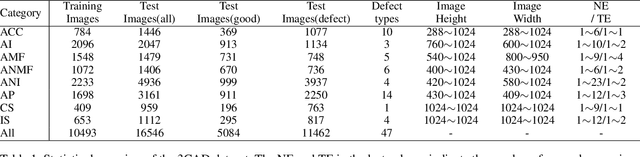
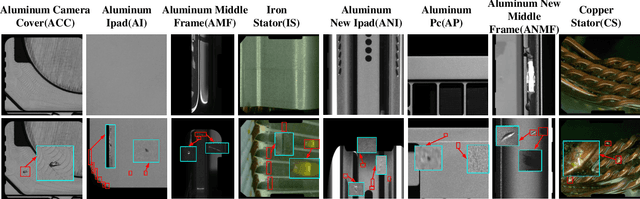
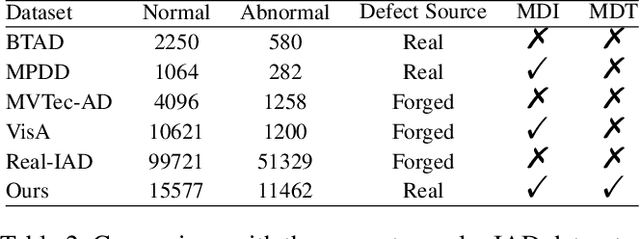
Industrial anomaly detection achieves progress thanks to datasets such as MVTec-AD and VisA. However, they suf- fer from limitations in terms of the number of defect sam- ples, types of defects, and availability of real-world scenes. These constraints inhibit researchers from further exploring the performance of industrial detection with higher accuracy. To this end, we propose a new large-scale anomaly detection dataset called 3CAD, which is derived from real 3C produc- tion lines. Specifically, the proposed 3CAD includes eight different types of manufactured parts, totaling 27,039 high- resolution images labeled with pixel-level anomalies. The key features of 3CAD are that it covers anomalous regions of different sizes, multiple anomaly types, and the possibility of multiple anomalous regions and multiple anomaly types per anomaly image. This is the largest and first anomaly de- tection dataset dedicated to 3C product quality control for community exploration and development. Meanwhile, we in- troduce a simple yet effective framework for unsupervised anomaly detection: a Coarse-to-Fine detection paradigm with Recovery Guidance (CFRG). To detect small defect anoma- lies, the proposed CFRG utilizes a coarse-to-fine detection paradigm. Specifically, we utilize a heterogeneous distilla- tion model for coarse localization and then fine localiza- tion through a segmentation model. In addition, to better capture normal patterns, we introduce recovery features as guidance. Finally, we report the results of our CFRG frame- work and popular anomaly detection methods on the 3CAD dataset, demonstrating strong competitiveness and providing a highly challenging benchmark to promote the development of the anomaly detection field. Data and code are available: https://github.com/EnquanYang2022/3CAD.