 Add to Chrome
 Add to Firefox
 Add to Edge
Scaling LLM Knowledge Boundaries via Distribution-Optimized Synthesis
Jun 22, 2026
Knowledge injection via synthetic data is crucial for enhancing Large Language Models (LLMs). However, current synthesis methods simply stop at preset token counts or fixed data ratios, lacking awareness of knowledge distribution. This results in some domains being sparse while others are redundant, limiting LLM knowledge boundaries. We revisit knowledge injection from a distribution perspective and hypothesize that an optimal knowledge distribution exists to maximize knowledge boundary expansion. We propose KDoS (Knowledge Distribution-optimized Synthesis), a framework that introduces knowledge density to drive synthesis through a three-stage feedback mechanism, shifting from blind generation to distribution-optimized synthesis. We construct Wikipedia-based synthetic data with varying knowledge distributions and conduct experiments on models from 0.6B to 16B (Qwen, Ling, LLaMA) and data scales from 1B to 5B tokens. Our key findings are: (1) an optimal knowledge distribution consistently maximizes boundary expansion; (2) this distribution is stable across backbones and scales; (3) KDoS outperforms baselines across six knowledge benchmarks. Our work offers a new perspective and practical framework for synthetic data-driven knowledge injection.

SKA-Bench: A Fine-Grained Benchmark for Evaluating Structured Knowledge Understanding of LLMs
Jul 23, 2025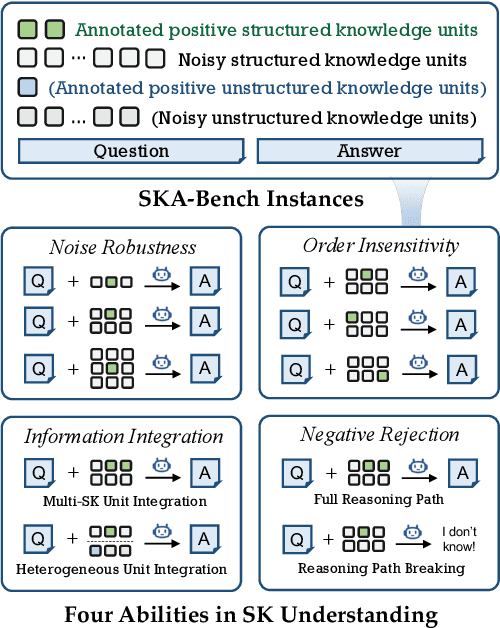

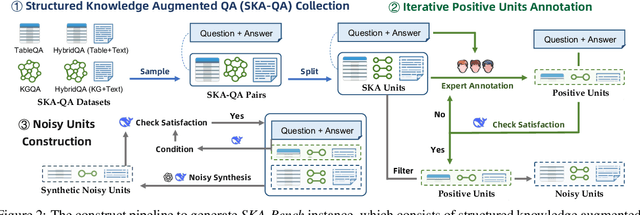

Although large language models (LLMs) have made significant progress in understanding Structured Knowledge (SK) like KG and Table, existing evaluations for SK understanding are non-rigorous (i.e., lacking evaluations of specific capabilities) and focus on a single type of SK. Therefore, we aim to propose a more comprehensive and rigorous structured knowledge understanding benchmark to diagnose the shortcomings of LLMs. In this paper, we introduce SKA-Bench, a Structured Knowledge Augmented QA Benchmark that encompasses four widely used structured knowledge forms: KG, Table, KG+Text, and Table+Text. We utilize a three-stage pipeline to construct SKA-Bench instances, which includes a question, an answer, positive knowledge units, and noisy knowledge units. To evaluate the SK understanding capabilities of LLMs in a fine-grained manner, we expand the instances into four fundamental ability testbeds: Noise Robustness, Order Insensitivity, Information Integration, and Negative Rejection. Empirical evaluations on 8 representative LLMs, including the advanced DeepSeek-R1, indicate that existing LLMs still face significant challenges in understanding structured knowledge, and their performance is influenced by factors such as the amount of noise, the order of knowledge units, and hallucination phenomenon. Our dataset and code are available at https://github.com/Lza12a/SKA-Bench.