 Add to Chrome
 Add to Firefox
 Add to Edge
Enhancing a Risk Model by Adding Transient Statistical Factors
May 13, 2026
Estimating the covariance of asset returns, i.e., the risk model, is a key component of financial portfolio construction and evaluation. Most risk modeling approaches produce a factor model that decomposes the asset variability into two components: the first attributed to a small number of factors that are common among the assets and the second attributed to the idiosyncratic behavior of each asset. Third-party providers typically provide risk models to investors, and while these models are typically of high quality, they may fail to capture important information, e.g., changing market regimes and transient factors. To overcome these limitations, we propose a systematic method based on maximum likelihood estimation to enhance an existing factor model by both refining the given model and adding new statistical factors. Our approach relies only on the observed sequence of realized returns and on the choice of two hyperparameters: the number of additional factors and the half-life parameter that determines the weights assigned to returns in the log-likelihood objective. Importantly, our methodology applies to the situation where asset returns may be missing, making it suitable for typical equity datasets. We demonstrate our approach on the Barra short-term US risk model, a high-quality risk model used in practice, for a universe of US high-capitalization equities. We show that the proposed extension captures structure in the returns that is missed by the original model.

One-Step Generative Modeling via Wasserstein Gradient Flows
May 12, 2026Diffusion models and flow-based methods have shown impressive generative capability, especially for images, but their sampling is expensive because it requires many iterative updates. We introduce W-Flow, a framework for training a generator that transforms samples from a simple reference distribution into samples from a target data distribution in a single step. This is achieved in two steps: we first define an evolution from the reference distribution to the target distribution through a Wasserstein gradient flow that minimizes an energy functional; second, we train a static neural generator to compress this evolution into one-step generation. We instantiate the energy functional with the Sinkhorn divergence, which yields an efficient optimal-transport-based update rule that captures global distributional discrepancy and improves coverage of the target distribution. We further prove that the finite-sample training dynamics converge to the continuous-time distributional dynamics under suitable assumptions. Empirically, W-Flow sets a new state of the art for one-step ImageNet 256$\times$256 generation, achieving 1.29 FID, with improved mode coverage and domain transfer. Compared to multi-step diffusion models with similar FID scores, our method yields approximately 100$\times$ faster sampling. These results show that Wasserstein gradient flows provide a principled and effective foundation for fast and high-fidelity generative modeling.
FUSE: Ensembling Verifiers with Zero Labeled Data
Apr 20, 2026Verification of model outputs is rapidly emerging as a key primitive for both training and real-world deployment of large language models (LLMs). In practice, this often involves using imperfect LLM judges and reward models since ground truth acquisition can be time-consuming and expensive. We introduce Fully Unsupervised Score Ensembling (FUSE), a method for improving verification quality by ensembling verifiers without access to ground truth correctness labels. The key idea behind FUSE is to control conditional dependencies between verifiers in a manner that improves the unsupervised performance of a class of spectral algorithms from the ensembling literature. Despite requiring zero ground truth labels, FUSE typically matches or improves upon semi-supervised alternatives in test-time scaling experiments with diverse sets of generator models, verifiers, and benchmarks. In particular, we validate our method on both conventional academic benchmarks such as GPQA Diamond and on frontier, unsaturated benchmarks such as Humanity's Last Exam and IMO Shortlist questions.
Efficient Evaluation of LLM Performance with Statistical Guarantees
Jan 29, 2026Exhaustively evaluating many large language models (LLMs) on a large suite of benchmarks is expensive. We cast benchmarking as finite-population inference and, under a fixed query budget, seek tight confidence intervals (CIs) for model accuracy with valid frequentist coverage. We propose Factorized Active Querying (FAQ), which (a) leverages historical information through a Bayesian factor model; (b) adaptively selects questions using a hybrid variance-reduction/active-learning sampling policy; and (c) maintains validity through Proactive Active Inference -- a finite-population extension of active inference (Zrnic & Candès, 2024) that enables direct question selection while preserving coverage. With negligible overhead cost, FAQ delivers up to $5\times$ effective sample size gains over strong baselines on two benchmark suites, across varying historical-data missingness levels: this means that it matches the CI width of uniform sampling while using up to $5\times$ fewer queries. We release our source code and our curated datasets to support reproducible evaluation and future research.
Probably Approximately Correct Labels
Jun 12, 2025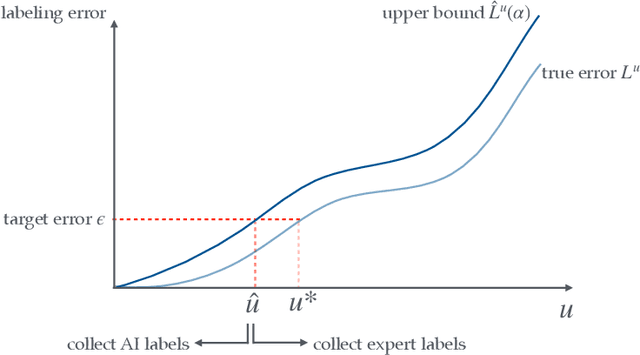
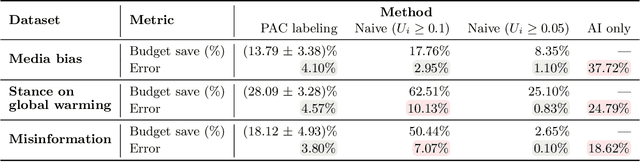
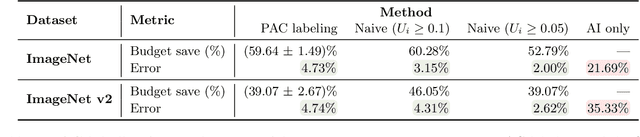
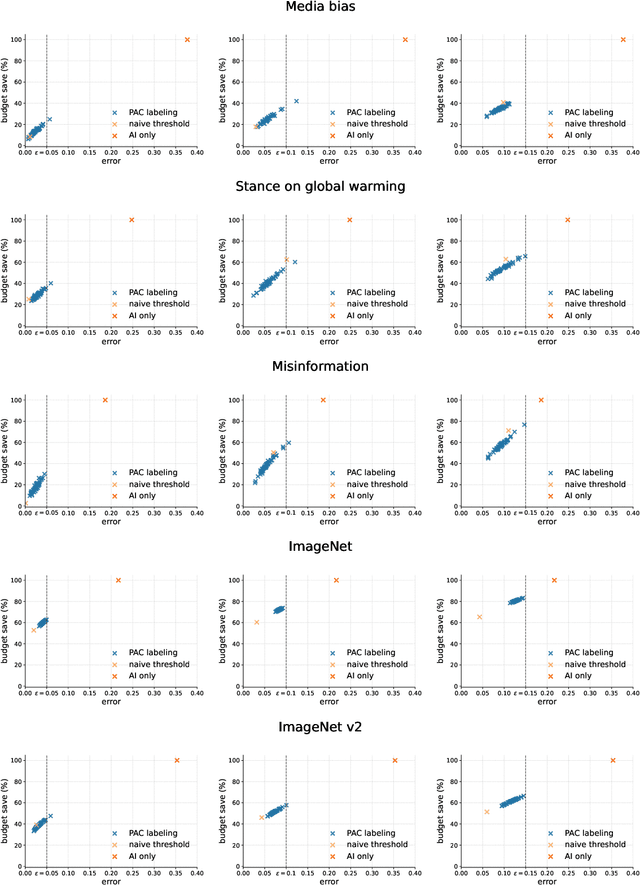
Obtaining high-quality labeled datasets is often costly, requiring either extensive human annotation or expensive experiments. We propose a method that supplements such "expert" labels with AI predictions from pre-trained models to construct labeled datasets more cost-effectively. Our approach results in probably approximately correct labels: with high probability, the overall labeling error is small. This solution enables rigorous yet efficient dataset curation using modern AI models. We demonstrate the benefits of the methodology through text annotation with large language models, image labeling with pre-trained vision models, and protein folding analysis with AlphaFold.
Posterior Conformal Prediction
Sep 29, 2024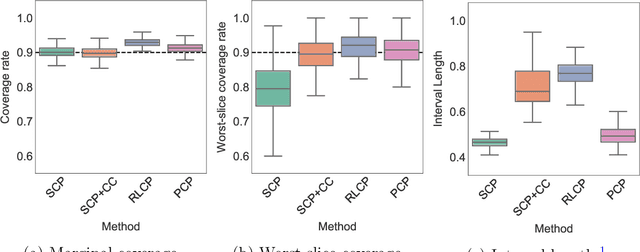
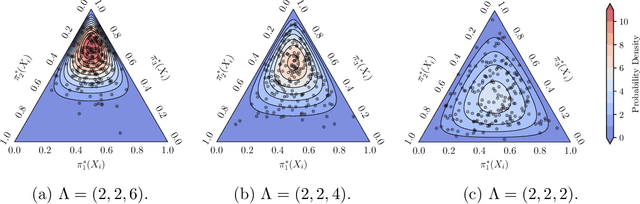
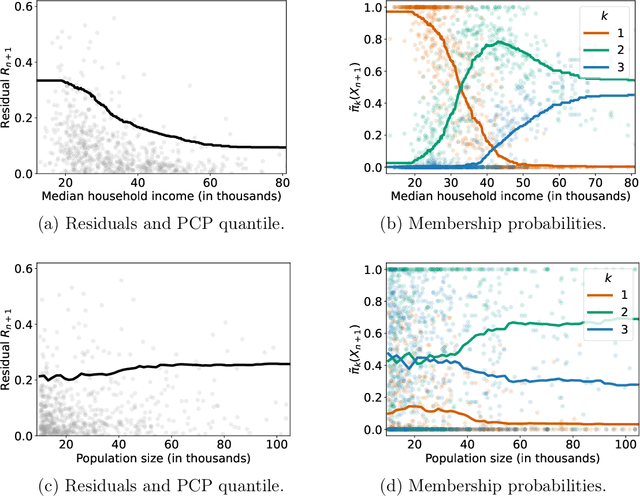
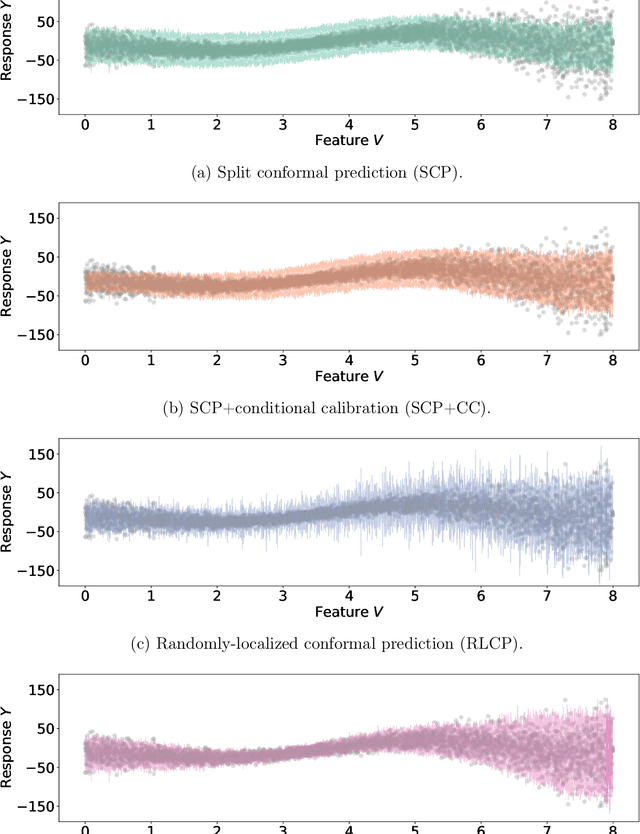
Conformal prediction is a popular technique for constructing prediction intervals with distribution-free coverage guarantees. The coverage is marginal, meaning it only holds on average over the entire population but not necessarily for any specific subgroup. This article introduces a new method, posterior conformal prediction (PCP), which generates prediction intervals with both marginal and approximate conditional validity for clusters (or subgroups) naturally discovered in the data. PCP achieves these guarantees by modelling the conditional conformity score distribution as a mixture of cluster distributions. Compared to other methods with approximate conditional validity, this approach produces tighter intervals, particularly when the test data is drawn from clusters that are well represented in the validation data. PCP can also be applied to guarantee conditional coverage on user-specified subgroups, in which case it achieves robust coverage on smaller subgroups within the specified subgroups. In classification, the theory underlying PCP allows for adjusting the coverage level based on the classifier's confidence, achieving significantly smaller sets than standard conformal prediction sets. We evaluate the performance of PCP on diverse datasets from socio-economic, scientific and healthcare applications.
RandALO: Out-of-sample risk estimation in no time flat
Sep 15, 2024Estimating out-of-sample risk for models trained on large high-dimensional datasets is an expensive but essential part of the machine learning process, enabling practitioners to optimally tune hyperparameters. Cross-validation (CV) serves as the de facto standard for risk estimation but poorly trades off high bias ($K$-fold CV) for computational cost (leave-one-out CV). We propose a randomized approximate leave-one-out (RandALO) risk estimator that is not only a consistent estimator of risk in high dimensions but also less computationally expensive than $K$-fold CV. We support our claims with extensive simulations on synthetic and real data and provide a user-friendly Python package implementing RandALO available on PyPI as randalo and at https://github.com/cvxgrp/randalo.
Can Unconfident LLM Annotations Be Used for Confident Conclusions?
Aug 27, 2024Large language models (LLMs) have shown high agreement with human raters across a variety of tasks, demonstrating potential to ease the challenges of human data collection. In computational social science (CSS), researchers are increasingly leveraging LLM annotations to complement slow and expensive human annotations. Still, guidelines for collecting and using LLM annotations, without compromising the validity of downstream conclusions, remain limited. We introduce Confidence-Driven Inference: a method that combines LLM annotations and LLM confidence indicators to strategically select which human annotations should be collected, with the goal of producing accurate statistical estimates and provably valid confidence intervals while reducing the number of human annotations needed. Our approach comes with safeguards against LLM annotations of poor quality, guaranteeing that the conclusions will be both valid and no less accurate than if we only relied on human annotations. We demonstrate the effectiveness of Confidence-Driven Inference over baselines in statistical estimation tasks across three CSS settings--text politeness, stance, and bias--reducing the needed number of human annotations by over 25% in each. Although we use CSS settings for demonstration, Confidence-Driven Inference can be used to estimate most standard quantities across a broad range of NLP problems.
Large language model validity via enhanced conformal prediction methods
Jun 14, 2024We develop new conformal inference methods for obtaining validity guarantees on the output of large language models (LLMs). Prior work in conformal language modeling identifies a subset of the text that satisfies a high-probability guarantee of correctness. These methods work by filtering claims from the LLM's original response if a scoring function evaluated on the claim fails to exceed a threshold calibrated via split conformal prediction. Existing methods in this area suffer from two deficiencies. First, the guarantee stated is not conditionally valid. The trustworthiness of the filtering step may vary based on the topic of the response. Second, because the scoring function is imperfect, the filtering step can remove many valuable and accurate claims. We address both of these challenges via two new conformal methods. First, we generalize the conditional conformal procedure of Gibbs et al. (2023) in order to adaptively issue weaker guarantees when they are required to preserve the utility of the output. Second, we show how to systematically improve the quality of the scoring function via a novel algorithm for differentiating through the conditional conformal procedure. We demonstrate the efficacy of our approach on both synthetic and real-world datasets.
Boosted Conformal Prediction Intervals
Jun 11, 2024This paper introduces a boosted conformal procedure designed to tailor conformalized prediction intervals toward specific desired properties, such as enhanced conditional coverage or reduced interval length. We employ machine learning techniques, notably gradient boosting, to systematically improve upon a predefined conformity score function. This process is guided by carefully constructed loss functions that measure the deviation of prediction intervals from the targeted properties. The procedure operates post-training, relying solely on model predictions and without modifying the trained model (e.g., the deep network). Systematic experiments demonstrate that starting from conventional conformal methods, our boosted procedure achieves substantial improvements in reducing interval length and decreasing deviation from target conditional coverage.