 Add to Chrome
 Add to Firefox
 Add to Edge
Word-order biases in deep-agent emergent communication
Jun 14, 2019
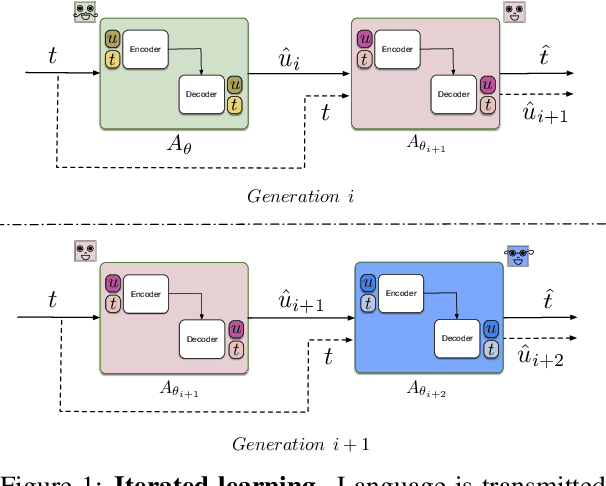
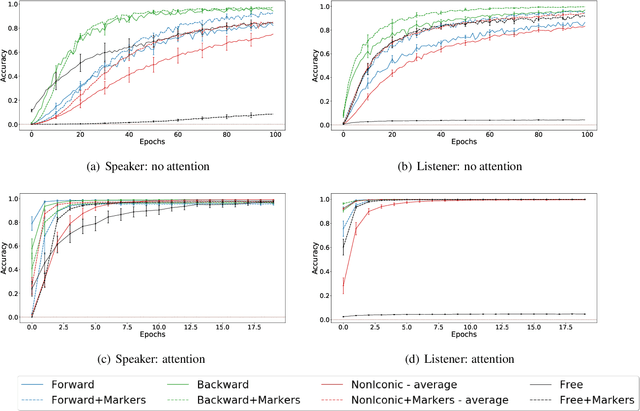
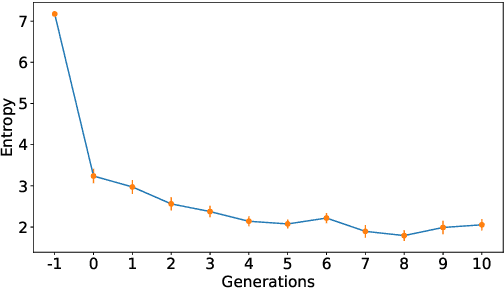
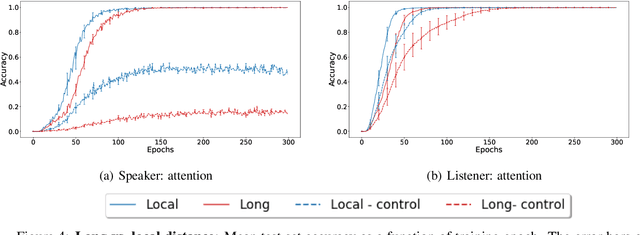
Sequence-processing neural networks led to remarkable progress on many NLP tasks. As a consequence, there has been increasing interest in understanding to what extent they process language as humans do. We aim here to uncover which biases such models display with respect to "natural" word-order constraints. We train models to communicate about paths in a simple gridworld, using miniature languages that reflect or violate various natural language trends, such as the tendency to avoid redundancy or to minimize long-distance dependencies. We study how the controlled characteristics of our miniature languages affect individual learning and their stability across multiple network generations. The results draw a mixed picture. On the one hand, neural networks show a strong tendency to avoid long-distance dependencies. On the other hand, there is no clear preference for the efficient, non-redundant encoding of information that is widely attested in natural language. We thus suggest inoculating a notion of "effort" into neural networks, as a possible way to make their linguistic behavior more human-like.

Anti-efficient encoding in emergent communication
Jun 13, 2019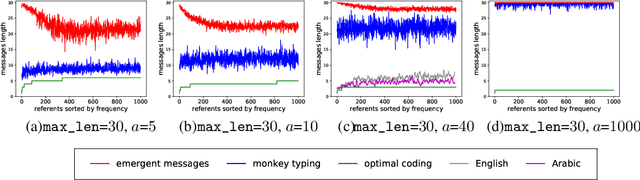
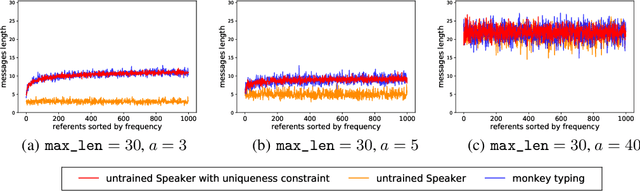
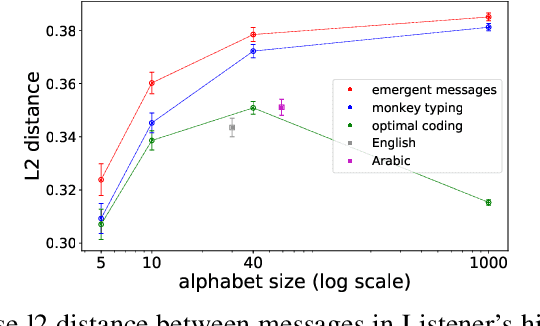
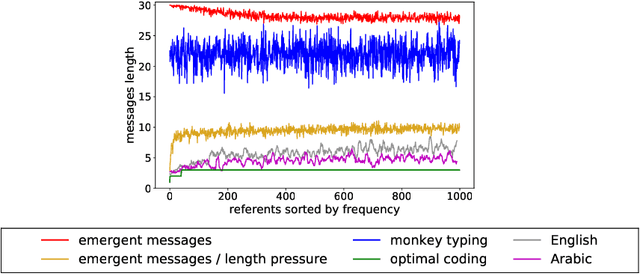
Despite renewed interest in emergent language simulations with neural networks, little is known about the basic properties of the induced code, and how they compare to human language. One fundamental characteristic of the latter, known as Zipf's Law of Abbreviation (ZLA), is that more frequent words are efficiently associated to shorter strings. We study whether the same pattern emerges when two neural networks, a "speaker" and a "listener", are trained to play a signaling game. Surprisingly, we find that networks develop an \emph{anti-efficient} encoding scheme, in which the most frequent inputs are associated to the longest messages, and messages in general are skewed towards the maximum length threshold. This anti-efficient code appears easier to discriminate for the listener, and, unlike in human communication, the speaker does not impose a contrasting least-effort pressure towards brevity. Indeed, when the cost function includes a penalty for longer messages, the resulting message distribution starts respecting ZLA. Our analysis stresses the importance of studying the basic features of emergent communication in a highly controlled setup, to ensure the latter will not strand too far from human language. Moreover, we present a concrete illustration of how different functional pressures can lead to successful communication codes that lack basic properties of human language, thus highlighting the role such pressures play in the latter.
The Zero Resource Speech Challenge 2019: TTS without T
Apr 25, 2019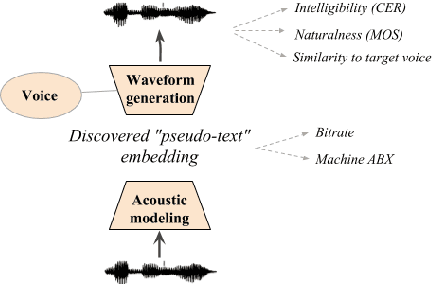
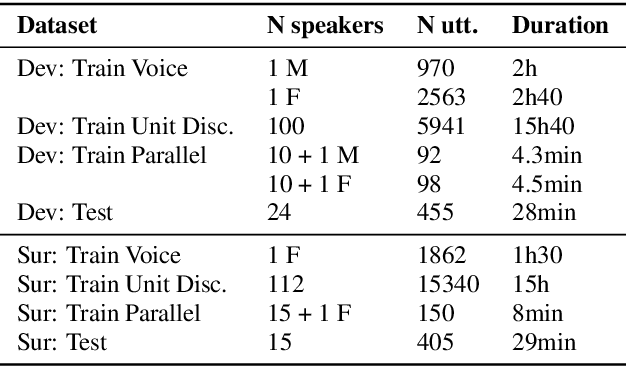
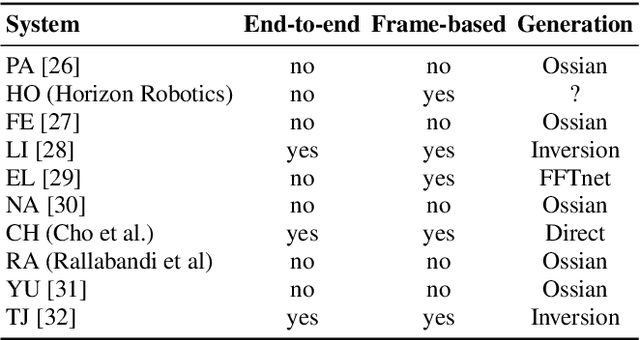
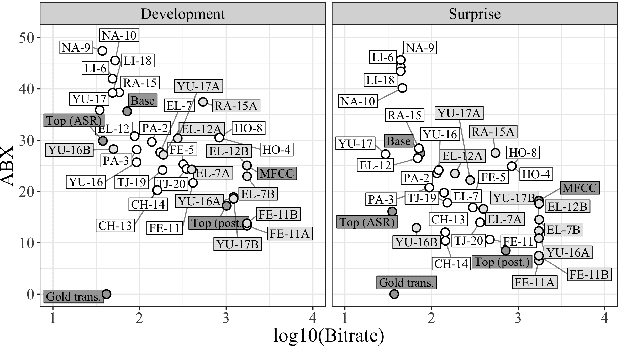
We present the Zero Resource Speech Challenge 2019, which proposes to build a speech synthesizer without any text or phonetic labels: hence, TTS without T (text-to-speech without text). We provide raw audio for a target voice in an unknown language (the Voice dataset), but no alignment, text or labels. Participants must discover subword units in an unsupervised way (using the Unit Discovery dataset) and align them to the voice recordings in a way that works best for the purpose of synthesizing novel utterances from novel speakers, similar to the target speaker's voice. We describe the metrics used for evaluation, a baseline system consisting of unsupervised subword unit discovery plus a standard TTS system, and a topline TTS using gold phoneme transcriptions. We present an overview of the 19 submitted systems from 11 teams and discuss the main results.
Sampling strategies in Siamese Networks for unsupervised speech representation learning
Aug 23, 2018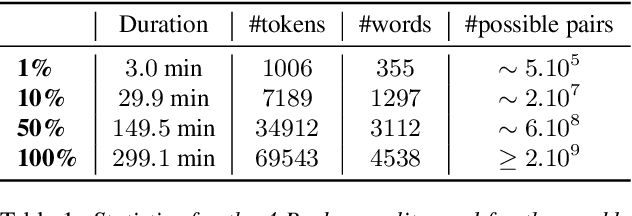
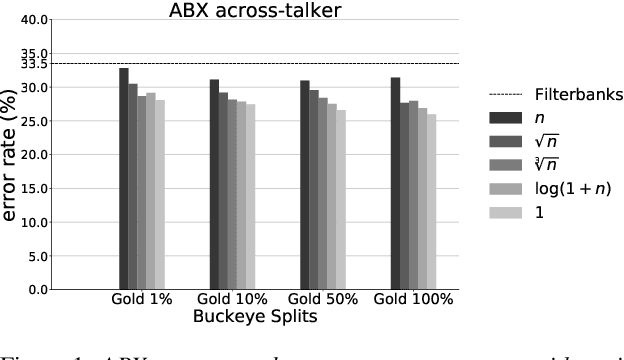
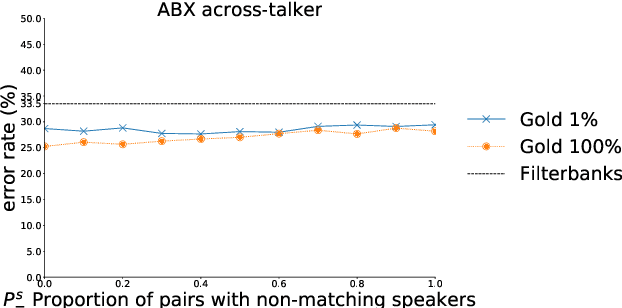
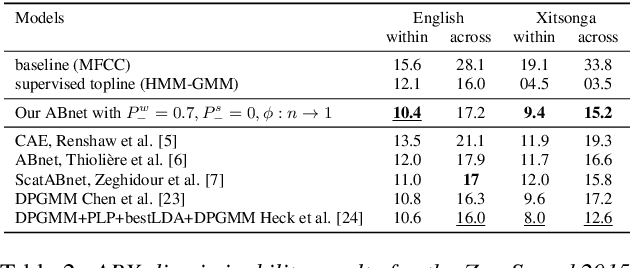
Recent studies have investigated siamese network architectures for learning invariant speech representations using same-different side information at the word level. Here we investigate systematically an often ignored component of siamese networks: the sampling procedure (how pairs of same vs. different tokens are selected). We show that sampling strategies taking into account Zipf's Law, the distribution of speakers and the proportions of same and different pairs of words significantly impact the performance of the network. In particular, we show that word frequency compression improves learning across a large range of variations in number of training pairs. This effect does not apply to the same extent to the fully unsupervised setting, where the pairs of same-different words are obtained by spoken term discovery. We apply these results to pairs of words discovered using an unsupervised algorithm and show an improvement on state-of-the-art in unsupervised representation learning using siamese networks.
IntPhys: A Framework and Benchmark for Visual Intuitive Physics Reasoning
Jun 26, 2018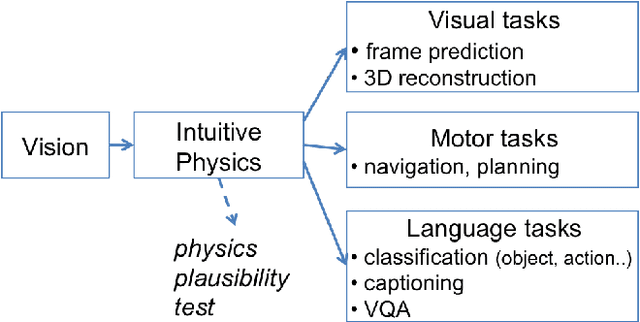
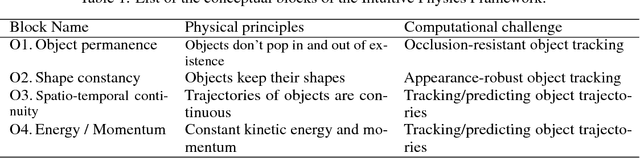
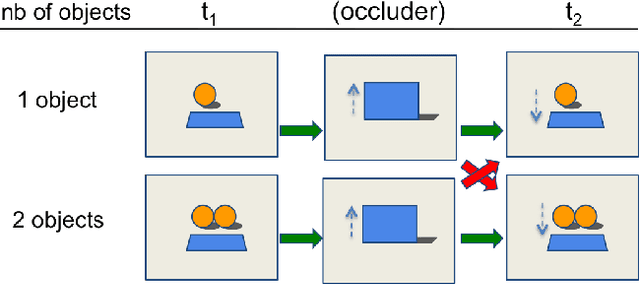
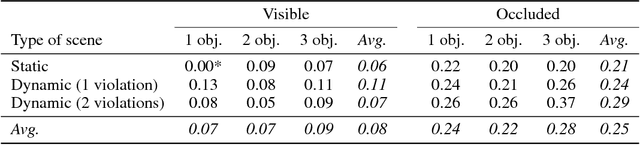
In order to reach human performance on complex visual tasks, artificial systems need to incorporate a significant amount of understanding of the world in terms of macroscopic objects, movements, forces, etc. Inspired by work on intuitive physics in infants, we propose an evaluation framework which diagnoses how much a given system understands about physics by testing whether it can tell apart well matched videos of possible versus impossible events. The test requires systems to compute a physical plausibility score over an entire video. It is free of bias and can test a range of specific physical reasoning skills. We then describe the first release of a benchmark dataset aimed at learning intuitive physics in an unsupervised way, using videos constructed with a game engine. We describe two Deep Neural Network baseline systems trained with a future frame prediction objective and tested on the possible versus impossible discrimination task. The analysis of their results compared to human data gives novel insights in the potentials and limitations of next frame prediction architectures.
End-to-End Speech Recognition From the Raw Waveform
Jun 21, 2018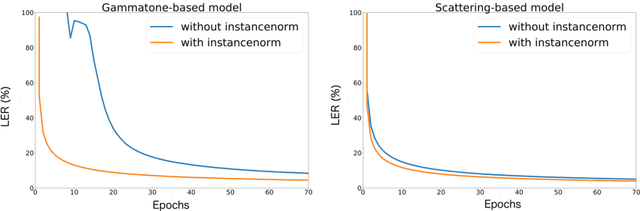
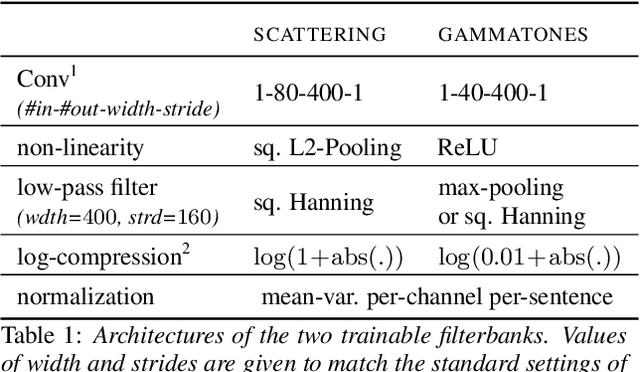
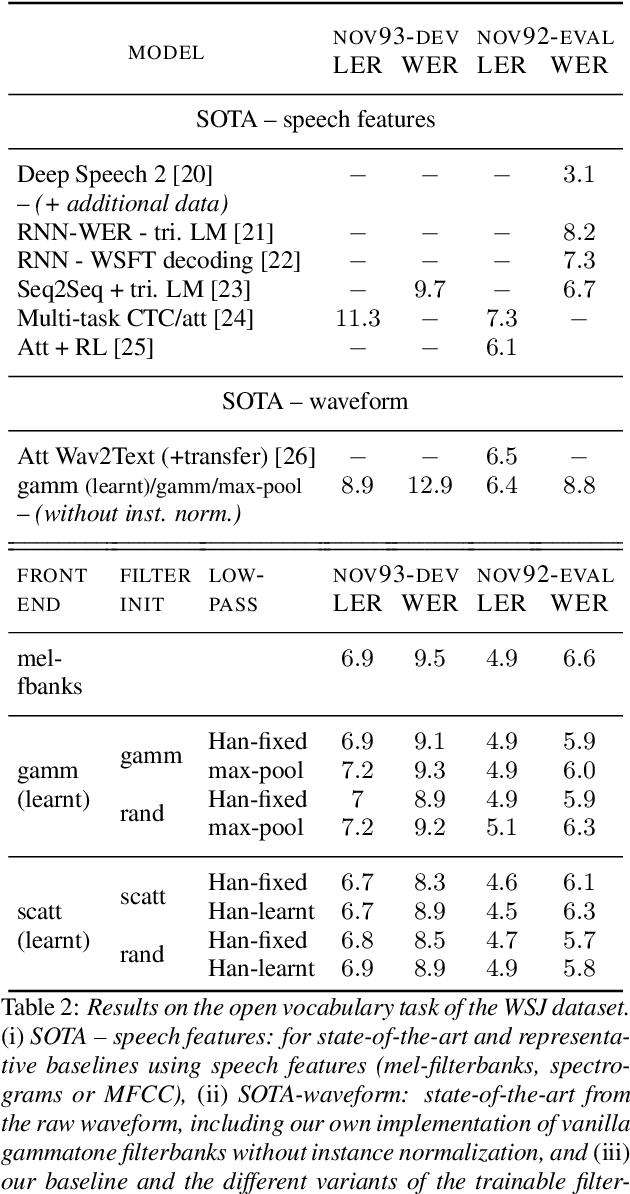
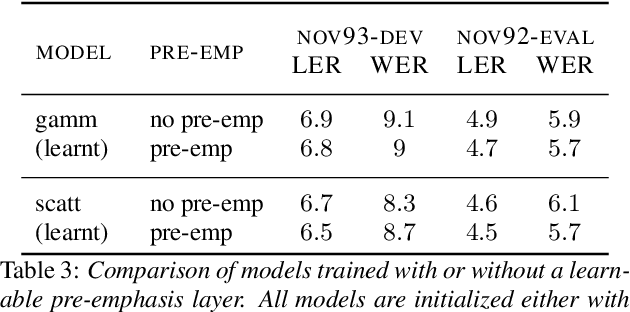
State-of-the-art speech recognition systems rely on fixed, hand-crafted features such as mel-filterbanks to preprocess the waveform before the training pipeline. In this paper, we study end-to-end systems trained directly from the raw waveform, building on two alternatives for trainable replacements of mel-filterbanks that use a convolutional architecture. The first one is inspired by gammatone filterbanks (Hoshen et al., 2015; Sainath et al, 2015), and the second one by the scattering transform (Zeghidour et al., 2017). We propose two modifications to these architectures and systematically compare them to mel-filterbanks, on the Wall Street Journal dataset. The first modification is the addition of an instance normalization layer, which greatly improves on the gammatone-based trainable filterbanks and speeds up the training of the scattering-based filterbanks. The second one relates to the low-pass filter used in these approaches. These modifications consistently improve performances for both approaches, and remove the need for a careful initialization in scattering-based trainable filterbanks. In particular, we show a consistent improvement in word error rate of the trainable filterbanks relatively to comparable mel-filterbanks. It is the first time end-to-end models trained from the raw signal significantly outperform mel-filterbanks on a large vocabulary task under clean recording conditions.
Learning Filterbanks from Raw Speech for Phone Recognition
Apr 04, 2018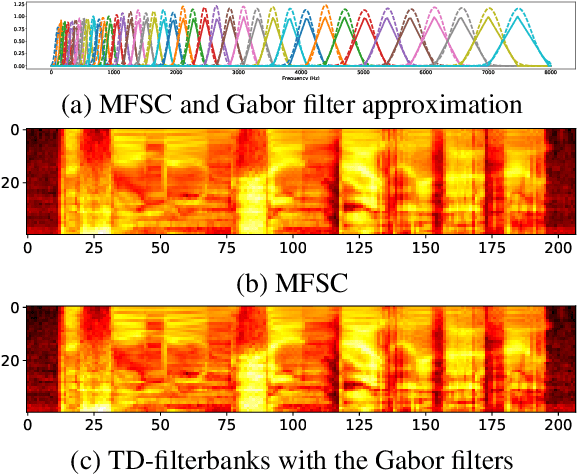
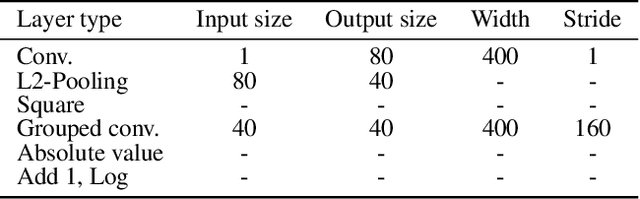
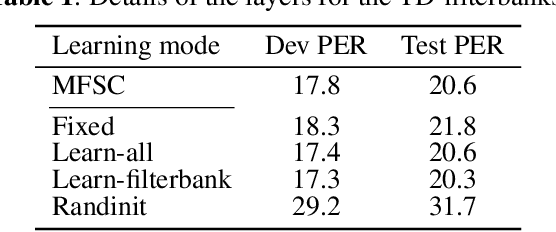
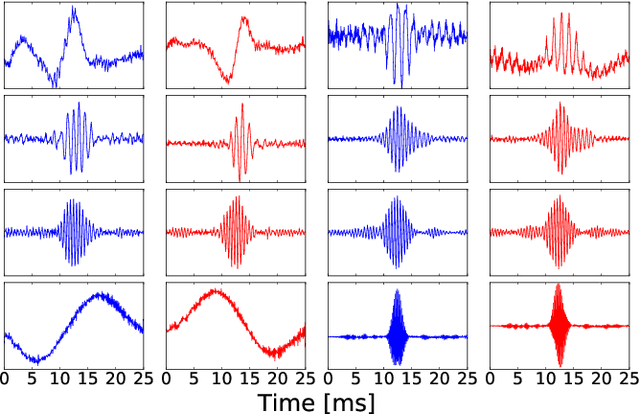
We train a bank of complex filters that operates on the raw waveform and is fed into a convolutional neural network for end-to-end phone recognition. These time-domain filterbanks (TD-filterbanks) are initialized as an approximation of mel-filterbanks, and then fine-tuned jointly with the remaining convolutional architecture. We perform phone recognition experiments on TIMIT and show that for several architectures, models trained on TD-filterbanks consistently outperform their counterparts trained on comparable mel-filterbanks. We get our best performance by learning all front-end steps, from pre-emphasis up to averaging. Finally, we observe that the filters at convergence have an asymmetric impulse response, and that some of them remain almost analytic.
Bayesian Models for Unit Discovery on a Very Low Resource Language
Feb 20, 2018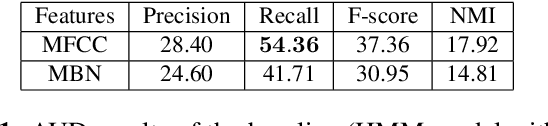
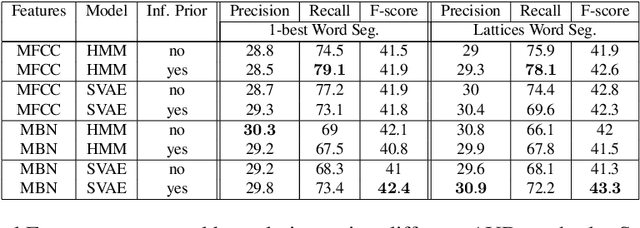
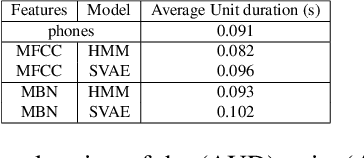
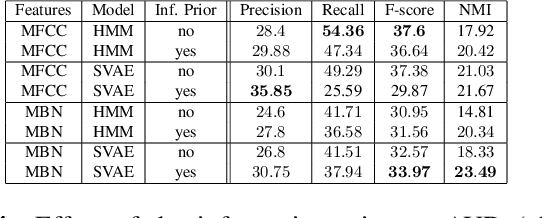
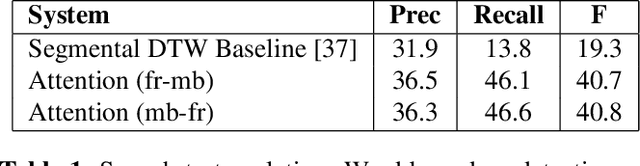
Developing speech technologies for low-resource languages has become a very active research field over the last decade. Among others, Bayesian models have shown some promising results on artificial examples but still lack of in situ experiments. Our work applies state-of-the-art Bayesian models to unsupervised Acoustic Unit Discovery (AUD) in a real low-resource language scenario. We also show that Bayesian models can naturally integrate information from other resourceful languages by means of informative prior leading to more consistent discovered units. Finally, discovered acoustic units are used, either as the 1-best sequence or as a lattice, to perform word segmentation. Word segmentation results show that this Bayesian approach clearly outperforms a Segmental-DTW baseline on the same corpus.
Cognitive Science in the era of Artificial Intelligence: A roadmap for reverse-engineering the infant language-learner
Feb 14, 2018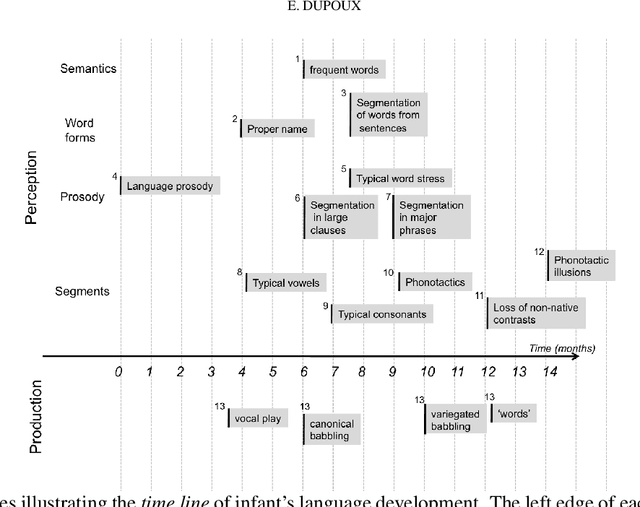
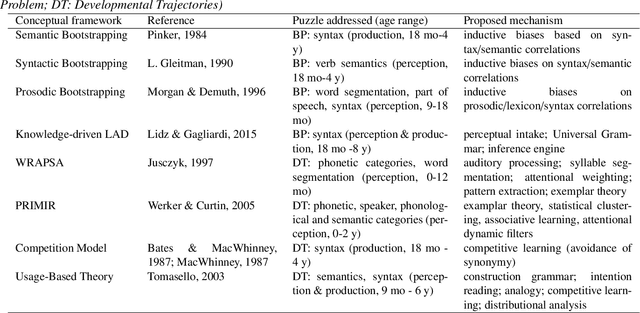
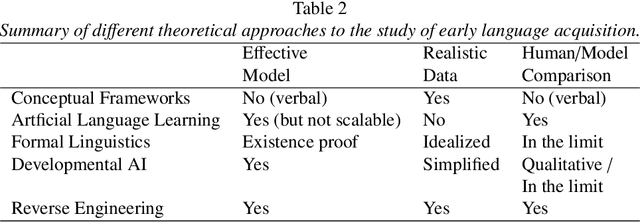
During their first years of life, infants learn the language(s) of their environment at an amazing speed despite large cross cultural variations in amount and complexity of the available language input. Understanding this simple fact still escapes current cognitive and linguistic theories. Recently, spectacular progress in the engineering science, notably, machine learning and wearable technology, offer the promise of revolutionizing the study of cognitive development. Machine learning offers powerful learning algorithms that can achieve human-like performance on many linguistic tasks. Wearable sensors can capture vast amounts of data, which enable the reconstruction of the sensory experience of infants in their natural environment. The project of 'reverse engineering' language development, i.e., of building an effective system that mimics infant's achievements appears therefore to be within reach. Here, we analyze the conditions under which such a project can contribute to our scientific understanding of early language development. We argue that instead of defining a sub-problem or simplifying the data, computational models should address the full complexity of the learning situation, and take as input the raw sensory signals available to infants. This implies that (1) accessible but privacy-preserving repositories of home data be setup and widely shared, and (2) models be evaluated at different linguistic levels through a benchmark of psycholinguist tests that can be passed by machines and humans alike, (3) linguistically and psychologically plausible learning architectures be scaled up to real data using probabilistic/optimization principles from machine learning. We discuss the feasibility of this approach and present preliminary results.
* 27 pages, 5 figures, 3 tables, supplementary materials
Linguistic unit discovery from multi-modal inputs in unwritten languages: Summary of the "Speaking Rosetta" JSALT 2017 Workshop
Feb 14, 2018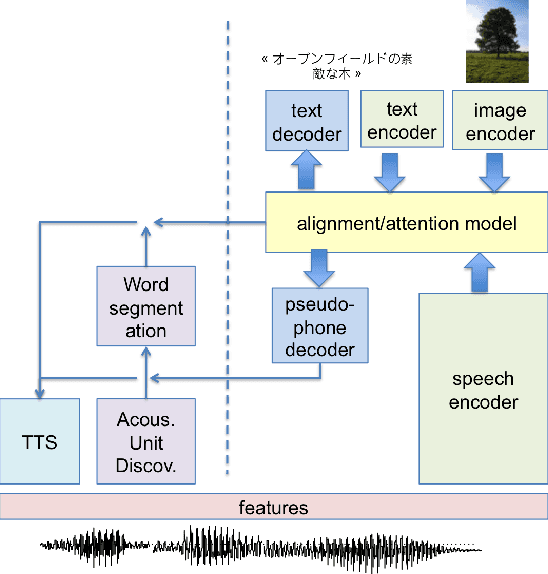
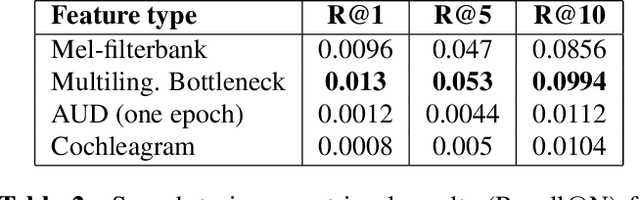
We summarize the accomplishments of a multi-disciplinary workshop exploring the computational and scientific issues surrounding the discovery of linguistic units (subwords and words) in a language without orthography. We study the replacement of orthographic transcriptions by images and/or translated text in a well-resourced language to help unsupervised discovery from raw speech.