 Add to Chrome
 Add to Firefox
 Add to Edge
$k$-server-bench: Automating Potential Discovery for the $k$-Server Conjecture
Apr 08, 2026
We introduce a code-based challenge for automated, open-ended mathematical discovery based on the $k$-server conjecture, a central open problem in competitive analysis. The task is to discover a potential function satisfying a large graph-structured system of simple linear inequalities. The resulting evaluation procedure is sound but incomplete: any violated inequality definitively refutes a candidate, whereas satisfying all inequalities does not by itself constitute a proof of the corresponding conjecture's special case. Nevertheless, a candidate that passes all constraints would be strong evidence toward a valid proof and, to the best of our knowledge, no currently known potential achieves this under our formulation in the open $k=4$ circle case. As such, a successful candidate would already be an interesting contribution to the $k$-server conjecture, and could become a substantial theoretical result when paired with a full proof. Experiments on the resolved $k=3$ regime show that current agentic methods can solve nontrivial instances, and in the open $k=4$ regime they reduce the number of violations relative to existing potentials without fully resolving the task. Taken together, these results suggest that the task is challenging but plausibly within reach of current methods. Beyond its relevance to the $k$-server community, where the developed tooling enables researchers to test new hypotheses and potentially improve on the current record, the task also serves as a useful \emph{benchmark} for developing code-based discovery agents. In particular, our $k=3$ results show that it mitigates important limitations of existing open-ended code-based benchmarks, including early saturation and the weak separation between naive random baselines and more sophisticated methods.

ODySSeI: An Open-Source End-to-End Framework for Automated Detection, Segmentation, and Severity Estimation of Lesions in Invasive Coronary Angiography Images
Mar 20, 2026Invasive Coronary Angiography (ICA) is the clinical gold standard for the assessment of coronary artery disease. However, its interpretation remains subjective and prone to intra- and inter-operator variability. In this work, we introduce ODySSeI: an Open-source end-to-end framework for automated Detection, Segmentation, and Severity estimation of lesions in ICA images. ODySSeI integrates deep learning-based lesion detection and lesion segmentation models trained using a novel Pyramidal Augmentation Scheme (PAS) to enhance robustness and real-time performance across diverse patient cohorts (2149 patients from Europe, North America, and Asia). Furthermore, we propose a quantitative coronary angiography-free Lesion Severity Estimation (LSE) technique that directly computes the Minimum Lumen Diameter (MLD) and diameter stenosis from the predicted lesion geometry. Extensive evaluation on both in-distribution and out-of-distribution clinical datasets demonstrates ODySSeI's strong generalizability. Our PAS yields large performance gains in highly complex tasks as compared to relatively simpler ones, notably, a 2.5-fold increase in lesion detection performance versus a 1-3\% increase in lesion segmentation performance over their respective baselines. Our LSE technique achieves high accuracy, with predicted MLD values differing by only $\pm$ 2-3 pixels from the corresponding ground truths. On average, ODySSeI processes a raw ICA image within only a few seconds on a CPU and in a fraction of a second on a GPU and is available as a plug-and-play web interface at swisscardia.epfl.ch. Overall, this work establishes ODySSeI as a comprehensive and open-source framework which supports automated, reproducible, and scalable ICA analysis for real-time clinical decision-making.
CM-UNet: A Self-Supervised Learning-Based Model for Coronary Artery Segmentation in X-Ray Angiography
Jul 22, 2025Accurate segmentation of coronary arteries remains a significant challenge in clinical practice, hindering the ability to effectively diagnose and manage coronary artery disease. The lack of large, annotated datasets for model training exacerbates this issue, limiting the development of automated tools that could assist radiologists. To address this, we introduce CM-UNet, which leverages self-supervised pre-training on unannotated datasets and transfer learning on limited annotated data, enabling accurate disease detection while minimizing the need for extensive manual annotations. Fine-tuning CM-UNet with only 18 annotated images instead of 500 resulted in a 15.2% decrease in Dice score, compared to a 46.5% drop in baseline models without pre-training. This demonstrates that self-supervised learning can enhance segmentation performance and reduce dependence on large datasets. This is one of the first studies to highlight the importance of self-supervised learning in improving coronary artery segmentation from X-ray angiography, with potential implications for advancing diagnostic accuracy in clinical practice. By enhancing segmentation accuracy in X-ray angiography images, the proposed approach aims to improve clinical workflows, reduce radiologists' workload, and accelerate disease detection, ultimately contributing to better patient outcomes. The source code is publicly available at https://github.com/CamilleChallier/Contrastive-Masked-UNet.
Boolformer: Symbolic Regression of Logic Functions with Transformers
Sep 21, 2023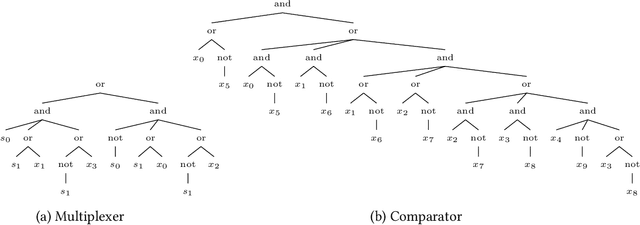

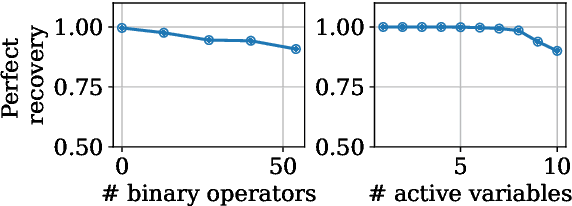
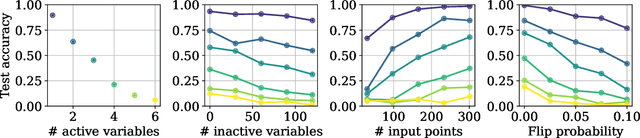
In this work, we introduce Boolformer, the first Transformer architecture trained to perform end-to-end symbolic regression of Boolean functions. First, we show that it can predict compact formulas for complex functions which were not seen during training, when provided a clean truth table. Then, we demonstrate its ability to find approximate expressions when provided incomplete and noisy observations. We evaluate the Boolformer on a broad set of real-world binary classification datasets, demonstrating its potential as an interpretable alternative to classic machine learning methods. Finally, we apply it to the widespread task of modelling the dynamics of gene regulatory networks. Using a recent benchmark, we show that Boolformer is competitive with state-of-the art genetic algorithms with a speedup of several orders of magnitude. Our code and models are available publicly.