 Add to Chrome
 Add to Firefox
 Add to Edge
$k$-server-bench: Automating Potential Discovery for the $k$-Server Conjecture
Apr 08, 2026
We introduce a code-based challenge for automated, open-ended mathematical discovery based on the $k$-server conjecture, a central open problem in competitive analysis. The task is to discover a potential function satisfying a large graph-structured system of simple linear inequalities. The resulting evaluation procedure is sound but incomplete: any violated inequality definitively refutes a candidate, whereas satisfying all inequalities does not by itself constitute a proof of the corresponding conjecture's special case. Nevertheless, a candidate that passes all constraints would be strong evidence toward a valid proof and, to the best of our knowledge, no currently known potential achieves this under our formulation in the open $k=4$ circle case. As such, a successful candidate would already be an interesting contribution to the $k$-server conjecture, and could become a substantial theoretical result when paired with a full proof. Experiments on the resolved $k=3$ regime show that current agentic methods can solve nontrivial instances, and in the open $k=4$ regime they reduce the number of violations relative to existing potentials without fully resolving the task. Taken together, these results suggest that the task is challenging but plausibly within reach of current methods. Beyond its relevance to the $k$-server community, where the developed tooling enables researchers to test new hypotheses and potentially improve on the current record, the task also serves as a useful \emph{benchmark} for developing code-based discovery agents. In particular, our $k=3$ results show that it mitigates important limitations of existing open-ended code-based benchmarks, including early saturation and the weak separation between naive random baselines and more sophisticated methods.

Is Value Functions Estimation with Classification Plug-and-play for Offline Reinforcement Learning?
Jun 10, 2024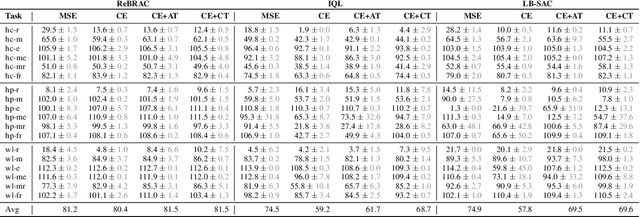
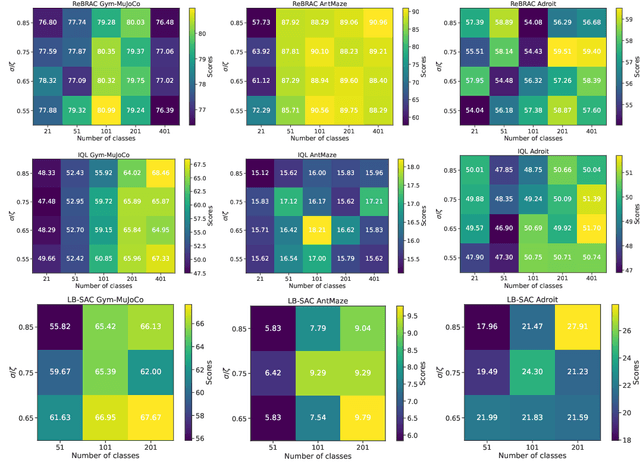


In deep Reinforcement Learning (RL), value functions are typically approximated using deep neural networks and trained via mean squared error regression objectives to fit the true value functions. Recent research has proposed an alternative approach, utilizing the cross-entropy classification objective, which has demonstrated improved performance and scalability of RL algorithms. However, existing study have not extensively benchmarked the effects of this replacement across various domains, as the primary objective was to demonstrate the efficacy of the concept across a broad spectrum of tasks, without delving into in-depth analysis. Our work seeks to empirically investigate the impact of such a replacement in an offline RL setup and analyze the effects of different aspects on performance. Through large-scale experiments conducted across a diverse range of tasks using different algorithms, we aim to gain deeper insights into the implications of this approach. Our results reveal that incorporating this change can lead to superior performance over state-of-the-art solutions for some algorithms in certain tasks, while maintaining comparable performance levels in other tasks, however for other algorithms this modification might lead to the dramatic performance drop. This findings are crucial for further application of classification approach in research and practical tasks.