 Add to Chrome
 Add to Firefox
 Add to Edge
Gemini Embedding 2: A Native Multimodal Embedding Model from Gemini
May 26, 2026
We introduce Gemini Embedding 2, a native multimodal embedding model that allows embedding video, audio, image, and text modalities in a unified representation space. We leverage the multimodal capabilities of Gemini to produce embeddings for arbitrary combinations of interleaved inputs across all these modalities that generalize well across a wide variety of tasks. Applying large-scale contrastive learning in a multi-task multi-stage training setup, we achieve state-of-the-art performance on key embedding benchmarks including unimodal, cross-modal, and multimodal retrieval spanning a diverse set of tasks. We show that our embedding model demonstrates strong performance (with a score of 62.9 R@1 on MSCOCO, 68.8 NDCG@10 on Vatex, 69.9 on MTEB multilingual and 84.0 on MTEB Code) across a variety of tasks surpassing the performance of specialized models. These unified capabilities make Gemini Embedding 2 a promising candidate for downstream use cases such as RAG, recommendation and search. Furthermore, its robust zero-shot performance across distinct fields - from astronomy and bioscience to fine arts and the culinary arts - establishes it as a highly reliable, out-of-the-box representation even for specialized domains.

LLMs generate structurally realistic social networks but overestimate political homophily
Aug 29, 2024


Generating social networks is essential for many applications, such as epidemic modeling and social simulations. Prior approaches either involve deep learning models, which require many observed networks for training, or stylized models, which are limited in their realism and flexibility. In contrast, LLMs offer the potential for zero-shot and flexible network generation. However, two key questions are: (1) are LLM's generated networks realistic, and (2) what are risks of bias, given the importance of demographics in forming social ties? To answer these questions, we develop three prompting methods for network generation and compare the generated networks to real social networks. We find that more realistic networks are generated with "local" methods, where the LLM constructs relations for one persona at a time, compared to "global" methods that construct the entire network at once. We also find that the generated networks match real networks on many characteristics, including density, clustering, community structure, and degree. However, we find that LLMs emphasize political homophily over all other types of homophily and overestimate political homophily relative to real-world measures.
Gemma 2: Improving Open Language Models at a Practical Size
Aug 02, 2024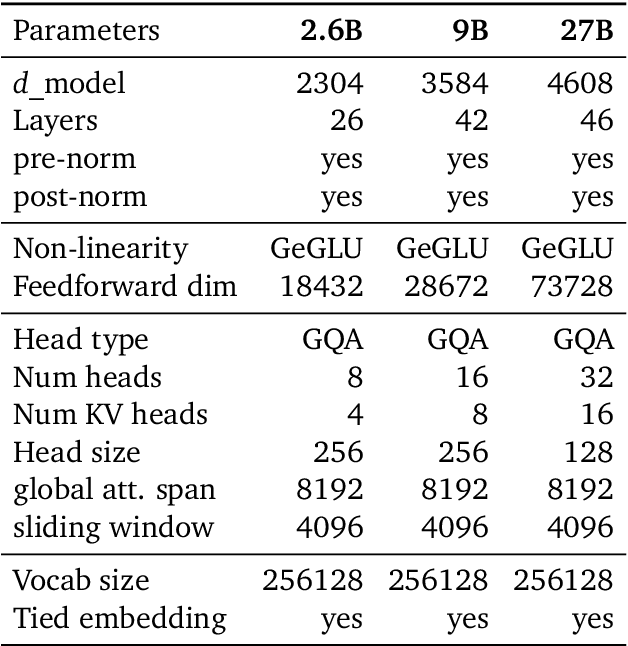
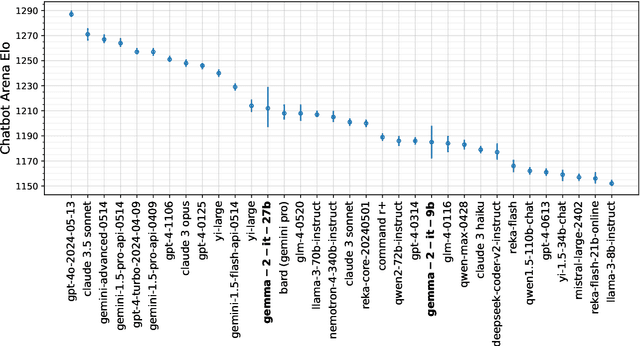
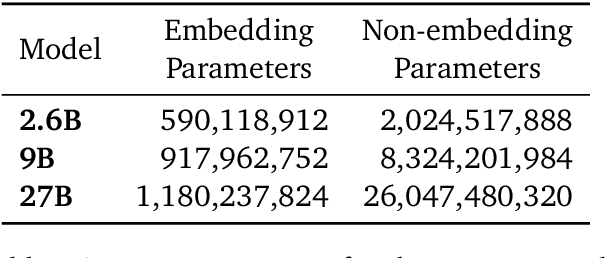
In this work, we introduce Gemma 2, a new addition to the Gemma family of lightweight, state-of-the-art open models, ranging in scale from 2 billion to 27 billion parameters. In this new version, we apply several known technical modifications to the Transformer architecture, such as interleaving local-global attentions (Beltagy et al., 2020a) and group-query attention (Ainslie et al., 2023). We also train the 2B and 9B models with knowledge distillation (Hinton et al., 2015) instead of next token prediction. The resulting models deliver the best performance for their size, and even offer competitive alternatives to models that are 2-3 times bigger. We release all our models to the community.