 Add to Chrome
 Add to Firefox
 Add to Edge
Structural Kolmogorov-Arnold Convolutions: Learnable Function on the Values or the Filter Shape as Parameter-Efficient Alternative to Per-Edge Convolutional KANs
Jun 23, 2026
Convolutional Kolmogorov--Arnold Networks (KANs) replace the fixed weights of a convolutional kernel with learnable univariate functions. The dominant formulation attaches one such function to every kernel entry and lets it act on pixel values, expressive but parameter-heavy and prone to overfitting. We argue that the learnable functions are better placed in the \emph{structure} of the convolution than on each edge, and we organise the design space along a single axis: whether the function acts on the pixel \emph{values} or on the filter \emph{shape}. We study three realisations. SV-KAN applies one shared univariate function to the values and leaves the spatial filter free and static, aa classical convolution with a single learnable shared activation. AG-KAN keeps the shared value function but supplies the spatial structure through a content-adaptive Gaussian gate. RF-KAN instead moves the learnable functions onto the filter shape, building each filter from oriented ridge profiles expanded in a localised oscillatory (Morlet) wavelet basis with content-adaptive amplitudes. Under a matched four-layer protocol with in-run references and three seeds, RF-KAN and SV-KAN reach $88.47\pm0.10\%$ and $88.20\pm0.31\%$ on CIFAR-10 and $64.40\pm0.19\%$ and $64.57\pm0.30\%$ on CIFAR-100, at about $0.4$M parameters. At this matched scale the shape model and the simplest value model meet at the top, both above a plain convolution and every per-edge KAN we tested, including the official Gram variant, at roughly a fifth of the parameters. A controlled study attributes the RF-KAN gain to an intrinsically localised oscillatory basis and to content adaptivity, and an ablation that removes the learned shape entirely, leaving only the shared value function, collapses accuracy by over forty points, identifying the learned shape as the load-bearing ingredient at this scale.

Time series Foundation Models based on Physics-Informed Synthetic Histories for Cold-Start Photovoltaic Forecasting
Jun 05, 2026At commissioning time, Photovoltaic (PV) operators must forecast production before target-site observations are available, limiting the direct use of standard supervised forecasters. This cold-start setting is addressed with a zero-shot pipeline that generates a synthetic production history from plant metadata and meteorological covariates, enabling time-series foundation models (TSFMs) to forecast through inference-time conditioning. Five TSFMs are benchmarked against classical baselines under strict Cold-Start Baseline, Real Feedback, and Self-Forecast Feedback strategies. The evaluation spans $440$ PV sites across four datasets and diverse climate regimes. Covariate-aware foundation models outperform baselines by approximately $1.7-2\times$: TabPFN-TS achieves the lowest error under Real Feedback (MAE $0.514$, RMSE $0.721$ $kWh$ ${kWp}^{-1}$ ${d}^{-1}$), while Chronos-2 is most robust under Self-Forecast Feedback. Performance is largely insensitive to the synthetic-history source, indicating that accuracy is driven more by the availability of plausible temporal context than by the specific generator.
EEG2Vision: A Multimodal EEG-Based Framework for 2D Visual Reconstruction in Cognitive Neuroscience
Apr 09, 2026Reconstructing visual stimuli from non-invasive electroencephalography (EEG) remains challenging due to its low spatial resolution and high noise, particularly under realistic low-density electrode configurations. To address this, we present EEG2Vision, a modular, end-to-end EEG-to-image framework that systematically evaluates reconstruction performance across different EEG resolutions (128, 64, 32, and 24 channels) and enhances visual quality through a prompt-guided post-reconstruction boosting mechanism. Starting from EEG-conditioned diffusion reconstruction, the boosting stage uses a multimodal large language model to extract semantic descriptions and leverages image-to-image diffusion to refine geometry and perceptual coherence while preserving EEG-grounded structure. Our experiments show that semantic decoding accuracy degrades significantly with channel reduction (e.g., 50-way Top-1 Acc from 89% to 38%), while reconstruction quality slight decreases (e.g., FID from 76.77 to 80.51). The proposed boosting consistently improves perceptual metrics across all configurations, achieving up to 9.71% IS gains in low-channel settings. A user study confirms the clear perceptual preference for boosted reconstructions. The proposed approach significantly boosts the feasibility of real-time brain-2-image applications using low-resolution EEG devices, potentially unlocking this type of applications outside laboratory settings.
Brain3D: EEG-to-3D Decoding of Visual Representations via Multimodal Reasoning
Apr 09, 2026Decoding visual information from electroencephalography (EEG) has recently achieved promising results, primarily focusing on reconstructing two-dimensional (2D) images from brain activity. However, the reconstruction of three-dimensional (3D) representations remains largely unexplored. This limits the geometric understanding and reduces the applicability of neural decoding in different contexts. To address this gap, we propose Brain3D, a multimodal architecture for EEG-to-3D reconstruction based on EEG-to-image decoding. It progressively transforms neural representations into the 3D domain using geometry-aware generative reasoning. Our pipeline first produces visually grounded images from EEG signals, then employs a multimodal large language model to extract structured 3D-aware descriptions, which guide a diffusion-based generation stage whose outputs are finally converted into coherent 3D meshes via a single-image-to-3D model. By decomposing the problem into structured stages, the proposed approach avoids direct EEG-to-3D mappings and enables scalable brain-driven 3D generation. We conduct a comprehensive evaluation comparing the reconstructed 3D outputs against the original visual stimuli, assessing both semantic alignment and geometric fidelity. Experimental results demonstrate strong performance of the proposed architecture, achieving up to 85.4% 10-way Top-1 EEG decoding accuracy and 0.648 CLIPScore, supporting the feasibility of multimodal EEG-driven 3D reconstruction.
ENEIDE: A High Quality Silver Standard Dataset for Named Entity Recognition and Linking in Historical Italian
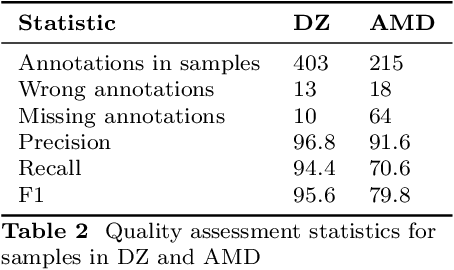
Mar 31, 2026This paper introduces ENEIDE (Extracting Named Entities from Italian Digital Editions), a silver standard dataset for Named Entity Recognition and Linking (NERL) in historical Italian texts. The corpus comprises 2,111 documents with over 8,000 entity annotations semi-automatically extracted from two scholarly digital editions: Digital Zibaldone, the philosophical diary of the Italian poet Giacomo Leopardi (1798--1837), and Aldo Moro Digitale, the complete works of the Italian politician Aldo Moro (1916--1978). Annotations cover multiple entity types (person, location, organization, literary work) linked to Wikidata identifiers, including NIL entities that cannot be mapped to the knowledge graph. To the best of our knowledge, ENEIDE represents the first multi-domain, publicly available NERL dataset for historical Italian with training, development, and test splits. We present a methodology for semi-automatic annotations extraction from manually curated scholarly digital editions, including quality control and annotation enhancement procedures. Baseline experiments using state-of-the-art models demonstrate the dataset's challenge for NERL and the gap between zero-shot approaches and fine-tuned models. The dataset's diachronic coverage spanning two centuries makes it particularly suitable for temporal entity disambiguation and cross-domain evaluation. ENEIDE is released under a CC BY-NC-SA 4.0 license.
DELICATE: Diachronic Entity LInking using Classes And Temporal Evidence
Nov 13, 2025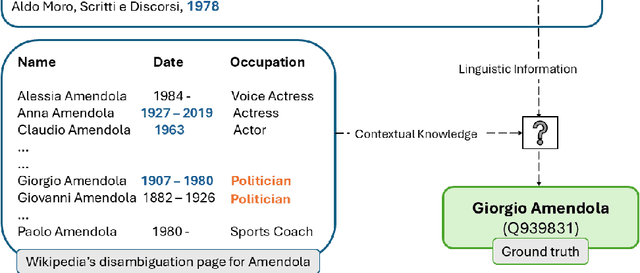
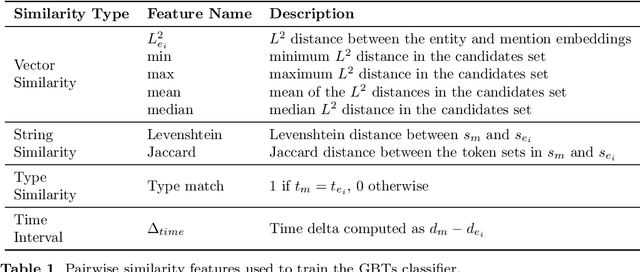
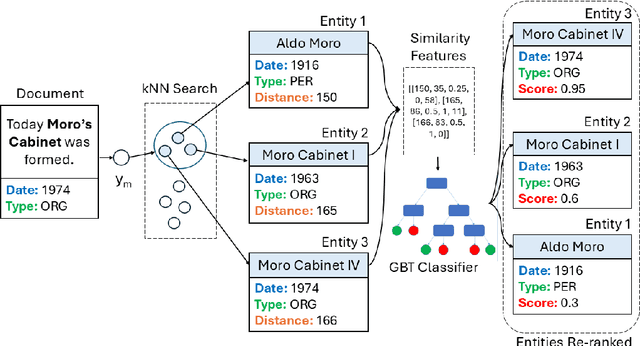
In spite of the remarkable advancements in the field of Natural Language Processing, the task of Entity Linking (EL) remains challenging in the field of humanities due to complex document typologies, lack of domain-specific datasets and models, and long-tail entities, i.e., entities under-represented in Knowledge Bases (KBs). The goal of this paper is to address these issues with two main contributions. The first contribution is DELICATE, a novel neuro-symbolic method for EL on historical Italian which combines a BERT-based encoder with contextual information from Wikidata to select appropriate KB entities using temporal plausibility and entity type consistency. The second contribution is ENEIDE, a multi-domain EL corpus in historical Italian semi-automatically extracted from two annotated editions spanning from the 19th to the 20th century and including literary and political texts. Results show how DELICATE outperforms other EL models in historical Italian even if compared with larger architectures with billions of parameters. Moreover, further analyses reveal how DELICATE confidence scores and features sensitivity provide results which are more explainable and interpretable than purely neural methods.
Empathic Prompting: Non-Verbal Context Integration for Multimodal LLM Conversations
Oct 23, 2025We present Empathic Prompting, a novel framework for multimodal human-AI interaction that enriches Large Language Model (LLM) conversations with implicit non-verbal context. The system integrates a commercial facial expression recognition service to capture users' emotional cues and embeds them as contextual signals during prompting. Unlike traditional multimodal interfaces, empathic prompting requires no explicit user control; instead, it unobtrusively augments textual input with affective information for conversational and smoothness alignment. The architecture is modular and scalable, allowing integration of additional non-verbal modules. We describe the system design, implemented through a locally deployed DeepSeek instance, and report a preliminary service and usability evaluation (N=5). Results show consistent integration of non-verbal input into coherent LLM outputs, with participants highlighting conversational fluidity. Beyond this proof of concept, empathic prompting points to applications in chatbot-mediated communication, particularly in domains like healthcare or education, where users' emotional signals are critical yet often opaque in verbal exchanges.
Deep Learning Models for Robust Facial Liveness Detection
Aug 12, 2025In the rapidly evolving landscape of digital security, biometric authentication systems, particularly facial recognition, have emerged as integral components of various security protocols. However, the reliability of these systems is compromised by sophisticated spoofing attacks, where imposters gain unauthorized access by falsifying biometric traits. Current literature reveals a concerning gap: existing liveness detection methodologies - designed to counteract these breaches - fall short against advanced spoofing tactics employing deepfakes and other artificial intelligence-driven manipulations. This study introduces a robust solution through novel deep learning models addressing the deficiencies in contemporary anti-spoofing techniques. By innovatively integrating texture analysis and reflective properties associated with genuine human traits, our models distinguish authentic presence from replicas with remarkable precision. Extensive evaluations were conducted across five diverse datasets, encompassing a wide range of attack vectors and environmental conditions. Results demonstrate substantial advancement over existing systems, with our best model (AttackNet V2.2) achieving 99.9% average accuracy when trained on combined data. Moreover, our research unveils critical insights into the behavioral patterns of impostor attacks, contributing to a more nuanced understanding of their evolving nature. The implications are profound: our models do not merely fortify the authentication processes but also instill confidence in biometric systems across various sectors reliant on secure access.
Named Entity Recognition in Historical Italian: The Case of Giacomo Leopardi's Zibaldone
May 26, 2025The increased digitization of world's textual heritage poses significant challenges for both computer science and literary studies. Overall, there is an urgent need of computational techniques able to adapt to the challenges of historical texts, such as orthographic and spelling variations, fragmentary structure and digitization errors. The rise of large language models (LLMs) has revolutionized natural language processing, suggesting promising applications for Named Entity Recognition (NER) on historical documents. In spite of this, no thorough evaluation has been proposed for Italian texts. This research tries to fill the gap by proposing a new challenging dataset for entity extraction based on a corpus of 19th century scholarly notes, i.e. Giacomo Leopardi's Zibaldone (1898), containing 2,899 references to people, locations and literary works. This dataset was used to carry out reproducible experiments with both domain-specific BERT-based models and state-of-the-art LLMs such as LLaMa3.1. Results show that instruction-tuned models encounter multiple difficulties handling historical humanistic texts, while fine-tuned NER models offer more robust performance even with challenging entity types such as bibliographic references.
Enhancing Cell Counting through MLOps: A Structured Approach for Automated Cell Analysis
Apr 28, 2025Machine Learning (ML) models offer significant potential for advancing cell counting applications in neuroscience, medical research, pharmaceutical development, and environmental monitoring. However, implementing these models effectively requires robust operational frameworks. This paper introduces Cell Counting Machine Learning Operations (CC-MLOps), a comprehensive framework that streamlines the integration of ML in cell counting workflows. CC-MLOps encompasses data access and preprocessing, model training, monitoring, explainability features, and sustainability considerations. Through a practical use case, we demonstrate how MLOps principles can enhance model reliability, reduce human error, and enable scalable Cell Counting solutions. This work provides actionable guidance for researchers and laboratory professionals seeking to implement machine learning (ML)- powered cell counting systems.