 Add to Chrome
 Add to Firefox
 Add to Edge
Tractable Query Answering under Epistemic Confidentiality Policies in DL Ontologies (extended version)
Jul 21, 2026
We study Controlled Query Evaluation (CQE), a declarative approach to confidentiality-preserving data access, in the context of Description Logic (DL) ontologies, and for confidentiality policies expressed through Epistemic Dependencies (EDs). We first address the problem of answering queries (specifically, Boolean unions of conjunctive queries) under known semantics for CQE (GA- and IGA-entailment). Our results show that if the TBox is expressed in $\text{DL-Lite}_{\mathcal{R}}$, CQE is computationally intractable in general. Moreover, in the presence of EDs, the IGA semantics has recently been proven not to satisfy an important confidentiality preservation property known as indistinguishability. With the goal of defining computationally easier and confidentiality-preserving forms of CQE, we introduce a new semantics for CQE, based on the notion of minimal policy violation (MPV). We show that the new semantics provides a sound approximation of the previous ones, while satisfying the indistinguishability property. We also prove that, in the case of $\text{DL-Lite}_{\mathcal{R}}$ ontologies, query entailment under the MPV semantics can be decided in polynomial time in data complexity. Finally, we present a software implementation of our framework that we used to evaluate the feasibility of this new approach using an existing benchmark for OWL 2 QL.

Time series Foundation Models based on Physics-Informed Synthetic Histories for Cold-Start Photovoltaic Forecasting
Jun 05, 2026At commissioning time, Photovoltaic (PV) operators must forecast production before target-site observations are available, limiting the direct use of standard supervised forecasters. This cold-start setting is addressed with a zero-shot pipeline that generates a synthetic production history from plant metadata and meteorological covariates, enabling time-series foundation models (TSFMs) to forecast through inference-time conditioning. Five TSFMs are benchmarked against classical baselines under strict Cold-Start Baseline, Real Feedback, and Self-Forecast Feedback strategies. The evaluation spans $440$ PV sites across four datasets and diverse climate regimes. Covariate-aware foundation models outperform baselines by approximately $1.7-2\times$: TabPFN-TS achieves the lowest error under Real Feedback (MAE $0.514$, RMSE $0.721$ $kWh$ ${kWp}^{-1}$ ${d}^{-1}$), while Chronos-2 is most robust under Self-Forecast Feedback. Performance is largely insensitive to the synthetic-history source, indicating that accuracy is driven more by the availability of plausible temporal context than by the specific generator.
From Kellgren-Lawrence to Calcium Pyrophosphate Crystal Deposition: A Soft-Labelling Framework for Knee Osteoarthritis Assessmen
May 27, 2026Background and objective. Conventional Deep Learning (DL) approaches for Knee Osteoarthritis (KOA) grading rely on one-hot labels, which fail to capture both the ordinal uncertainty of Kellgren--Lawrence (KL) and Calcium Pyrophosphate Deposition Disease (CPPD) severity scores and the asymmetric relationship between the two scales observed in clinical practice. Methods. We retrospectively collected 2172 knee X-ray images, including 968 radiographs jointly annotated for KL and CPPD severity. An ordinal DL framework based on soft-labelling was developed for both tasks, replacing one-hot targets with unimodal probability distributions centred on the annotated grade. Four formulations were investigated: binomial, beta, triangular, and exponential. Results. All soft-labelling strategies consistently outperformed the nominal baseline. For CPPD grading, the triangular formulation achieved the highest Quadratic Weighted Kappa (QWK) and the lowest Mean Absolute Error (MAE) (QWK = 0.796; MAE = 0.438), while the beta formulation yielded the most balanced class-wise performance considering Average MAE (AMAE) and Maximum MAE (MMAE) across classes (AMAE = 0.458; MMAE = 0.573). For KL grading, the beta-based approach provided the best overall performance, achieving the highest QWK together with the lowest MAE and class-wise errors (QWK = 0.777; MAE = 0.529; AMAE = 0.523; MMAE = 0.775). Statistical analysis demonstrated significant improvements over conventional one-hot supervision (p < 0.001).
RPA-Check: A Multi-Stage Automated Framework for Evaluating Dynamic LLM-based Role-Playing Agents
Apr 13, 2026The rapid adoption of Large Language Models (LLMs) in interactive systems has enabled the creation of dynamic, open-ended Role-Playing Agents (RPAs). However, evaluating these agents remains a significant challenge, as standard NLP metrics fail to capture the nuances of role adherence, logical consistency, and long-term narrative stability. This paper introduces RPA-Check, a multi-stage automated evaluation framework designed to objectively assess the performance of LLM-based RPAs in complex, constraints-heavy environments. Our methodology is based on a four-step pipeline: (1) Dimension Definition, establishing high-level qualitative behavioral criteria; (2) Augmentation, where these requirements are expanded into granular boolean checklist indicators; (3) Semantic Filtering, to ensure indicator objectivity, no redundancy and agent isolation; and (4) LLM-as-a-Judge Evaluation, which employs chain-of-thought verification to score agent fidelity. We validate this framework by applying it to LLM Court, a serious game for forensic training involving several quantized local models. Experimental results across five distinct legal scenarios demonstrate the framework's ability to identify subtle trade-offs between model size, reasoning depth, and operational stability. Notably, the findings reveal an inverse relationship between parametric scale and procedural consistency, showing that smaller, adequately instruction-tuned models (8-9B) can outperform larger architectures prone to user-alignment bias or sycophancy. RPA-Check thus provides a standardized and reproducible metric for future research in generative agent evaluation within specialized domains.
Deep Learning Models for Robust Facial Liveness Detection
Aug 12, 2025In the rapidly evolving landscape of digital security, biometric authentication systems, particularly facial recognition, have emerged as integral components of various security protocols. However, the reliability of these systems is compromised by sophisticated spoofing attacks, where imposters gain unauthorized access by falsifying biometric traits. Current literature reveals a concerning gap: existing liveness detection methodologies - designed to counteract these breaches - fall short against advanced spoofing tactics employing deepfakes and other artificial intelligence-driven manipulations. This study introduces a robust solution through novel deep learning models addressing the deficiencies in contemporary anti-spoofing techniques. By innovatively integrating texture analysis and reflective properties associated with genuine human traits, our models distinguish authentic presence from replicas with remarkable precision. Extensive evaluations were conducted across five diverse datasets, encompassing a wide range of attack vectors and environmental conditions. Results demonstrate substantial advancement over existing systems, with our best model (AttackNet V2.2) achieving 99.9% average accuracy when trained on combined data. Moreover, our research unveils critical insights into the behavioral patterns of impostor attacks, contributing to a more nuanced understanding of their evolving nature. The implications are profound: our models do not merely fortify the authentication processes but also instill confidence in biometric systems across various sectors reliant on secure access.
CQE under Epistemic Dependencies: Algorithms and Experiments (extended version)
Jul 23, 2025
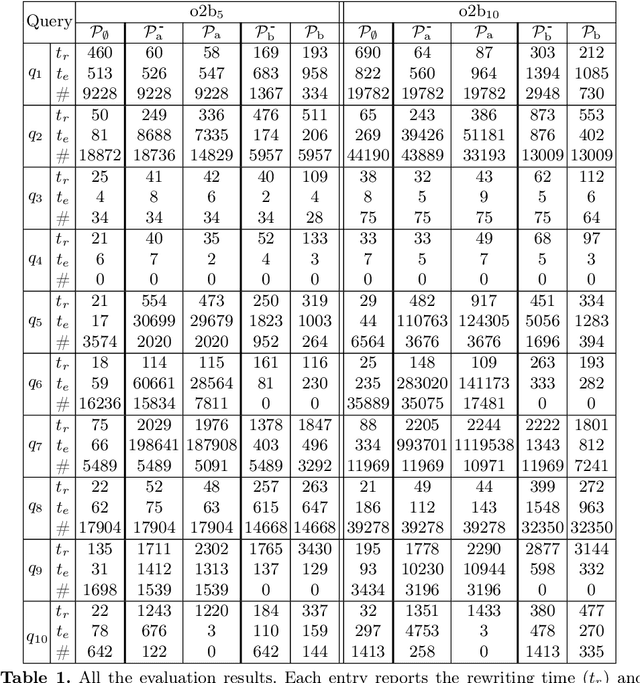
We investigate Controlled Query Evaluation (CQE) over ontologies, where information disclosure is regulated by epistemic dependencies (EDs), a family of logical rules recently proposed for the CQE framework. In particular, we combine EDs with the notion of optimal GA censors, i.e. maximal sets of ground atoms that are entailed by the ontology and can be safely revealed. We focus on answering Boolean unions of conjunctive queries (BUCQs) with respect to the intersection of all optimal GA censors - an approach that has been shown in other contexts to ensure strong security guarantees with favorable computational behavior. First, we characterize the security of this intersection-based approach and identify a class of EDs (namely, full EDs) for which it remains safe. Then, for a subclass of EDs and for DL-Lite_R ontologies, we show that answering BUCQs in the above CQE semantics is in AC^0 in data complexity by presenting a suitable, detailed first-order rewriting algorithm. Finally, we report on experiments conducted in two different evaluation scenarios, showing the practical feasibility of our rewriting function.
Controlled Query Evaluation through Epistemic Dependencies
May 03, 2024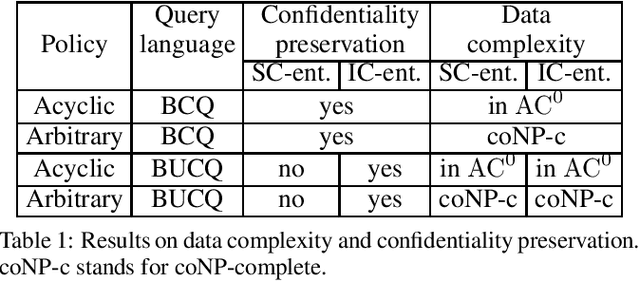
In this paper, we propose the use of epistemic dependencies to express data protection policies in Controlled Query Evaluation (CQE), which is a form of confidentiality-preserving query answering over ontologies and databases. The resulting policy language goes significantly beyond those proposed in the literature on CQE so far, allowing for very rich and practically interesting forms of data protection rules. We show the expressive abilities of our framework and study the data complexity of CQE for (unions of) conjunctive queries when ontologies are specified in the Description Logic DL-Lite_R. Interestingly, while we show that the problem is in general intractable, we prove tractability for the case of acyclic epistemic dependencies by providing a suitable query rewriting algorithm. The latter result paves the way towards the implementation and practical application of this new approach to CQE.
Consistent Query Answering for Existential Rules under Tuple-Deletion Semantics
Jan 11, 2024We study consistent query answering over knowledge bases expressed by existential rules. Specifically, we establish the data complexity of consistent query answering and repair checking under tuple-deletion semantics for a general class of disjunctive existential rules and for several subclasses thereof (acyclic, linear, full, guarded, and sticky). In particular, we identify several cases in which the above problems are tractable or even first-order rewritable, and present new query rewriting techniques that can be the basis for practical inconsistency-tolerant query answering systems.
A hybrid feature learning approach based on convolutional kernels for ATM fault prediction using event-log data
May 17, 2023Predictive Maintenance (PdM) methods aim to facilitate the scheduling of maintenance work before equipment failure. In this context, detecting early faults in automated teller machines (ATMs) has become increasingly important since these machines are susceptible to various types of unpredictable failures. ATMs track execution status by generating massive event-log data that collect system messages unrelated to the failure event. Predicting machine failure based on event logs poses additional challenges, mainly in extracting features that might represent sequences of events indicating impending failures. Accordingly, feature learning approaches are currently being used in PdM, where informative features are learned automatically from minimally processed sensor data. However, a gap remains to be seen on how these approaches can be exploited for deriving relevant features from event-log-based data. To fill this gap, we present a predictive model based on a convolutional kernel (MiniROCKET and HYDRA) to extract features from the original event-log data and a linear classifier to classify the sample based on the learned features. The proposed methodology is applied to a significant real-world collected dataset. Experimental results demonstrated how one of the proposed convolutional kernels (i.e. HYDRA) exhibited the best classification performance (accuracy of 0.759 and AUC of 0.693). In addition, statistical analysis revealed that the HYDRA and MiniROCKET models significantly overcome one of the established state-of-the-art approaches in time series classification (InceptionTime), and three non-temporal ML methods from the literature. The predictive model was integrated into a container-based decision support system to support operators in the timely maintenance of ATMs.
CQE in OWL 2 QL: A "Longest Honeymoon" Approach
Jul 22, 2022Controlled Query Evaluation (CQE) has been recently studied in the context of Semantic Web ontologies. The goal of CQE is concealing some query answers so as to prevent external users from inferring confidential information. In general, there exist multiple, mutually incomparable ways of concealing answers, and previous CQE approaches choose in advance which answers are visible and which are not. In this paper, instead, we study a dynamic CQE method, namely, we propose to alter the answer to the current query based on the evaluation of previous ones. We aim at a system that, besides being able to protect confidential data, is maximally cooperative, which intuitively means that it answers affirmatively to as many queries as possible; it achieves this goal by delaying answer modifications as much as possible. We also show that the behavior we get cannot be intensionally simulated through a static approach, independent of query history. Interestingly, for OWL 2 QL ontologies and policy expressed through denials, query evaluation under our semantics is first-order rewritable, and thus in AC0 in data complexity. This paves the way for the development of practical algorithms, which we also preliminarily discuss in the paper.