 Add to Chrome
 Add to Firefox
 Add to Edge
Physics-Informed Diffusion for Biomechanically Plausible 3D Sign Language Generation
Jul 16, 2026
Sign language production, which generates continuous 3D skeletal motion from spoken language input, must simultaneously satisfy two constraints: semantic fidelity, so that a deaf viewer can recognize the intended sequence of glosses, and biomechanical plausibility, so that the generated skeleton respects anatomical constraints. Existing approaches optimize semantic reconstruction through coordinate-based objectives that treat the skeleton as an unstructured vector, thus allowing for bone length drift, joint angle violations, and temporarily locked fingers. We introduce PIDiffSign, a physics-informed diffusion model for gloss-to-pose translation that incorporates anatomical constraints into both the architecture and training objective. The model uses a Transformer encoder-decoder, where the decoder is conditioned on the diffusion time step through adaptive zero-initialized layer normalization and cross-attends to gloss representations. A differentiable geometry module enforces bone length consistency and biologically valid joint angles throughout generation. Training combines anthropomorphic, kinematic, angular, and finger-joint constraints with a contrastive gloss-pose alignment loss and classifier-free guidance for semantically conditioned sampling. Experiments on the PHOENIX14T and CSL-Daily benchmarks show consistent improvements over a strong diffusion baseline in pose accuracy, joint-angle correctness, distributional realism, and back-translation quality. These results demonstrate that physics-informed diffusion improves both motion realism and semantic fidelity for sign language generation.

Label Anything: Multi-Class Few-Shot Semantic Segmentation with Visual Prompts
Jul 02, 2024
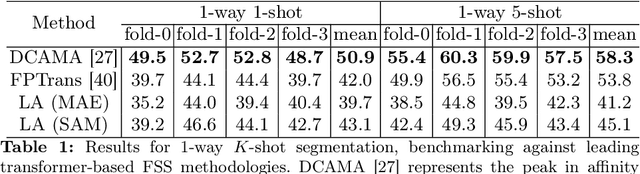

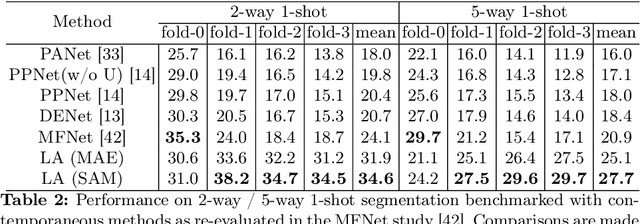
We present Label Anything, an innovative neural network architecture designed for few-shot semantic segmentation (FSS) that demonstrates remarkable generalizability across multiple classes with minimal examples required per class. Diverging from traditional FSS methods that predominantly rely on masks for annotating support images, Label Anything introduces varied visual prompts -- points, bounding boxes, and masks -- thereby enhancing the framework's versatility and adaptability. Unique to our approach, Label Anything is engineered for end-to-end training across multi-class FSS scenarios, efficiently learning from diverse support set configurations without retraining. This approach enables a "universal" application to various FSS challenges, ranging from $1$-way $1$-shot to complex $N$-way $K$-shot configurations while remaining agnostic to the specific number of class examples. This innovative training strategy reduces computational requirements and substantially improves the model's adaptability and generalization across diverse segmentation tasks. Our comprehensive experimental validation, particularly achieving state-of-the-art results on the COCO-$20^i$ benchmark, underscores Label Anything's robust generalization and flexibility. The source code is publicly available at: https://github.com/pasqualedem/LabelAnything.