 Add to Chrome
 Add to Firefox
 Add to Edge
Understanding How MLLMs Describe Artworks Using Token Activation Maps
Jun 26, 2026
Multimodal Large Language Models (MLLMs) describe artworks with remarkable fluency, yet the visual reasoning behind their outputs remains opaque. When an MLLM names a style, identifies a subject, or recognizes an iconographic symbol, does it ground each claim in the relevant region of the canvas, draw on an undifferentiated visual signal, or rely primarily on textual priors? We study this using the Token Activation Map (TAM), which produces, for each generated token, a heatmap isolating the visual evidence specific to that token from prior-context interference. Applying TAM to a curated set of paintings spanning multiple periods and genres, we analyze grounding patterns across five semantically distinct token categories: common visual objects, style descriptors, metadata, iconographic tokens, and affective expressions. We find that visual grounding varies substantially with token semantics. We further show that MLLMs attempt to identify artworks and artists, achieving higher accuracy in artist attribution than in title prediction, where hallucinations are more frequent. Finally, we compare TAM with SAM~3 open-vocabulary segmentation. To ensure reproducibility, we release our code, experimental configurations, prompts, and qualitative results on the project page at https://nicolafan.github.io/tamart/.

Label Anything: Multi-Class Few-Shot Semantic Segmentation with Visual Prompts
Jul 02, 2024
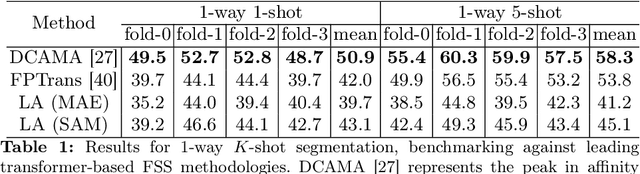

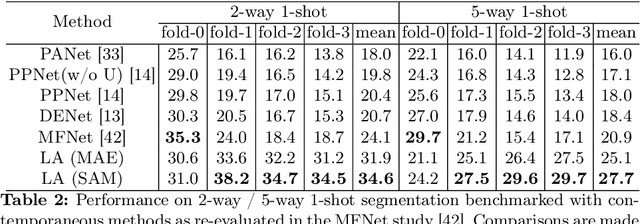
We present Label Anything, an innovative neural network architecture designed for few-shot semantic segmentation (FSS) that demonstrates remarkable generalizability across multiple classes with minimal examples required per class. Diverging from traditional FSS methods that predominantly rely on masks for annotating support images, Label Anything introduces varied visual prompts -- points, bounding boxes, and masks -- thereby enhancing the framework's versatility and adaptability. Unique to our approach, Label Anything is engineered for end-to-end training across multi-class FSS scenarios, efficiently learning from diverse support set configurations without retraining. This approach enables a "universal" application to various FSS challenges, ranging from $1$-way $1$-shot to complex $N$-way $K$-shot configurations while remaining agnostic to the specific number of class examples. This innovative training strategy reduces computational requirements and substantially improves the model's adaptability and generalization across diverse segmentation tasks. Our comprehensive experimental validation, particularly achieving state-of-the-art results on the COCO-$20^i$ benchmark, underscores Label Anything's robust generalization and flexibility. The source code is publicly available at: https://github.com/pasqualedem/LabelAnything.