 Add to Chrome
 Add to Firefox
 Add to Edge
Explainable Fuzzy GNNs for Leak Detection in Water Distribution Networks
Jan 06, 2026
Timely leak detection in water distribution networks is critical for conserving resources and maintaining operational efficiency. Although Graph Neural Networks (GNNs) excel at capturing spatial-temporal dependencies in sensor data, their black-box nature and the limited work on graph-based explainable models for water networks hinder practical adoption. We propose an explainable GNN framework that integrates mutual information to identify critical network regions and fuzzy logic to provide clear, rule-based explanations for node classification tasks. After benchmarking several GNN architectures, we selected the generalized graph convolution network (GENConv) for its superior performance and developed a fuzzy-enhanced variant that offers intuitive explanations for classified leak locations. Our fuzzy graph neural network (FGENConv) achieved Graph F1 scores of 0.889 for detection and 0.814 for localization, slightly below the crisp GENConv 0.938 and 0.858, respectively. Yet it compensates by providing spatially localized, fuzzy rule-based explanations. By striking the right balance between precision and explainability, the proposed fuzzy network could enable hydraulic engineers to validate predicted leak locations, conserve human resources, and optimize maintenance strategies. The code is available at github.com/pasqualedem/GNNLeakDetection.

Take a Peek: Efficient Encoder Adaptation for Few-Shot Semantic Segmentation via LoRA
Dec 11, 2025Few-shot semantic segmentation (FSS) aims to segment novel classes in query images using only a small annotated support set. While prior research has mainly focused on improving decoders, the encoder's limited ability to extract meaningful features for unseen classes remains a key bottleneck. In this work, we introduce \textit{Take a Peek} (TaP), a simple yet effective method that enhances encoder adaptability for both FSS and cross-domain FSS (CD-FSS). TaP leverages Low-Rank Adaptation (LoRA) to fine-tune the encoder on the support set with minimal computational overhead, enabling fast adaptation to novel classes while mitigating catastrophic forgetting. Our method is model-agnostic and can be seamlessly integrated into existing FSS pipelines. Extensive experiments across multiple benchmarks--including COCO $20^i$, Pascal $5^i$, and cross-domain datasets such as DeepGlobe, ISIC, and Chest X-ray--demonstrate that TaP consistently improves segmentation performance across diverse models and shot settings. Notably, TaP delivers significant gains in complex multi-class scenarios, highlighting its practical effectiveness in realistic settings. A rank sensitivity analysis also shows that strong performance can be achieved even with low-rank adaptations, ensuring computational efficiency. By addressing a critical limitation in FSS--the encoder's generalization to novel classes--TaP paves the way toward more robust, efficient, and generalizable segmentation systems. The code is available at https://github.com/pasqualedem/TakeAPeek.
RoWeeder: Unsupervised Weed Mapping through Crop-Row Detection
Oct 07, 2024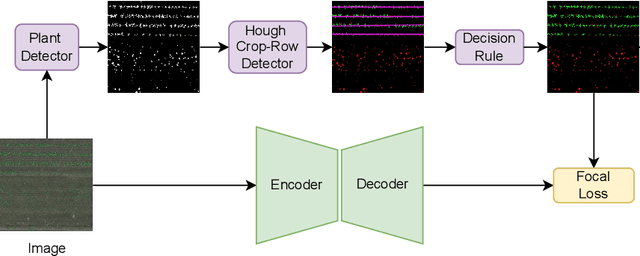
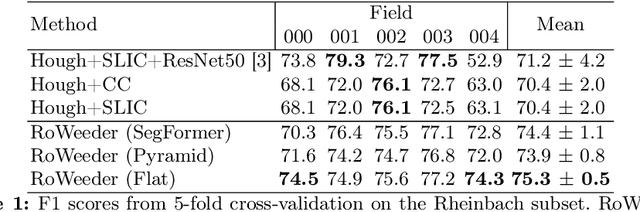
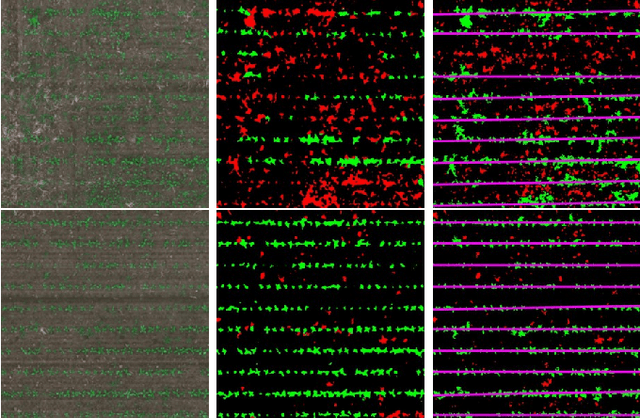
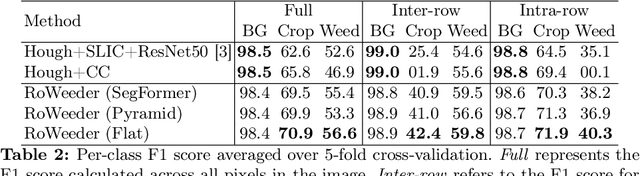
Precision agriculture relies heavily on effective weed management to ensure robust crop yields. This study presents RoWeeder, an innovative framework for unsupervised weed mapping that combines crop-row detection with a noise-resilient deep learning model. By leveraging crop-row information to create a pseudo-ground truth, our method trains a lightweight deep learning model capable of distinguishing between crops and weeds, even in the presence of noisy data. Evaluated on the WeedMap dataset, RoWeeder achieves an F1 score of 75.3, outperforming several baselines. Comprehensive ablation studies further validated the model's performance. By integrating RoWeeder with drone technology, farmers can conduct real-time aerial surveys, enabling precise weed management across large fields. The code is available at: \url{https://github.com/pasqualedem/RoWeeder}.
Label Anything: Multi-Class Few-Shot Semantic Segmentation with Visual Prompts
Jul 02, 2024
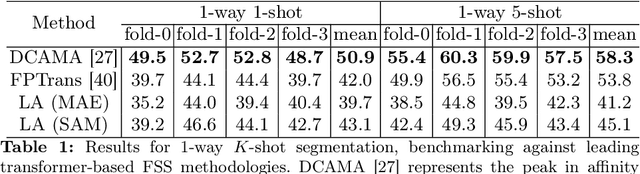

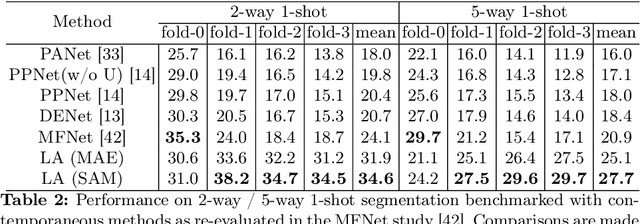
We present Label Anything, an innovative neural network architecture designed for few-shot semantic segmentation (FSS) that demonstrates remarkable generalizability across multiple classes with minimal examples required per class. Diverging from traditional FSS methods that predominantly rely on masks for annotating support images, Label Anything introduces varied visual prompts -- points, bounding boxes, and masks -- thereby enhancing the framework's versatility and adaptability. Unique to our approach, Label Anything is engineered for end-to-end training across multi-class FSS scenarios, efficiently learning from diverse support set configurations without retraining. This approach enables a "universal" application to various FSS challenges, ranging from $1$-way $1$-shot to complex $N$-way $K$-shot configurations while remaining agnostic to the specific number of class examples. This innovative training strategy reduces computational requirements and substantially improves the model's adaptability and generalization across diverse segmentation tasks. Our comprehensive experimental validation, particularly achieving state-of-the-art results on the COCO-$20^i$ benchmark, underscores Label Anything's robust generalization and flexibility. The source code is publicly available at: https://github.com/pasqualedem/LabelAnything.