 Add to Chrome
 Add to Firefox
 Add to Edge
Constitutional Arms Races in the Public Goods Game: Co-Evolving LLM Constitutions Under Cooperation-Defection Pressure
May 26, 2026
Frontier LLM agents engage in blackmail, sabotage, and document leaks under goal conflicts in agentic settings, exposing limitations of alignment methods built around single-agent or cooperative assumptions. Recent work shows LLM-guided evolutionary search can discover effective cooperative constitutions, but two properties of the adversarial setting remain uncharacterized: whether the fitness function actually induces adversarial pressure, and whether the LLM mutation operator behaves reliably under adversarial-specialist objectives. We study adversarial constitutional co-evolution (Blue cooperators vs. Red free-riders, 30 generations) across a Public Goods Game (PGG) and a spatial grid-world. Three findings: (1) in the PGG, both factions converge to a near-parity equilibrium at S approximately 0.78, robust across tested multipliers m in {1.2, 1.5, 2.0, 3.0}; (2) in independently scored environments, per-faction scoring leaves outcomes statistically uncoupled, with corr(S_B, S_R) = +0.088, and produces no adversarial pressure; a score-advantage fitness target S_own - S_opp restores it; (3) under pure-adversary fitness, evaluation seed count K controls mode regression: K = 2 regresses, while K = 5 sustains a strong specialist for all 30 generations. Adversarial co-evolution of natural-language constitutions is feasible, but only under coupled fitness and adequate evaluation budget; the evolved Red constitutions serve as interpretable red-team artifacts for testing future cooperative designs.

Underwater Image Enhancement with Physical-based Denoising Diffusion Implicit Models
Sep 27, 2024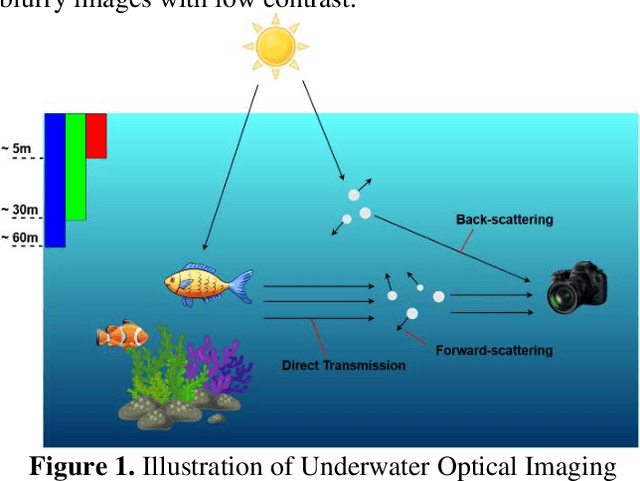
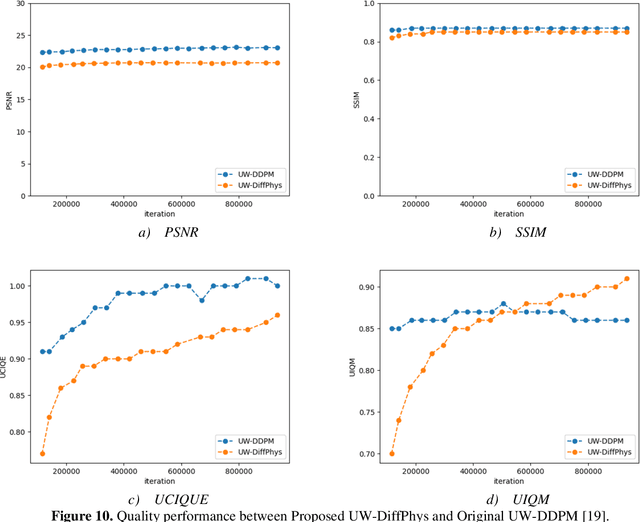
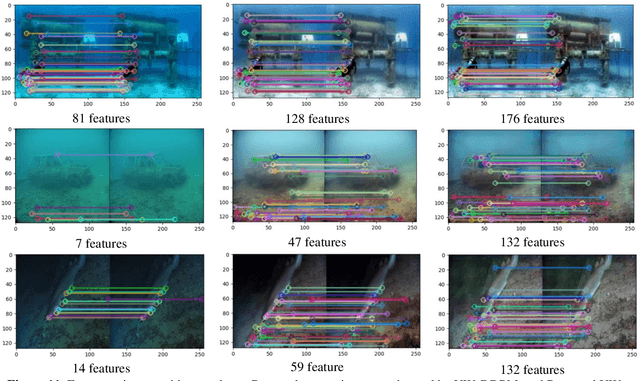
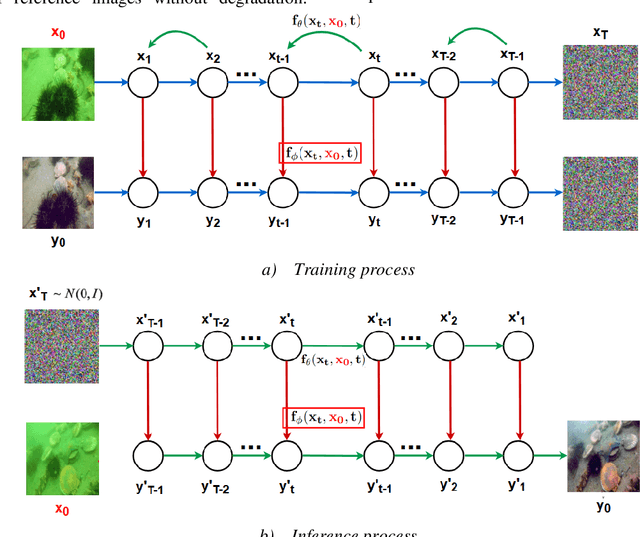
Underwater vision is crucial for autonomous underwater vehicles (AUVs), and enhancing degraded underwater images in real-time on a resource-constrained AUV is a key challenge due to factors like light absorption and scattering, or the sufficient model computational complexity to resolve such factors. Traditional image enhancement techniques lack adaptability to varying underwater conditions, while learning-based methods, particularly those using convolutional neural networks (CNNs) and generative adversarial networks (GANs), offer more robust solutions but face limitations such as inadequate enhancement, unstable training, or mode collapse. Denoising diffusion probabilistic models (DDPMs) have emerged as a state-of-the-art approach in image-to-image tasks but require intensive computational complexity to achieve the desired underwater image enhancement (UIE) using the recent UW-DDPM solution. To address these challenges, this paper introduces UW-DiffPhys, a novel physical-based and diffusion-based UIE approach. UW-DiffPhys combines light-computation physical-based UIE network components with a denoising U-Net to replace the computationally intensive distribution transformation U-Net in the existing UW-DDPM framework, reducing complexity while maintaining performance. Additionally, the Denoising Diffusion Implicit Model (DDIM) is employed to accelerate the inference process through non-Markovian sampling. Experimental results demonstrate that UW-DiffPhys achieved a substantial reduction in computational complexity and inference time compared to UW-DDPM, with competitive performance in key metrics such as PSNR, SSIM, UCIQE, and an improvement in the overall underwater image quality UIQM metric. The implementation code can be found at the following repository: https://github.com/bachzz/UW-DiffPhys