 Add to Chrome
 Add to Firefox
 Add to Edge
Direct Causation in International Humanitarian Law and the Challenge of AI-Mediated Civilian Cyber Operations
Jun 28, 2026
International humanitarian law protects civilians from direct attack unless and for such time as they take direct part in hostilities, with the ICRC's 2009 Interpretive Guidance operationalising this rule through a three-criterion cumulative test. This paper argues that AI-mediated civilian cyber operations challenge the direct causation element of this test in a structurally specific way: when a civilian deploys an autonomous multi-agent cyber system of the kind recently demonstrated in offensive AI research, the "one causal step" standard fails because harm is produced by system-generated decisions made after human disengagement, and the integral-part requirement does not extend because it presupposes downstream human contributors whose conduct can be independently classified. The framework therefore defaults to treating such deployments as indirect participation, in tension with its purpose of capturing civilians who personally take part in hostilities. Beyond the doctrinal analysis, this paper identifies goal-specification granularity as the property on which the integral-part test's concreteness component implicitly turns, classifies AI-mediated operations along a five-level spectrum, and argues that existing technical AI governance instruments do not log or report this property.

Gender Bias in LLM Hiring Decisions: Evidence from a Japanese Context and Evaluation of Mitigation Strategies
Jun 17, 2026Large language models (LLMs) are increasingly deployed in hiring workflows, yet most research on gender bias in LLM hiring decisions has focused on English-language, Western-format resumes. This study examines whether pro-female gender bias extends to a Japanese corporate context and evaluates two practical mitigation strategies. Using a counterfactual resume design with 60 Japanese rirekisho-format resumes, 12 name pairs selected on linguistically grounded gender-signal criteria, and five state-of-the-art LLMs (Claude Sonnet 4.6, GPT-4o, DeepSeek-V3, Gemini 2.5 Flash, Llama 3.3 70B), we conducted 43,200 API calls across baseline, prompt instruction, and privacy filter conditions. A crossed random-effects linear mixed model confirms a significant pro-female bias across all five models, replicating Western findings in a non-Western context. A prompt-level gender-neutrality instruction produces no meaningful reduction in bias. A name-reliance analysis formally identifies the candidate name as the primary gender channel: removing the name from the prompt reduces the female effect by nearly its full magnitude. An unexpected incompatibility between the privacy filter and GPT-4o's content safety filter, resulting in a 42% refusal rate, highlights a practical deployment challenge for name anonymization in LLM-assisted recruitment pipelines.
Constitutional Arms Races in the Public Goods Game: Co-Evolving LLM Constitutions Under Cooperation-Defection Pressure
May 26, 2026Frontier LLM agents engage in blackmail, sabotage, and document leaks under goal conflicts in agentic settings, exposing limitations of alignment methods built around single-agent or cooperative assumptions. Recent work shows LLM-guided evolutionary search can discover effective cooperative constitutions, but two properties of the adversarial setting remain uncharacterized: whether the fitness function actually induces adversarial pressure, and whether the LLM mutation operator behaves reliably under adversarial-specialist objectives. We study adversarial constitutional co-evolution (Blue cooperators vs. Red free-riders, 30 generations) across a Public Goods Game (PGG) and a spatial grid-world. Three findings: (1) in the PGG, both factions converge to a near-parity equilibrium at S approximately 0.78, robust across tested multipliers m in {1.2, 1.5, 2.0, 3.0}; (2) in independently scored environments, per-faction scoring leaves outcomes statistically uncoupled, with corr(S_B, S_R) = +0.088, and produces no adversarial pressure; a score-advantage fitness target S_own - S_opp restores it; (3) under pure-adversary fitness, evaluation seed count K controls mode regression: K = 2 regresses, while K = 5 sustains a strong specialist for all 30 generations. Adversarial co-evolution of natural-language constitutions is feasible, but only under coupled fitness and adequate evaluation budget; the evolved Red constitutions serve as interpretable red-team artifacts for testing future cooperative designs.
Evolving Interpretable Constitutions for Multi-Agent Simulation
Jan 31, 2026Constitutional AI has focused on single-model alignment using fixed principles. However, multi-agent systems create novel alignment challenges through emergent social dynamics. We present Constitutional Evolution, a framework for automatically discovering behavioral norms in multi-agent LLM systems. Using a grid-world simulation with survival pressure, we study the tension between individual and collective welfare, quantified via a Societal Stability Score S in [0,1] that combines productivity, survival, and conflict metrics. Adversarial constitutions lead to societal collapse (S= 0), while vague prosocial principles ("be helpful, harmless, honest") produce inconsistent coordination (S = 0.249). Even constitutions designed by Claude 4.5 Opus with explicit knowledge of the objective achieve only moderate performance (S= 0.332). Using LLM-driven genetic programming with multi-island evolution, we evolve constitutions maximizing social welfare without explicit guidance toward cooperation. The evolved constitution C* achieves S = 0.556 +/- 0.008 (123% higher than human-designed baselines, N = 10), eliminates conflict, and discovers that minimizing communication (0.9% vs 62.2% social actions) outperforms verbose coordination. Our interpretable rules demonstrate that cooperative norms can be discovered rather than prescribed.
Memorization Control in Diffusion Models from Denoising-centric Perspective
Jan 29, 2026Controlling memorization in diffusion models is critical for applications that require generated data to closely match the training distribution. Existing approaches mainly focus on data centric or model centric modifications, treating the diffusion model as an isolated predictor. In this paper, we study memorization in diffusion models from a denoising centric perspective. We show that uniform timestep sampling leads to unequal learning contributions across denoising steps due to differences in signal to noise ratio, which biases training toward memorization. To address this, we propose a timestep sampling strategy that explicitly controls where learning occurs along the denoising trajectory. By adjusting the width of the confidence interval, our method provides direct control over the memorization generalization trade off. Experiments on image and 1D signal generation tasks demonstrate that shifting learning emphasis toward later denoising steps consistently reduces memorization and improves distributional alignment with training data, validating the generality and effectiveness of our approach.
Underwater Image Enhancement with Physical-based Denoising Diffusion Implicit Models
Sep 27, 2024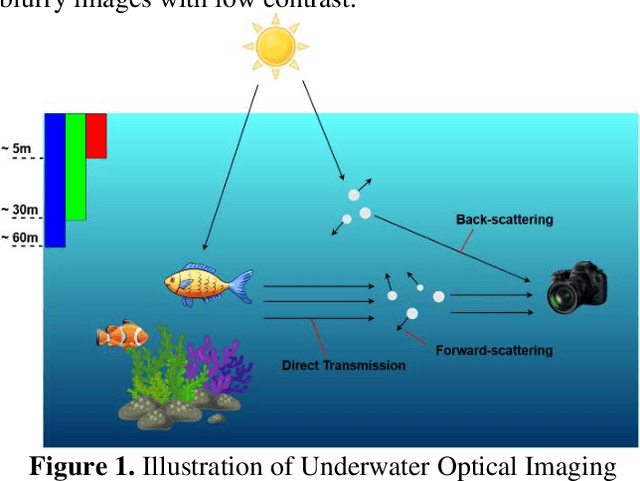
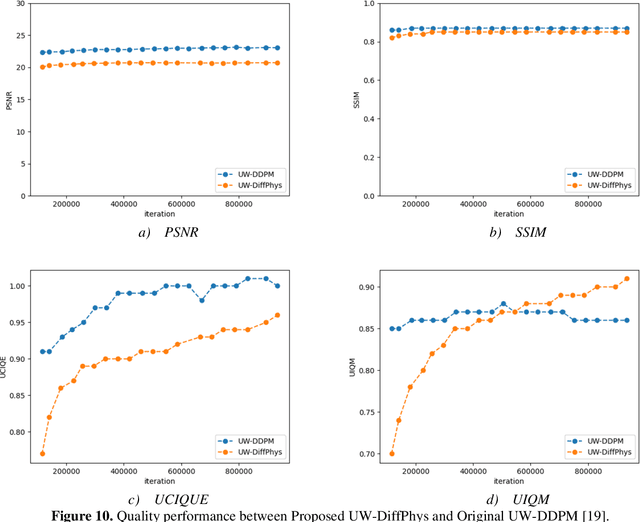
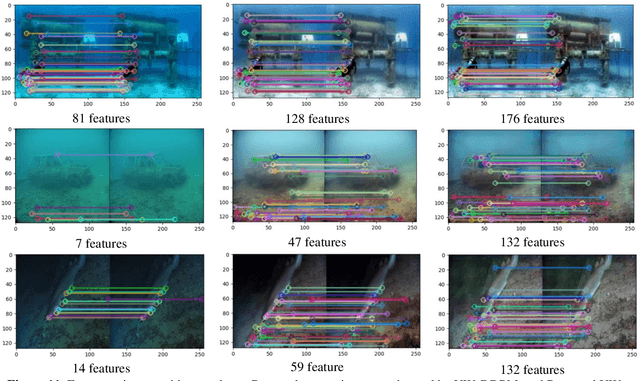
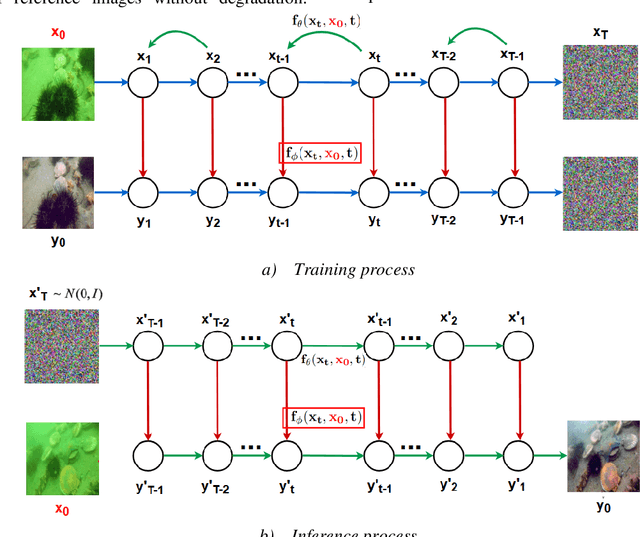
Underwater vision is crucial for autonomous underwater vehicles (AUVs), and enhancing degraded underwater images in real-time on a resource-constrained AUV is a key challenge due to factors like light absorption and scattering, or the sufficient model computational complexity to resolve such factors. Traditional image enhancement techniques lack adaptability to varying underwater conditions, while learning-based methods, particularly those using convolutional neural networks (CNNs) and generative adversarial networks (GANs), offer more robust solutions but face limitations such as inadequate enhancement, unstable training, or mode collapse. Denoising diffusion probabilistic models (DDPMs) have emerged as a state-of-the-art approach in image-to-image tasks but require intensive computational complexity to achieve the desired underwater image enhancement (UIE) using the recent UW-DDPM solution. To address these challenges, this paper introduces UW-DiffPhys, a novel physical-based and diffusion-based UIE approach. UW-DiffPhys combines light-computation physical-based UIE network components with a denoising U-Net to replace the computationally intensive distribution transformation U-Net in the existing UW-DDPM framework, reducing complexity while maintaining performance. Additionally, the Denoising Diffusion Implicit Model (DDIM) is employed to accelerate the inference process through non-Markovian sampling. Experimental results demonstrate that UW-DiffPhys achieved a substantial reduction in computational complexity and inference time compared to UW-DDPM, with competitive performance in key metrics such as PSNR, SSIM, UCIQE, and an improvement in the overall underwater image quality UIQM metric. The implementation code can be found at the following repository: https://github.com/bachzz/UW-DiffPhys