 Add to Chrome
 Add to Firefox
 Add to Edge
Blind denoising diffusion models and the blessings of dimensionality
Feb 10, 2026
We analyze, theoretically and empirically, the performance of generative diffusion models based on \emph{blind denoisers}, in which the denoiser is not given the noise amplitude in either the training or sampling processes. Assuming that the data distribution has low intrinsic dimensionality, we prove that blind denoising diffusion models (BDDMs), despite not having access to the noise amplitude, \emph{automatically} track a particular \emph{implicit} noise schedule along the reverse process. Our analysis shows that BDDMs can accurately sample from the data distribution in polynomially many steps as a function of the intrinsic dimension. Empirical results corroborate these mathematical findings on both synthetic and image data, demonstrating that the noise variance is accurately estimated from the noisy image. Remarkably, we observe that schedule-free BDDMs produce samples of higher quality compared to their non-blind counterparts. We provide evidence that this performance gain arises because BDDMs correct the mismatch between the true residual noise (of the image) and the noise assumed by the schedule used in non-blind diffusion models.

Learning Efficient Coding of Natural Images with Maximum Manifold Capacity Representations
Mar 06, 2023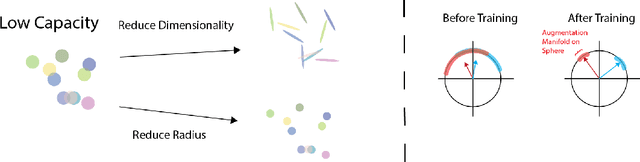
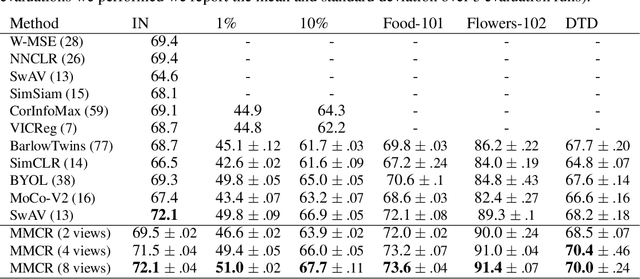
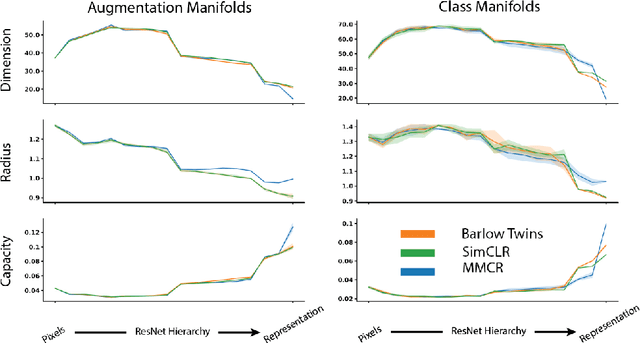
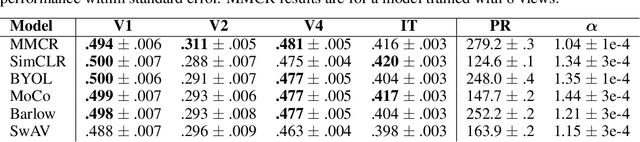
Self-supervised Learning (SSL) provides a strategy for constructing useful representations of images without relying on hand-assigned labels. Many such methods aim to map distinct views of the same scene or object to nearby points in the representation space, while employing some constraint to prevent representational collapse. Here we recast the problem in terms of efficient coding by adopting manifold capacity, a measure that quantifies the quality of a representation based on the number of linearly separable object manifolds it can support, as the efficiency metric to optimize. Specifically, we adapt the manifold capacity for use as an objective function in a contrastive learning framework, yielding a Maximum Manifold Capacity Representation (MMCR). We apply this method to unlabeled images, each augmented by a set of basic transformations, and find that it learns meaningful features using the standard linear evaluation protocol. Specifically, we find that MMCRs support performance on object recognition comparable to or surpassing that of recently developed SSL frameworks, while providing more robustness to adversarial attacks. Empirical analyses reveal differences between MMCRs and representations learned by other SSL frameworks, and suggest a mechanism by which manifold compression gives rise to class separability.
Toward Next-Generation Artificial Intelligence: Catalyzing the NeuroAI Revolution
Oct 15, 2022Neuroscience has long been an important driver of progress in artificial intelligence (AI). We propose that to accelerate progress in AI, we must invest in fundamental research in NeuroAI.