 Add to Chrome
 Add to Firefox
 Add to Edge
DECADE: A Temporally-Consistent Unsupervised Diffusion Model for Enhanced Rb-82 Dynamic Cardiac PET Image Denoising
Mar 08, 2026
Rb-82 dynamic cardiac PET imaging is widely used for the clinical diagnosis of coronary artery disease (CAD), but its short half-life results in high noise levels that degrade dynamic frame quality and parametric imaging. The lack of paired clean-noisy training data, rapid tracer kinetics, and frame-dependent noise variations further limit the effectiveness of existing deep learning denoising methods. We propose DECADE (A Temporally-Consistent Unsupervised Diffusion model for Enhanced Rb-82 CArdiac PET DEnoising), an unsupervised diffusion framework that generalizes across early- to late-phase dynamic frames. DECADE incorporates temporal consistency during both training and iterative sampling, using noisy frames as guidance to preserve quantitative accuracy. The method was trained and evaluated on datasets acquired from Siemens Vision 450 and Siemens Biograph Vision Quadra scanners. On the Vision 450 dataset, DECADE consistently produced high-quality dynamic and parametric images with reduced noise while preserving myocardial blood flow (MBF) and myocardial flow reserve (MFR). On the Quadra dataset, using 15%-count images as input and full-count images as reference, DECADE outperformed UNet-based and other diffusion models in image quality and K1/MBF quantification. The proposed framework enables effective unsupervised denoising of Rb-82 dynamic cardiac PET without paired training data, supporting clearer visualization while maintaining quantitative integrity.

TAI-GAN: A Temporally and Anatomically Informed Generative Adversarial Network for early-to-late frame conversion in dynamic cardiac PET inter-frame motion correction
Feb 14, 2024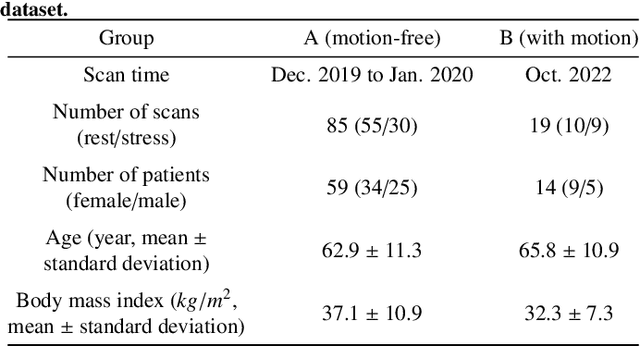

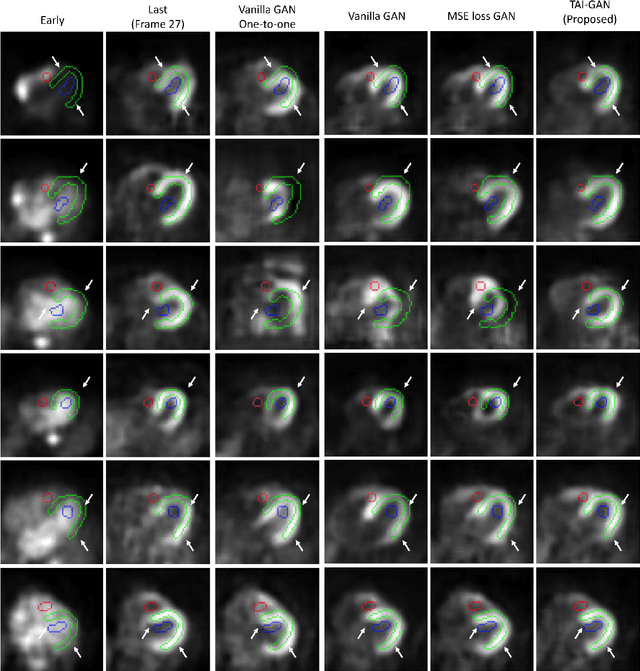
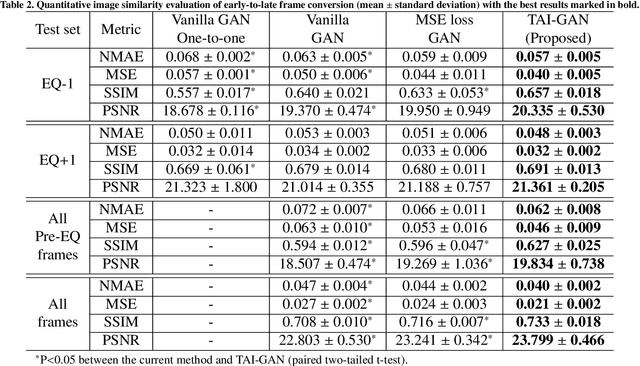
Inter-frame motion in dynamic cardiac positron emission tomography (PET) using rubidium-82 (82-Rb) myocardial perfusion imaging impacts myocardial blood flow (MBF) quantification and the diagnosis accuracy of coronary artery diseases. However, the high cross-frame distribution variation due to rapid tracer kinetics poses a considerable challenge for inter-frame motion correction, especially for early frames where intensity-based image registration techniques often fail. To address this issue, we propose a novel method called Temporally and Anatomically Informed Generative Adversarial Network (TAI-GAN) that utilizes an all-to-one mapping to convert early frames into those with tracer distribution similar to the last reference frame. The TAI-GAN consists of a feature-wise linear modulation layer that encodes channel-wise parameters generated from temporal information and rough cardiac segmentation masks with local shifts that serve as anatomical information. Our proposed method was evaluated on a clinical 82-Rb PET dataset, and the results show that our TAI-GAN can produce converted early frames with high image quality, comparable to the real reference frames. After TAI-GAN conversion, the motion estimation accuracy and subsequent myocardial blood flow (MBF) quantification with both conventional and deep learning-based motion correction methods were improved compared to using the original frames.
TAI-GAN: Temporally and Anatomically Informed GAN for early-to-late frame conversion in dynamic cardiac PET motion correction
Aug 23, 2023The rapid tracer kinetics of rubidium-82 ($^{82}$Rb) and high variation of cross-frame distribution in dynamic cardiac positron emission tomography (PET) raise significant challenges for inter-frame motion correction, particularly for the early frames where conventional intensity-based image registration techniques are not applicable. Alternatively, a promising approach utilizes generative methods to handle the tracer distribution changes to assist existing registration methods. To improve frame-wise registration and parametric quantification, we propose a Temporally and Anatomically Informed Generative Adversarial Network (TAI-GAN) to transform the early frames into the late reference frame using an all-to-one mapping. Specifically, a feature-wise linear modulation layer encodes channel-wise parameters generated from temporal tracer kinetics information, and rough cardiac segmentations with local shifts serve as the anatomical information. We validated our proposed method on a clinical $^{82}$Rb PET dataset and found that our TAI-GAN can produce converted early frames with high image quality, comparable to the real reference frames. After TAI-GAN conversion, motion estimation accuracy and clinical myocardial blood flow (MBF) quantification were improved compared to using the original frames. Our code is published at https://github.com/gxq1998/TAI-GAN.