 Add to Chrome
 Add to Firefox
 Add to Edge
Minimal surfaces, Knots, and Neural Networks
May 25, 2026
A recent conjecture by Joel Fine posits a relationship between the coefficients of the HOMFLY polynomial of a knot $K$ in the 3-sphere $S^3$, and the signed count of minimal surfaces in hyperbolic 4-space $\mathrm{H}^4$ meeting the sphere at infinity at $K$, with prescribed genus and self-intersection number. In this paper, we develop a novel machine learning framework based on Physics-Informed Neural Networks (PINNs) to solve the minimal surface equation in hyperbolic space. We utilise this framework to test Fine's Conjecture by constructing near-minimal surfaces bounding various families of knots in $S^3$. Furthermore, we develop an algorithmic method to find self-intersections and compute their sign. For every knot analysed, the computationally discovered minimal surfaces and their self-intersection numbers perfectly align with the predictions of Fine's Conjecture, providing empirical evidence for it.

A Machine Learning Approach to the Nirenberg Problem
Feb 12, 2026This work introduces the Nirenberg Neural Network: a numerical approach to the Nirenberg problem of prescribing Gaussian curvature on $S^2$ for metrics that are pointwise conformal to the round metric. Our mesh-free physics-informed neural network (PINN) approach directly parametrises the conformal factor globally and is trained with a geometry-aware loss enforcing the curvature equation. Additional consistency checks were performed via the Gauss-Bonnet theorem, and spherical-harmonic expansions were fit to the learnt models to provide interpretability. For prescribed curvatures with known realisability, the neural network achieves very low losses ($10^{-7} - 10^{-10}$), while unrealisable curvatures yield significantly higher losses. This distinction enables the assessment of unknown cases, separating likely realisable functions from non-realisable ones. The current capabilities of the Nirenberg Neural Network demonstrate that neural solvers can serve as exploratory tools in geometric analysis, offering a quantitative computational perspective on longstanding existence questions.
Calabi-Yau Four/Five/Six-folds as $\mathbb{P}^n_\textbf{w}$ Hypersurfaces: Machine Learning, Approximation, and Generation
Nov 28, 2023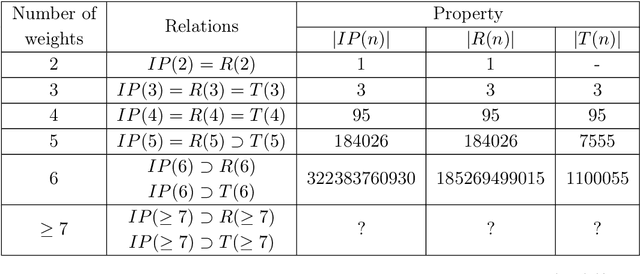
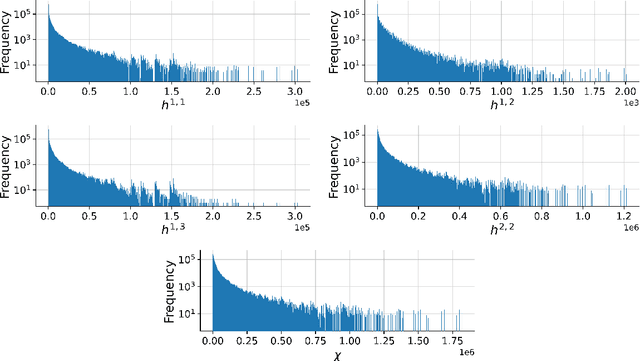

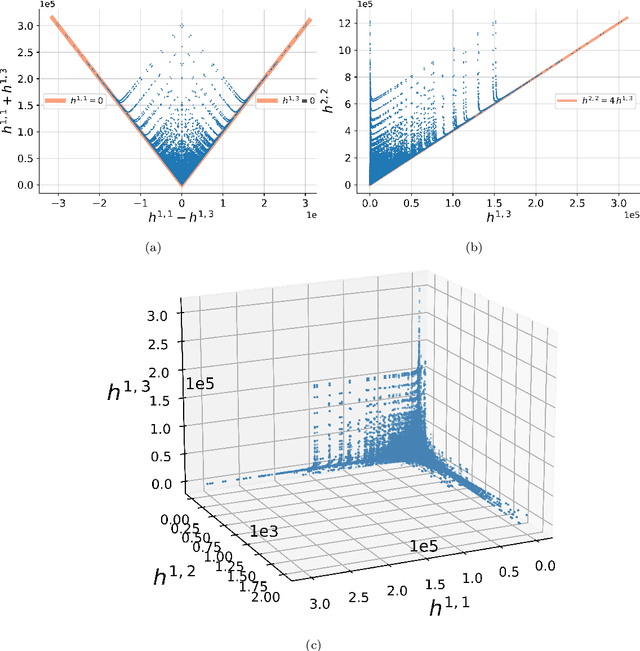
Calabi-Yau four-folds may be constructed as hypersurfaces in weighted projective spaces of complex dimension 5 defined via weight systems of 6 weights. In this work, neural networks were implemented to learn the Calabi-Yau Hodge numbers from the weight systems, where gradient saliency and symbolic regression then inspired a truncation of the Landau-Ginzburg model formula for the Hodge numbers of any dimensional Calabi-Yau constructed in this way. The approximation always provides a tight lower bound, is shown to be dramatically quicker to compute (with compute times reduced by up to four orders of magnitude), and gives remarkably accurate results for systems with large weights. Additionally, complementary datasets of weight systems satisfying the necessary but insufficient conditions for transversality were constructed, including considerations of the IP, reflexivity, and intradivisibility properties. Overall producing a classification of this weight system landscape, further confirmed with machine learning methods. Using the knowledge of this classification, and the properties of the presented approximation, a novel dataset of transverse weight systems consisting of 7 weights was generated for a sum of weights $\leq 200$; producing a new database of Calabi-Yau five-folds, with their respective topological properties computed. Further to this an equivalent database of candidate Calabi-Yau six-folds was generated with approximated Hodge numbers.