 Add to Chrome
 Add to Firefox
 Add to Edge
Interactions Between Crosscoder Features: A Compact Proofs Perspective
Jun 08, 2026
Dictionary learning methods like Sparse Autoencoders (SAEs) and crosscoders attempt to explain a model by decomposing its activations into independent features. Interactions between features hence induce errors in the reconstruction. We formalize this intuition via compact proofs and make five contributions. First, we show how, \textit{in principle}, a compact proof of model performance can be constructed using a crosscoder. Second, we show that an error term arising in this proof can naturally be interpreted as a measure of interaction between crosscoder features and provide an explicit expression for the interaction term in the Multi-Layer Perceptron (MLP) layers. We then provide three applications of this new interaction measure. In our third contribution we show that the interaction term itself can be used as a differentiable loss penalty. Applying this penalty, we can achieve ``computationally sparse'' crosscoders that retain $60\%$ of MLP performance when only keeping a single feature at each datapoint and neuron, compared to $10\%$ in standard crosscoders. We then show that clustering according to our interaction measure provides semantically meaningful feature clusters, and finally that sleeper agents have significant interactions. Code is available at https://github.com/chainik1125/crosscoders-feature-interactions/tree/arxiv.

Grokking vs. Learning: Same Features, Different Encodings
Feb 03, 2025
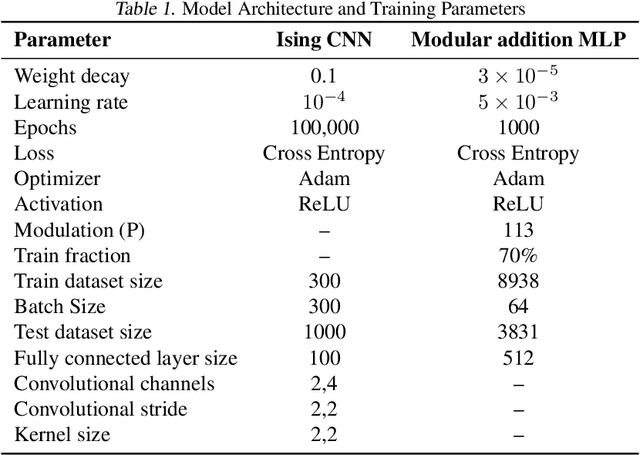
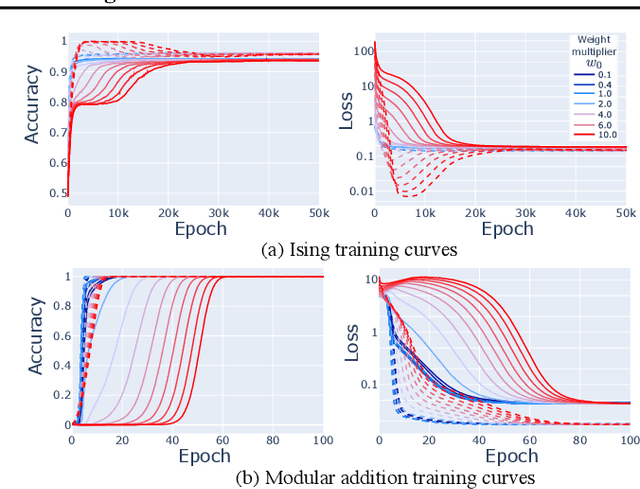
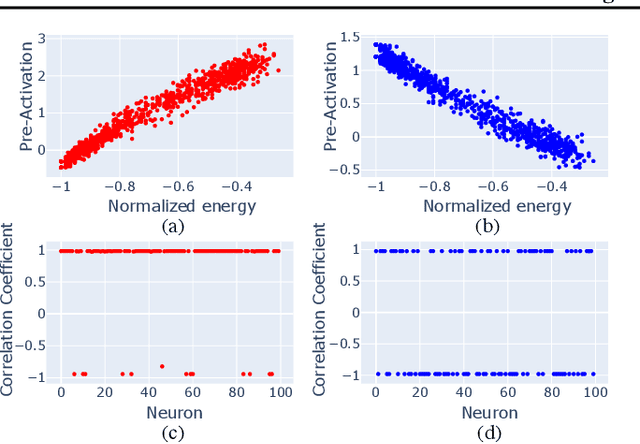
Grokking typically achieves similar loss to ordinary, "steady", learning. We ask whether these different learning paths - grokking versus ordinary training - lead to fundamental differences in the learned models. To do so we compare the features, compressibility, and learning dynamics of models trained via each path in two tasks. We find that grokked and steadily trained models learn the same features, but there can be large differences in the efficiency with which these features are encoded. In particular, we find a novel "compressive regime" of steady training in which there emerges a linear trade-off between model loss and compressibility, and which is absent in grokking. In this regime, we can achieve compression factors 25x times the base model, and 5x times the compression achieved in grokking. We then track how model features and compressibility develop through training. We show that model development in grokking is task-dependent, and that peak compressibility is achieved immediately after the grokking plateau. Finally, novel information-geometric measures are introduced which demonstrate that models undergoing grokking follow a straight path in information space.