 Add to Chrome
 Add to Firefox
 Add to Edge
Underwater Dead Reckoning with Deployable Situation-Triggered Covariance Scheduling
Jul 12, 2026
Underwater dead reckoning estimates vehicle position when vision is unavailable and external positioning cannot be assumed. A single set of filter parameters can work well in many situations, but fixed tuning may be poorly matched during turns, motion transitions, or periods when sensor measurements are less reliable. This paper presents the Situation-Triggered Calibrated Adaptive Robust Extended Kalman Filter for a BlueROV2. An onboard probabilistic trigger identifies the current motion situation while one error-state filter runs continuously. When the trigger is confident, the filter changes only to the corresponding pre-calibrated process- and measurement-noise matrices; the state estimate, covariance history, dynamics, and measurement models are not reset or replaced. The trigger, noise profiles, and a one-time Doppler velocity log yaw-alignment correction are calibrated offline using sparse AprilTag-supervised pool runs. A separate validation set selects the scheduling policy, which is then fixed before held-out testing. Across four held-out pool runs, the method reduces label-weighted mean per-run translation root-mean-square error from 0.488 m to 0.471 m relative to the same filter backbone with one global noise profile, and every held-out run favors the scheduled method. A paired bootstrap over 10-second segments gives a candidate-minus-baseline difference of -0.017 m with a 95% confidence interval of [-0.024, -0.008] m, while orientation error remains essentially unchanged. These results indicate that situation-aware covariance scheduling provides a modest but consistent vision-free dead-reckoning improvement without switching estimators or resetting the filter.

LDLT L-Lipschitz Network Weight Parameterization Initialization
Jan 13, 2026We analyze initialization dynamics for LDLT-based $\mathcal{L}$-Lipschitz layers by deriving the exact marginal output variance when the underlying parameter matrix $W_0\in \mathbb{R}^{m\times n}$ is initialized with IID Gaussian entries $\mathcal{N}(0,σ^2)$. The Wishart distribution, $S=W_0W_0^\top\sim\mathcal{W}_m(n,σ^2 \boldsymbol{I}_m)$, used for computing the output marginal variance is derived in closed form using expectations of zonal polynomials via James' theorem and a Laplace-integral expansion of $(α\boldsymbol{I}_m+S)^{-1}$. We develop an Isserlis/Wick-based combinatorial expansion for $\operatorname{\mathbb{E}}\left[\operatorname{tr}(S^k)\right]$ and provide explicit truncated moments up to $k=10$, which yield accurate series approximations for small-to-moderate $σ^2$. Monte Carlo experiments confirm the theoretical estimates. Furthermore, empirical analysis was performed to quantify that, using current He or Kaiming initialization with scaling $1/\sqrt{n}$, the output variance is $0.41$, whereas the new parameterization with $10/ \sqrt{n}$ for $α=1$ results in an output variance of $0.9$. The findings clarify why deep $\mathcal{L}$-Lipschitz networks suffer rapid information loss at initialization and offer practical prescriptions for choosing initialization hyperparameters to mitigate this effect. However, using the Higgs boson classification dataset, a hyperparameter sweep over optimizers, initialization scale, and depth was conducted to validate the results on real-world data, showing that although the derivation ensures variance preservation, empirical results indicate He initialization still performs better.
L-Lipschitz Gershgorin ResNet Network
Feb 28, 2025Deep residual networks (ResNets) have demonstrated outstanding success in computer vision tasks, attributed to their ability to maintain gradient flow through deep architectures. Simultaneously, controlling the Lipschitz bound in neural networks has emerged as an essential area of research for enhancing adversarial robustness and network certifiability. This paper uses a rigorous approach to design $\mathcal{L}$-Lipschitz deep residual networks using a Linear Matrix Inequality (LMI) framework. The ResNet architecture was reformulated as a pseudo-tri-diagonal LMI with off-diagonal elements and derived closed-form constraints on network parameters to ensure $\mathcal{L}$-Lipschitz continuity. To address the lack of explicit eigenvalue computations for such matrix structures, the Gershgorin circle theorem was employed to approximate eigenvalue locations, guaranteeing the LMI's negative semi-definiteness. Our contributions include a provable parameterization methodology for constructing Lipschitz-constrained networks and a compositional framework for managing recursive systems within hierarchical architectures. These findings enable robust network designs applicable to adversarial robustness, certified training, and control systems. However, a limitation was identified in the Gershgorin-based approximations, which over-constrain the system, suppressing non-linear dynamics and diminishing the network's expressive capacity.
Cooperative Modular Manipulation with Numerous Cable-Driven Robots for Assistive Construction and Gap Crossing
Mar 19, 2024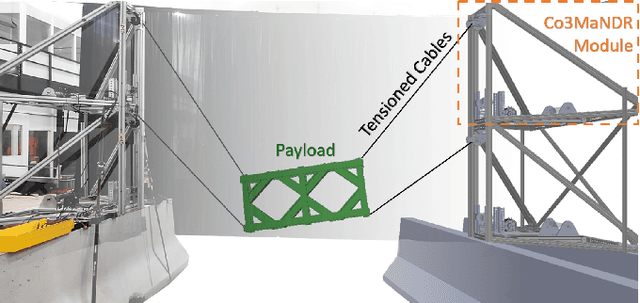
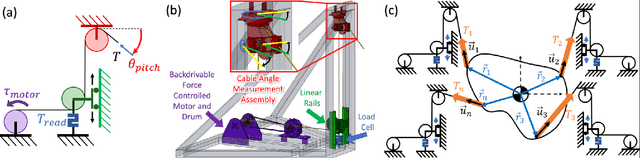
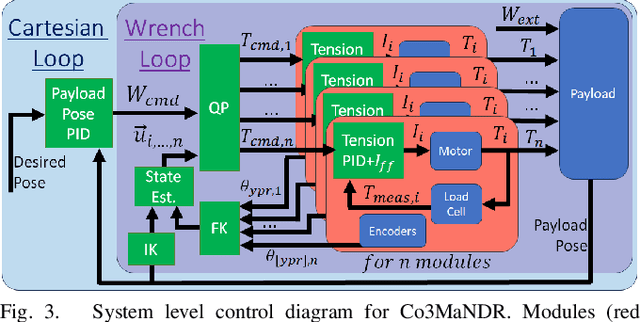
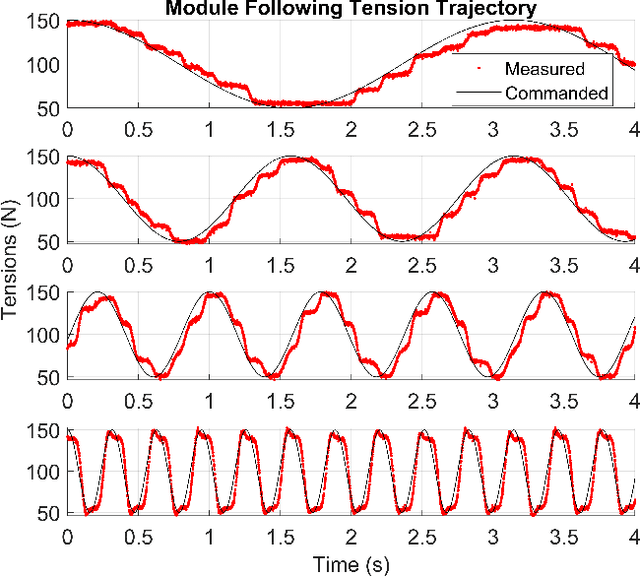
Soldiers in the field often need to cross negative obstacles, such as rivers or canyons, to reach goals or safety. Military gap crossing involves on-site temporary bridges construction. However, this procedure is conducted with dangerous, time and labor intensive operations, and specialized machinery. We envision a scalable robotic solution inspired by advancements in force-controlled and Cable Driven Parallel Robots (CDPRs); this solution can address the challenges inherent in this transportation problem, achieving fast, efficient, and safe deployment and field operations. We introduce the embodied vision in Co3MaNDR, a solution to the military gap crossing problem, a distributed robot consisting of several modules simultaneously pulling on a central payload, controlling the cables' tensions to achieve complex objectives, such as precise trajectory tracking or force amplification. Hardware experiments demonstrate teleoperation of a payload, trajectory following, and the sensing and amplification of operators' applied physical forces during slow operations. An operator was shown to manipulate a 27.2 kg (60 lb) payload with an average force utilization of 14.5\% of its weight. Results indicate that the system can be scaled up to heavier payloads without compromising performance or introducing superfluous complexity. This research lays a foundation to expand CDPR technology to uncoordinated and unstable mobile platforms in unknown environments.
In Situ Soil Property Estimation for Autonomous Earthmoving Using Physics-Infused Neural Networks
Sep 05, 2023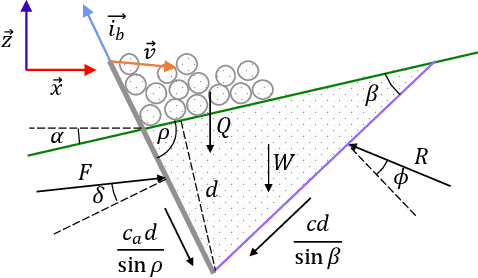
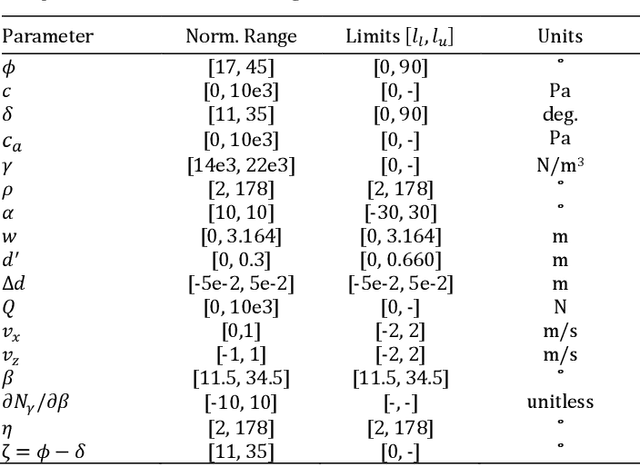
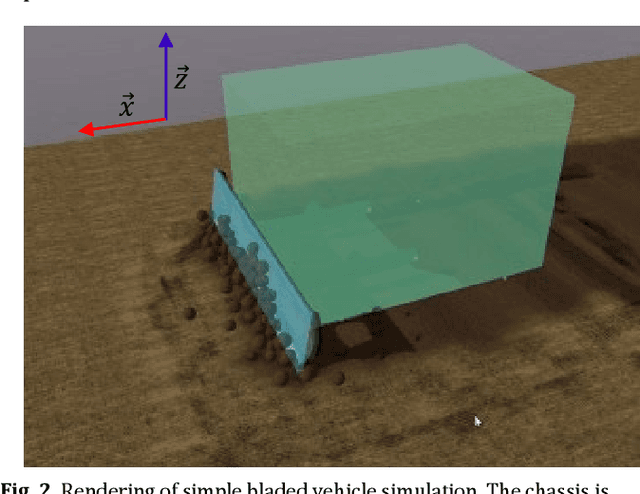

A novel, learning-based method for in situ estimation of soil properties using a physics-infused neural network (PINN) is presented. The network is trained to produce estimates of soil cohesion, angle of internal friction, soil-tool friction, soil failure angle, and residual depth of cut which are then passed through an earthmoving model based on the fundamental equation of earthmoving (FEE) to produce an estimated force. The network ingests a short history of kinematic observations along with past control commands and predicts interaction forces accurately with average error of less than 2kN, 13% of the measured force. To validate the approach, an earthmoving simulation of a bladed vehicle is developed using Vortex Studio, enabling comparison of the estimated parameters to pseudo-ground-truth values which is challenging in real-world experiments. The proposed approach is shown to enable accurate estimation of interaction forces and produces meaningful parameter estimates even when the model and the environmental physics deviate substantially.