 Add to Chrome
 Add to Firefox
 Add to Edge
Decoupled Travel Planning with Behavior Forest
Apr 23, 2026
Behavior sequences, composed of executable steps, serve as the operational foundation for multi-constraint planning problems such as travel planning. In such tasks, each planning step is not only constrained locally but also influenced by global constraints spanning multiple subtasks, leading to a tightly coupled and complex decision process. Existing travel planning methods typically rely on a single decision space that entangles all subtasks and constraints, failing to distinguish between locally acting constraints within a subtask and global constraints that span multiple subtasks. Consequently, the model is forced to jointly reason over local and global constraints at each decision step, increasing the reasoning burden and reducing planning efficiency. To address this problem, we propose the Behavior Forest method. Specifically, our approach structures the decision-making process into a forest of parallel behavior trees, where each behavior tree is responsible for a subtask. A global coordination mechanism is introduced to orchestrate the interactions among these trees, enabling modular and coherent travel planning. Within this framework, large language models are embedded as decision engines within behavior tree nodes, performing localized reasoning conditioned on task-specific constraints to generate candidate subplans and adapt decisions based on coordination feedback. The behavior trees, in turn, provide an explicit control structure that guides LLM generation. This design decouples complex tasks and constraints into manageable subspaces, enabling task-specific reasoning and reducing the cognitive load of LLM. Experimental results show that our method outperforms state-of-the-art methods by 6.67% on the TravelPlanner and by 11.82% on the ChinaTravel benchmarks, demonstrating its effectiveness in increasing LLM performance for complex multi-constraint travel planning.

Knowledge Graph Completion with Relation-Aware Anchor Enhancement
Apr 08, 2025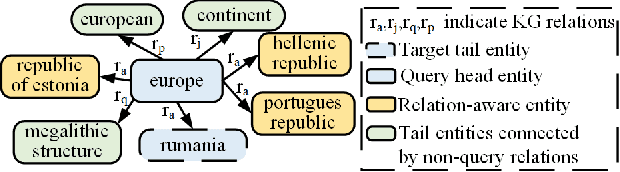
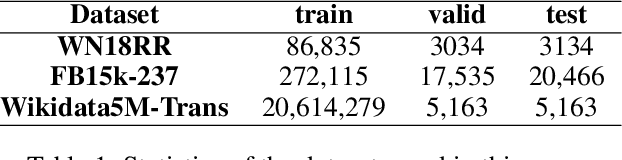
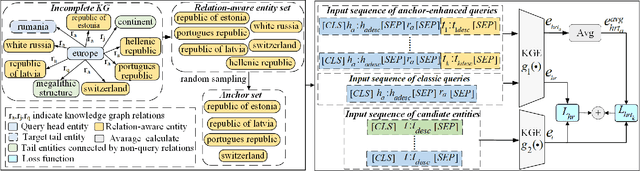
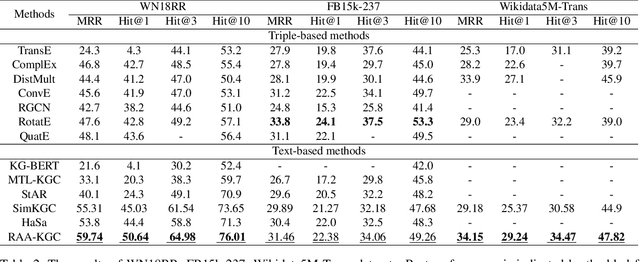
Text-based knowledge graph completion methods take advantage of pre-trained language models (PLM) to enhance intrinsic semantic connections of raw triplets with detailed text descriptions. Typical methods in this branch map an input query (textual descriptions associated with an entity and a relation) and its candidate entities into feature vectors, respectively, and then maximize the probability of valid triples. These methods are gaining promising performance and increasing attention for the rapid development of large language models. According to the property of the language models, the more related and specific context information the input query provides, the more discriminative the resultant embedding will be. In this paper, through observation and validation, we find a neglected fact that the relation-aware neighbors of the head entities in queries could act as effective contexts for more precise link prediction. Driven by this finding, we propose a relation-aware anchor enhanced knowledge graph completion method (RAA-KGC). Specifically, in our method, to provide a reference of what might the target entity be like, we first generate anchor entities within the relation-aware neighborhood of the head entity. Then, by pulling the query embedding towards the neighborhoods of the anchors, it is tuned to be more discriminative for target entity matching. The results of our extensive experiments not only validate the efficacy of RAA-KGC but also reveal that by integrating our relation-aware anchor enhancement strategy, the performance of current leading methods can be notably enhanced without substantial modifications.