 Add to Chrome
 Add to Firefox
 Add to Edge
Single-Layer Learnable Activation for Implicit Neural Representation (SL$^{2}$A-INR)
Sep 18, 2024
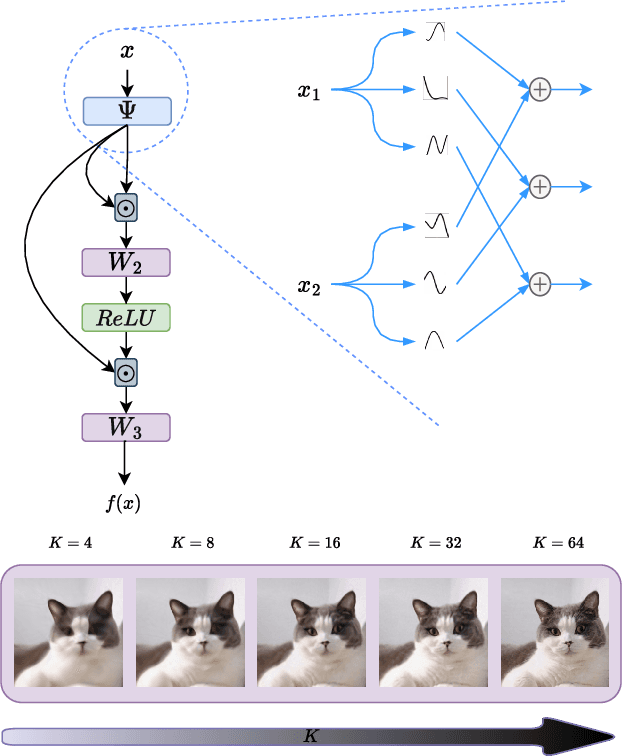



Implicit Neural Representation (INR), leveraging a neural network to transform coordinate input into corresponding attributes, has recently driven significant advances in several vision-related domains. However, the performance of INR is heavily influenced by the choice of the nonlinear activation function used in its multilayer perceptron (MLP) architecture. Multiple nonlinearities have been investigated; yet, current INRs face limitations in capturing high-frequency components, diverse signal types, and handling inverse problems. We have identified that these problems can be greatly alleviated by introducing a paradigm shift in INRs. We find that an architecture with learnable activations in initial layers can represent fine details in the underlying signals. Specifically, we propose SL$^{2}$A-INR, a hybrid network for INR with a single-layer learnable activation function, prompting the effectiveness of traditional ReLU-based MLPs. Our method performs superior across diverse tasks, including image representation, 3D shape reconstructions, inpainting, single image super-resolution, CT reconstruction, and novel view synthesis. Through comprehensive experiments, SL$^{2}$A-INR sets new benchmarks in accuracy, quality, and convergence rates for INR.

Continual Domain Incremental Learning for Privacy-aware Digital Pathology
Sep 10, 2024
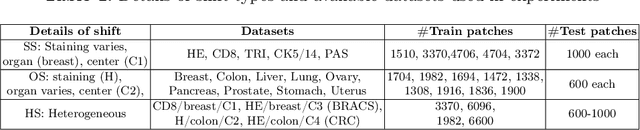
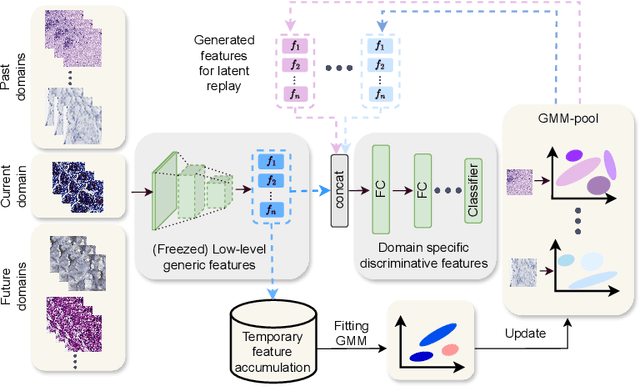
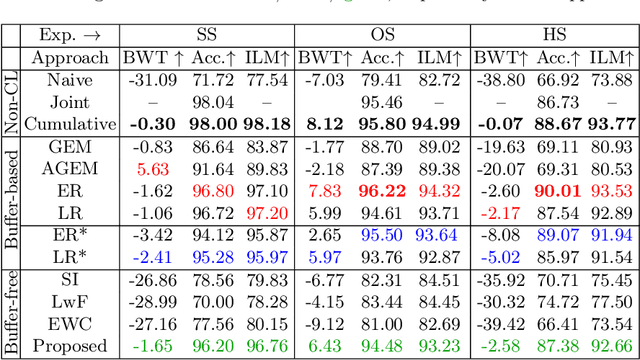
In recent years, there has been remarkable progress in the field of digital pathology, driven by the ability to model complex tissue patterns using advanced deep-learning algorithms. However, the robustness of these models is often severely compromised in the presence of data shifts (e.g., different stains, organs, centers, etc.). Alternatively, continual learning (CL) techniques aim to reduce the forgetting of past data when learning new data with distributional shift conditions. Specifically, rehearsal-based CL techniques, which store some past data in a buffer and then replay it with new data, have proven effective in medical image analysis tasks. However, privacy concerns arise as these approaches store past data, prompting the development of our novel Generative Latent Replay-based CL (GLRCL) approach. GLRCL captures the previous distribution through Gaussian Mixture Models instead of storing past samples, which are then utilized to generate features and perform latent replay with new data. We systematically evaluate our proposed framework under different shift conditions in histopathology data, including stain and organ shift. Our approach significantly outperforms popular buffer-free CL approaches and performs similarly to rehearsal-based CL approaches that require large buffers causing serious privacy violations.
Tissue Concepts: supervised foundation models in computational pathology
Sep 05, 2024

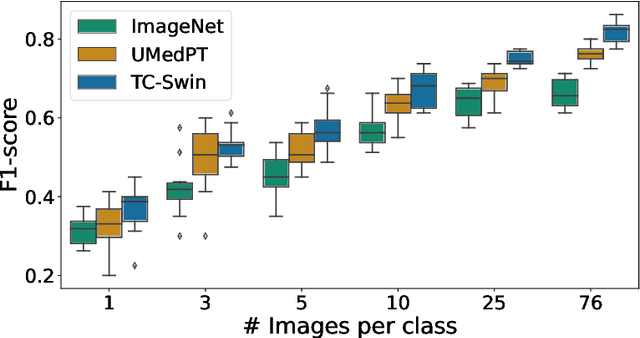
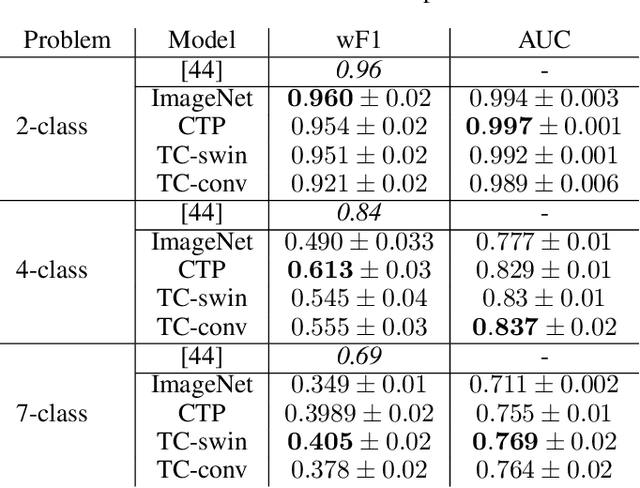
Due to the increasing workload of pathologists, the need for automation to support diagnostic tasks and quantitative biomarker evaluation is becoming more and more apparent. Foundation models have the potential to improve generalizability within and across centers and serve as starting points for data efficient development of specialized yet robust AI models. However, the training foundation models themselves is usually very expensive in terms of data, computation, and time. This paper proposes a supervised training method that drastically reduces these expenses. The proposed method is based on multi-task learning to train a joint encoder, by combining 16 different classification, segmentation, and detection tasks on a total of 912,000 patches. Since the encoder is capable of capturing the properties of the samples, we term it the Tissue Concepts encoder. To evaluate the performance and generalizability of the Tissue Concepts encoder across centers, classification of whole slide images from four of the most prevalent solid cancers - breast, colon, lung, and prostate - was used. The experiments show that the Tissue Concepts model achieve comparable performance to models trained with self-supervision, while requiring only 6% of the amount of training patches. Furthermore, the Tissue Concepts encoder outperforms an ImageNet pre-trained encoder on both in-domain and out-of-domain data.
MSA$^2$Net: Multi-scale Adaptive Attention-guided Network for Medical Image Segmentation
Aug 03, 2024Medical image segmentation involves identifying and separating object instances in a medical image to delineate various tissues and structures, a task complicated by the significant variations in size, shape, and density of these features. Convolutional neural networks (CNNs) have traditionally been used for this task but have limitations in capturing long-range dependencies. Transformers, equipped with self-attention mechanisms, aim to address this problem. However, in medical image segmentation it is beneficial to merge both local and global features to effectively integrate feature maps across various scales, capturing both detailed features and broader semantic elements for dealing with variations in structures. In this paper, we introduce MSA$^2$Net, a new deep segmentation framework featuring an expedient design of skip-connections. These connections facilitate feature fusion by dynamically weighting and combining coarse-grained encoder features with fine-grained decoder feature maps. Specifically, we propose a Multi-Scale Adaptive Spatial Attention Gate (MASAG), which dynamically adjusts the receptive field (Local and Global contextual information) to ensure that spatially relevant features are selectively highlighted while minimizing background distractions. Extensive evaluations involving dermatology, and radiological datasets demonstrate that our MSA$^2$Net outperforms state-of-the-art (SOTA) works or matches their performance. The source code is publicly available at https://github.com/xmindflow/MSA-2Net.
MSA2Net: Multi-scale Adaptive Attention-guided Network for Medical Image Segmentation
Jul 31, 2024Medical image segmentation involves identifying and separating object instances in a medical image to delineate various tissues and structures, a task complicated by the significant variations in size, shape, and density of these features. Convolutional neural networks (CNNs) have traditionally been used for this task but have limitations in capturing long-range dependencies. Transformers, equipped with self-attention mechanisms, aim to address this problem. However, in medical image segmentation it is beneficial to merge both local and global features to effectively integrate feature maps across various scales, capturing both detailed features and broader semantic elements for dealing with variations in structures. In this paper, we introduce MSA2Net, a new deep segmentation framework featuring an expedient design of skip-connections. These connections facilitate feature fusion by dynamically weighting and combining coarse-grained encoder features with fine-grained decoder feature maps. Specifically, we propose a Multi-Scale Adaptive Spatial Attention Gate (MASAG), which dynamically adjusts the receptive field (Local and Global contextual information) to ensure that spatially relevant features are selectively highlighted while minimizing background distractions. Extensive evaluations involving dermatology, and radiological datasets demonstrate that our MSA2Net outperforms state-of-the-art (SOTA) works or matches their performance. The source code is publicly available at https://github.com/xmindflow/MSA-2Net.
Segmentation of Brain Metastases in MRI: A Two-Stage Deep Learning Approach with Modality Impact Study
Jul 19, 2024Brain metastasis segmentation poses a significant challenge in medical imaging due to the complex presentation and variability in size and location of metastases. In this study, we first investigate the impact of different imaging modalities on segmentation performance using a 3D U-Net. Through a comprehensive analysis, we determine that combining all available modalities does not necessarily enhance performance. Instead, the combination of T1-weighted with contrast enhancement (T1c), T1-weighted (T1), and FLAIR modalities yields superior results. Building on these findings, we propose a two-stage detection and segmentation model specifically designed to accurately segment brain metastases. Our approach demonstrates that leveraging three key modalities (T1c, T1, and FLAIR) achieves significantly higher accuracy compared to single-pass deep learning models. This targeted combination allows for precise segmentation, capturing even small metastases that other models often miss. Our model sets a new benchmark in brain metastasis segmentation, highlighting the importance of strategic modality selection and multi-stage processing in medical imaging. Our implementation is freely accessible to the research community on \href{https://github.com/xmindflow/Met-Seg}{GitHub}.
Physics-Inspired Generative Models in Medical Imaging: A Review
Jul 15, 2024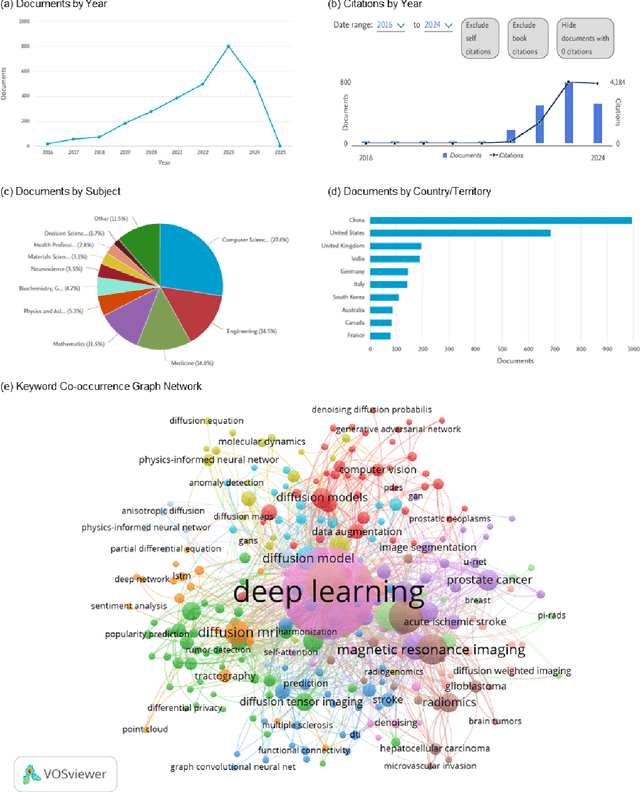
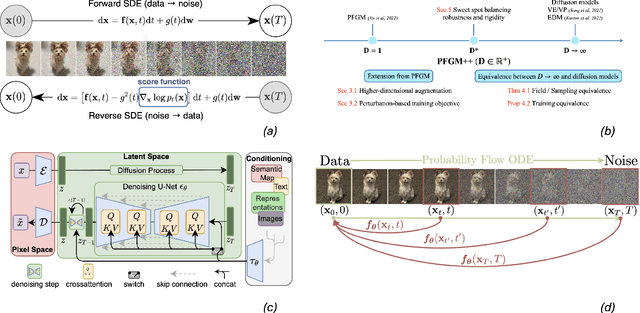
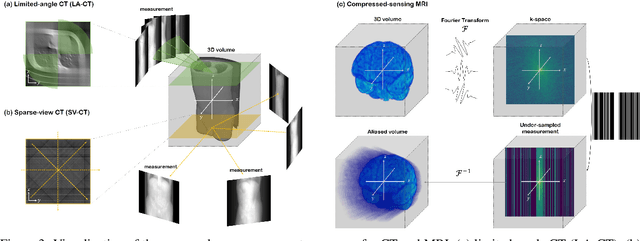
Physics-inspired generative models, in particular diffusion and Poisson flow models, enhance Bayesian methods and promise great utilities in medical imaging. This review examines the transformative role of such generative methods. First, a variety of physics-inspired generative models, including Denoising Diffusion Probabilistic Models (DDPM), Score-based Diffusion Models, and Poisson Flow Generative Models (PFGM and PFGM++), are revisited, with an emphasis on their accuracy, robustness as well as acceleration. Then, major applications of physics-inspired generative models in medical imaging are presented, comprising image reconstruction, image generation, and image analysis. Finally, future research directions are brainstormed, including unification of physics-inspired generative models, integration with vision-language models (VLMs),and potential novel applications of generative models. Since the development of generative methods has been rapid, this review will hopefully give peers and learners a timely snapshot of this new family of physics-driven generative models and help capitalize their enormous potential for medical imaging.
Unsupervised Latent Stain Adaptation for Computational Pathology
Jul 03, 2024In computational pathology, deep learning (DL) models for tasks such as segmentation or tissue classification are known to suffer from domain shifts due to different staining techniques. Stain adaptation aims to reduce the generalization error between different stains by training a model on source stains that generalizes to target stains. Despite the abundance of target stain data, a key challenge is the lack of annotations. To address this, we propose a joint training between artificially labeled and unlabeled data including all available stained images called Unsupervised Latent Stain Adaptation (ULSA). Our method uses stain translation to enrich labeled source images with synthetic target images in order to increase the supervised signals. Moreover, we leverage unlabeled target stain images using stain-invariant feature consistency learning. With ULSA we present a semi-supervised strategy for efficient stain adaptation without access to annotated target stain data. Remarkably, ULSA is task agnostic in patch-level analysis for whole slide images (WSIs). Through extensive evaluation on external datasets, we demonstrate that ULSA achieves state-of-the-art (SOTA) performance in kidney tissue segmentation and breast cancer classification across a spectrum of staining variations. Our findings suggest that ULSA is an important framework for stain adaptation in computational pathology.
Unsupervised Latent Stain Adaption for Digital Pathology
Jun 27, 2024In digital pathology, deep learning (DL) models for tasks such as segmentation or tissue classification are known to suffer from domain shifts due to different staining techniques. Stain adaptation aims to reduce the generalization error between different stains by training a model on source stains that generalizes to target stains. Despite the abundance of target stain data, a key challenge is the lack of annotations. To address this, we propose a joint training between artificially labeled and unlabeled data including all available stained images called Unsupervised Latent Stain Adaption (ULSA). Our method uses stain translation to enrich labeled source images with synthetic target images in order to increase supervised signals. Moreover, we leverage unlabeled target stain images using stain-invariant feature consistency learning. With ULSA we present a semi-supervised strategy for efficient stain adaption without access to annotated target stain data. Remarkably, ULSA is task agnostic in patch-level analysis for whole slide images (WSIs). Through extensive evaluation on external datasets, we demonstrate that ULSA achieves state-of-the-art (SOTA) performance in kidney tissue segmentation and breast cancer classification across a spectrum of staining variations. Our findings suggest that ULSA is an important framework towards stain adaption in digital pathology.
Computation-Efficient Era: A Comprehensive Survey of State Space Models in Medical Image Analysis
Jun 05, 2024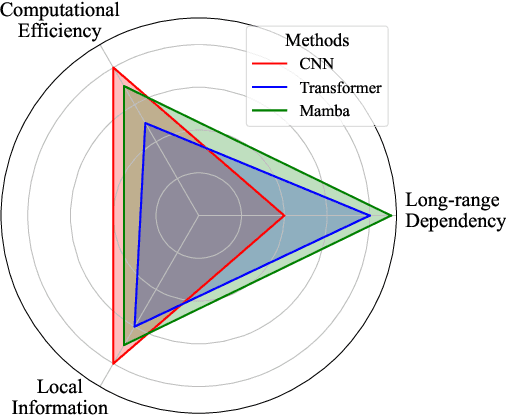
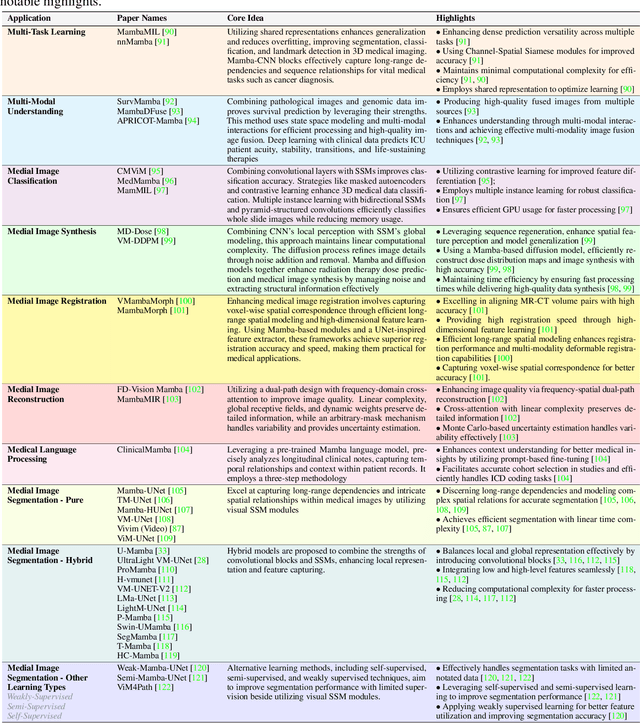
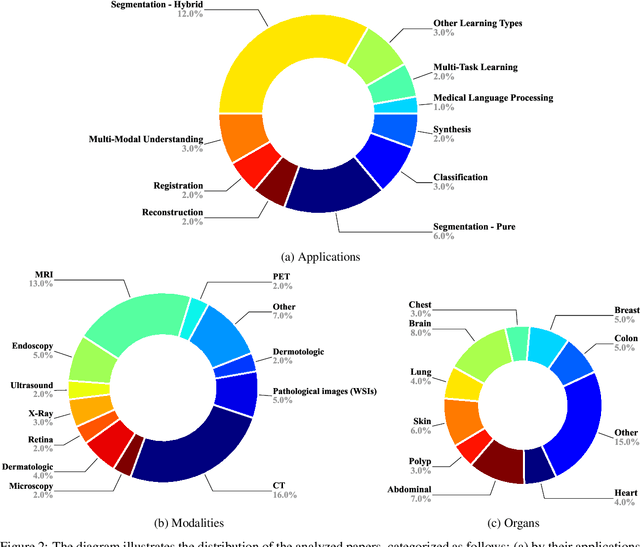
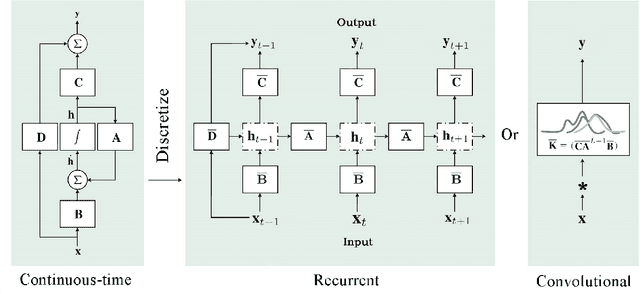
Sequence modeling plays a vital role across various domains, with recurrent neural networks being historically the predominant method of performing these tasks. However, the emergence of transformers has altered this paradigm due to their superior performance. Built upon these advances, transformers have conjoined CNNs as two leading foundational models for learning visual representations. However, transformers are hindered by the $\mathcal{O}(N^2)$ complexity of their attention mechanisms, while CNNs lack global receptive fields and dynamic weight allocation. State Space Models (SSMs), specifically the \textit{\textbf{Mamba}} model with selection mechanisms and hardware-aware architecture, have garnered immense interest lately in sequential modeling and visual representation learning, challenging the dominance of transformers by providing infinite context lengths and offering substantial efficiency maintaining linear complexity in the input sequence. Capitalizing on the advances in computer vision, medical imaging has heralded a new epoch with Mamba models. Intending to help researchers navigate the surge, this survey seeks to offer an encyclopedic review of Mamba models in medical imaging. Specifically, we start with a comprehensive theoretical review forming the basis of SSMs, including Mamba architecture and its alternatives for sequence modeling paradigms in this context. Next, we offer a structured classification of Mamba models in the medical field and introduce a diverse categorization scheme based on their application, imaging modalities, and targeted organs. Finally, we summarize key challenges, discuss different future research directions of the SSMs in the medical domain, and propose several directions to fulfill the demands of this field. In addition, we have compiled the studies discussed in this paper along with their open-source implementations on our GitHub repository.