 Add to Chrome
 Add to Firefox
 Add to Edge
V-Retrver: Evidence-Driven Agentic Reasoning for Universal Multimodal Retrieval
Feb 05, 2026
Multimodal Large Language Models (MLLMs) have recently been applied to universal multimodal retrieval, where Chain-of-Thought (CoT) reasoning improves candidate reranking. However, existing approaches remain largely language-driven, relying on static visual encodings and lacking the ability to actively verify fine-grained visual evidence, which often leads to speculative reasoning in visually ambiguous cases. We propose V-Retrver, an evidence-driven retrieval framework that reformulates multimodal retrieval as an agentic reasoning process grounded in visual inspection. V-Retrver enables an MLLM to selectively acquire visual evidence during reasoning via external visual tools, performing a multimodal interleaved reasoning process that alternates between hypothesis generation and targeted visual verification.To train such an evidence-gathering retrieval agent, we adopt a curriculum-based learning strategy combining supervised reasoning activation, rejection-based refinement, and reinforcement learning with an evidence-aligned objective. Experiments across multiple multimodal retrieval benchmarks demonstrate consistent improvements in retrieval accuracy (with 23.0% improvements on average), perception-driven reasoning reliability, and generalization.

QuantEval: A Benchmark for Financial Quantitative Tasks in Large Language Models
Jan 13, 2026Large Language Models (LLMs) have shown strong capabilities across many domains, yet their evaluation in financial quantitative tasks remains fragmented and mostly limited to knowledge-centric question answering. We introduce QuantEval, a benchmark that evaluates LLMs across three essential dimensions of quantitative finance: knowledge-based QA, quantitative mathematical reasoning, and quantitative strategy coding. Unlike prior financial benchmarks, QuantEval integrates a CTA-style backtesting framework that executes model-generated strategies and evaluates them using financial performance metrics, enabling a more realistic assessment of quantitative coding ability. We evaluate some state-of-the-art open-source and proprietary LLMs and observe substantial gaps to human experts, particularly in reasoning and strategy coding. Finally, we conduct large-scale supervised fine-tuning and reinforcement learning experiments on domain-aligned data, demonstrating consistent improvements. We hope QuantEval will facilitate research on LLMs' quantitative finance capabilities and accelerate their practical adoption in real-world trading workflows. We additionally release the full deterministic backtesting configuration (asset universe, cost model, and metric definitions) to ensure strict reproducibility.
AdaTooler-V: Adaptive Tool-Use for Images and Videos
Dec 19, 2025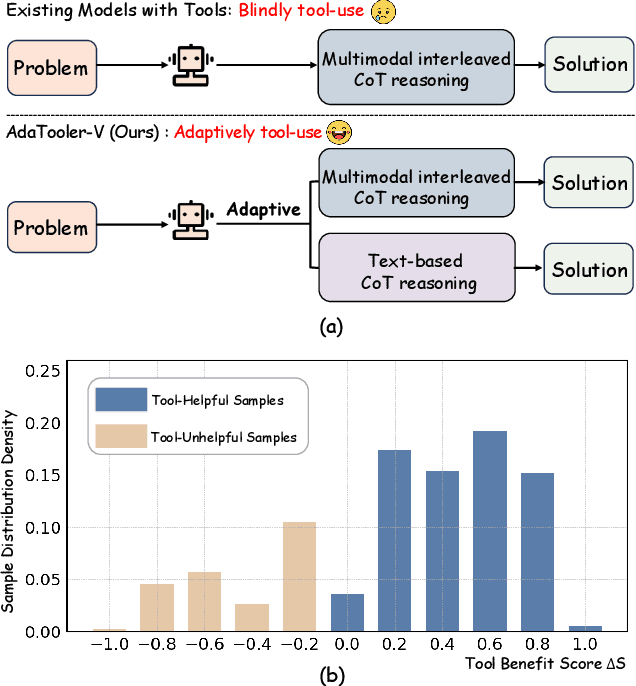
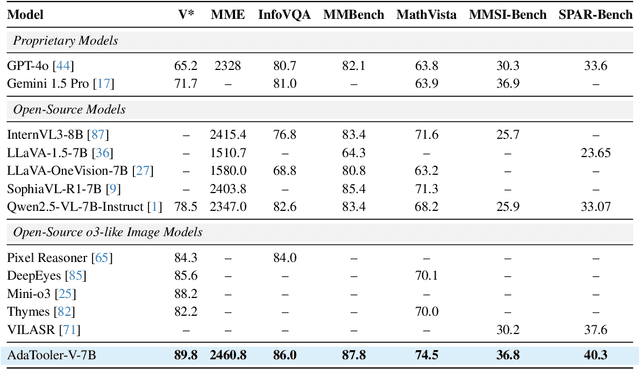
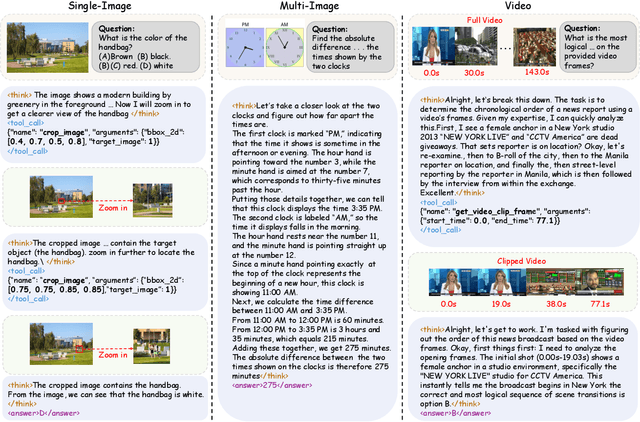
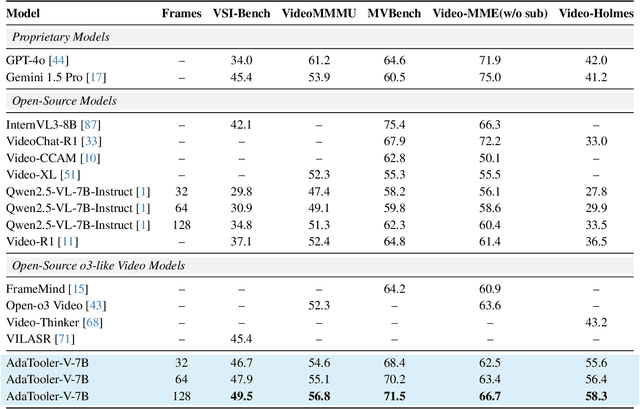
Recent advances have shown that multimodal large language models (MLLMs) benefit from multimodal interleaved chain-of-thought (CoT) with vision tool interactions. However, existing open-source models often exhibit blind tool-use reasoning patterns, invoking vision tools even when they are unnecessary, which significantly increases inference overhead and degrades model performance. To this end, we propose AdaTooler-V, an MLLM that performs adaptive tool-use by determining whether a visual problem truly requires tools. First, we introduce AT-GRPO, a reinforcement learning algorithm that adaptively adjusts reward scales based on the Tool Benefit Score of each sample, encouraging the model to invoke tools only when they provide genuine improvements. Moreover, we construct two datasets to support training: AdaTooler-V-CoT-100k for SFT cold start and AdaTooler-V-300k for RL with verifiable rewards across single-image, multi-image, and video data. Experiments across twelve benchmarks demonstrate the strong reasoning capability of AdaTooler-V, outperforming existing methods in diverse visual reasoning tasks. Notably, AdaTooler-V-7B achieves an accuracy of 89.8\% on the high-resolution benchmark V*, surpassing the commercial proprietary model GPT-4o and Gemini 1.5 Pro. All code, models, and data are released.