 Add to Chrome
 Add to Firefox
 Add to Edge
OpAgent: Operator Agent for Web Navigation
Feb 14, 2026
To fulfill user instructions, autonomous web agents must contend with the inherent complexity and volatile nature of real-world websites. Conventional paradigms predominantly rely on Supervised Fine-Tuning (SFT) or Offline Reinforcement Learning (RL) using static datasets. However, these methods suffer from severe distributional shifts, as offline trajectories fail to capture the stochastic state transitions and real-time feedback of unconstrained wide web environments. In this paper, we propose a robust Online Reinforcement Learning WebAgent, designed to optimize its policy through direct, iterative interactions with unconstrained wide websites. Our approach comprises three core innovations: 1) Hierarchical Multi-Task Fine-tuning: We curate a comprehensive mixture of datasets categorized by functional primitives -- Planning, Acting, and Grounding -- establishing a Vision-Language Model (VLM) with strong instruction-following capabilities for Web GUI tasks. 2) Online Agentic RL in the Wild: We develop an online interaction environment and fine-tune the VLM using a specialized RL pipeline. We introduce a Hybrid Reward Mechanism that combines a ground-truth-agnostic WebJudge for holistic outcome assessment with a Rule-based Decision Tree (RDT) for progress reward. This system effectively mitigates the credit assignment challenge in long-horizon navigation. Notably, our RL-enhanced model achieves a 38.1\% success rate (pass@5) on WebArena, outperforming all existing monolithic baselines. 3) Operator Agent: We introduce a modular agentic framework, namely \textbf{OpAgent}, orchestrating a Planner, Grounder, Reflector, and Summarizer. This synergy enables robust error recovery and self-correction, elevating the agent's performance to a new State-of-the-Art (SOTA) success rate of \textbf{71.6\%}.

ISImed: A Framework for Self-Supervised Learning using Intrinsic Spatial Information in Medical Images
Oct 22, 2024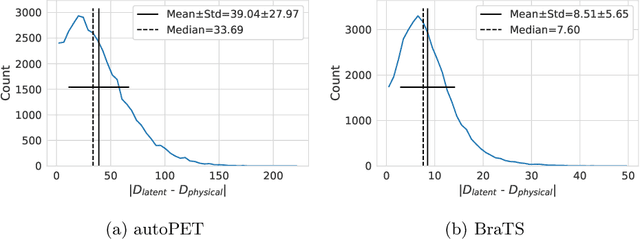
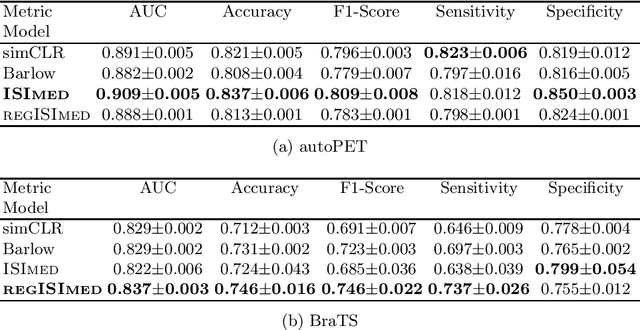
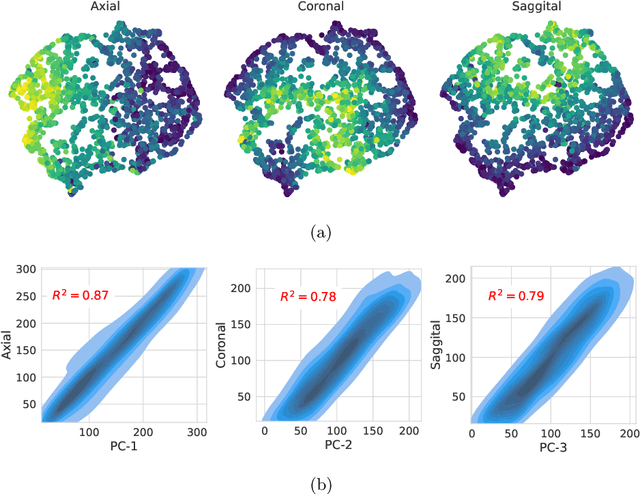
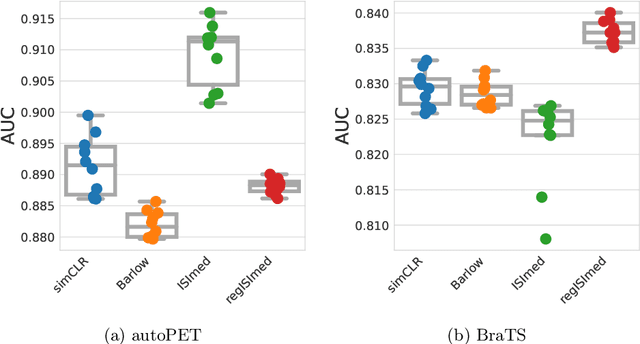
This paper demonstrates that spatial information can be used to learn interpretable representations in medical images using Self-Supervised Learning (SSL). Our proposed method, ISImed, is based on the observation that medical images exhibit a much lower variability among different images compared to classic data vision benchmarks. By leveraging this resemblance of human body structures across multiple images, we establish a self-supervised objective that creates a latent representation capable of capturing its location in the physical realm. More specifically, our method involves sampling image crops and creating a distance matrix that compares the learned representation vectors of all possible combinations of these crops to the true distance between them. The intuition is, that the learned latent space is a positional encoding for a given image crop. We hypothesize, that by learning these positional encodings, comprehensive image representations have to be generated. To test this hypothesis and evaluate our method, we compare our learned representation with two state-of-the-art SSL benchmarking methods on two publicly available medical imaging datasets. We show that our method can efficiently learn representations that capture the underlying structure of the data and can be used to transfer to a downstream classification task.