 Add to Chrome
 Add to Firefox
 Add to Edge
Behavior-Aware Dual-Channel Preference Learning for Heterogeneous Sequential Recommendation
Apr 16, 2026
Heterogeneous sequential recommendation (HSR) aims to learn dynamic behavior dependencies from the diverse behaviors of user-item interactions to facilitate precise sequential recommendation. Despite many efforts yielding promising achievements, there are still challenges in modeling heterogeneous behavior data. One significant issue is the inherent sparsity of a real-world data, which can weaken the recommendation performance. Although auxiliary behaviors (e.g., clicks) partially address this problem, they inevitably introduce some noise, and the sparsity of the target behavior (e.g., purchases) remains unresolved. Additionally, contrastive learning-based augmentation in existing methods often focuses on a single behavior type, overlooking fine-grained user preferences and losing valuable information. To address these challenges, we have meticulously designed a behavior-aware dual-channel preference learning framework (BDPL). This framework begins with the construction of customized behavior-aware subgraphs to capture personalized behavior transition relationships, followed by a novel cascade-structured graph neural network to aggregate node context information. We then model and enhance user representations through a preference-level contrastive learning paradigm, considering both long-term and short-term preferences. Finally, we fuse the overall preference information using an adaptive gating mechanism to predict the next item the user will interact with under the target behavior. Extensive experiments on three real-world datasets demonstrate the superiority of our BDPL over the state-of-the-art models.

OpenGridGym: An Open-Source AI-Friendly Toolkit for Distribution Market Simulation
Mar 06, 2022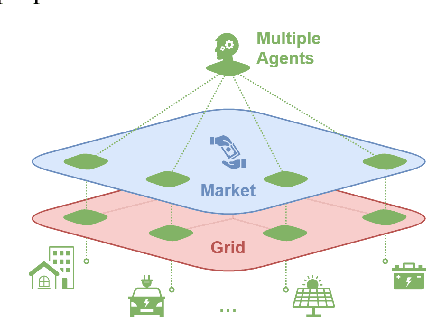
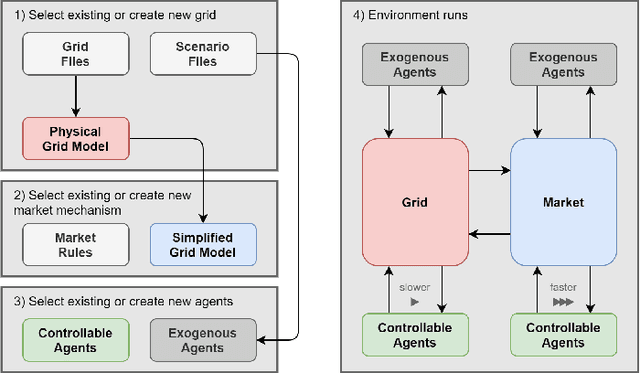

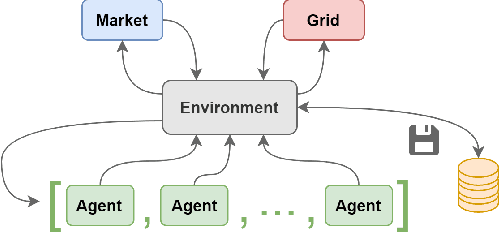
This paper presents OpenGridGym, an open-source Python-based package that allows for seamless integration of distribution market simulation with state-of-the-art artificial intelligence (AI) decision-making algorithms. We present the architecture and design choice for the proposed framework, elaborate on how users interact with OpenGridGym, and highlight its value by providing multiple cases to demonstrate its use. Four modules are used in any simulation: (1) the physical grid, (2) market mechanisms, (3) a set of trainable agents which interact with the former two modules, and (4) environment module that connects and coordinates the above three. We provide templates for each of those four, but they are easily interchangeable with custom alternatives. Several case studies are presented to illustrate the capability and potential of this toolkit in helping researchers address key design and operational questions in distribution electricity markets.
PSML: A Multi-scale Time-series Dataset for Machine Learning in Decarbonized Energy Grids
Oct 12, 2021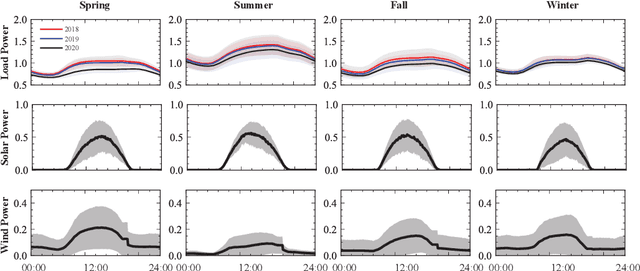
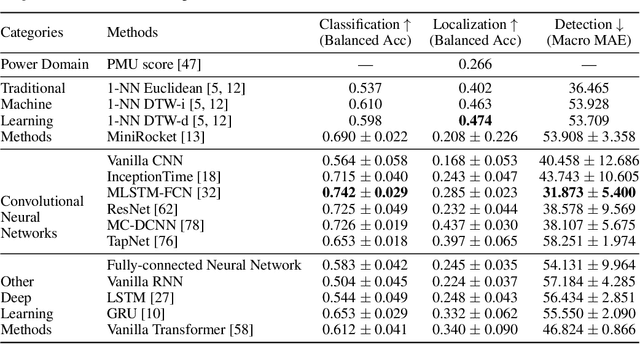
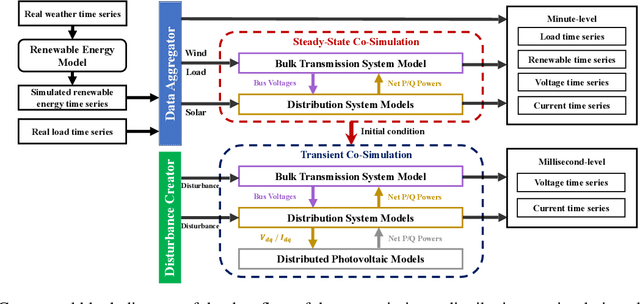
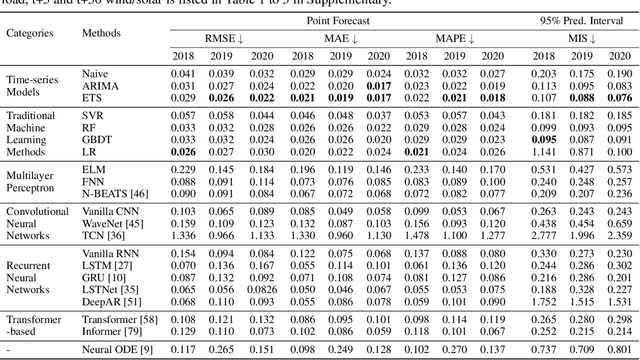
The electric grid is a key enabling infrastructure for the ambitious transition towards carbon neutrality as we grapple with climate change. With deepening penetration of renewable energy resources and electrified transportation, the reliable and secure operation of the electric grid becomes increasingly challenging. In this paper, we present PSML, a first-of-its-kind open-access multi-scale time-series dataset, to aid in the development of data-driven machine learning (ML) based approaches towards reliable operation of future electric grids. The dataset is generated through a novel transmission + distribution (T+D) co-simulation designed to capture the increasingly important interactions and uncertainties of the grid dynamics, containing electric load, renewable generation, weather, voltage and current measurements at multiple spatio-temporal scales. Using PSML, we provide state-of-the-art ML baselines on three challenging use cases of critical importance to achieve: (i) early detection, accurate classification and localization of dynamic disturbance events; (ii) robust hierarchical forecasting of load and renewable energy with the presence of uncertainties and extreme events; and (iii) realistic synthetic generation of physical-law-constrained measurement time series. We envision that this dataset will enable advances for ML in dynamic systems, while simultaneously allowing ML researchers to contribute towards carbon-neutral electricity and mobility.