 Add to Chrome
 Add to Firefox
 Add to Edge
Behavior-Aware Dual-Channel Preference Learning for Heterogeneous Sequential Recommendation
Apr 16, 2026
Heterogeneous sequential recommendation (HSR) aims to learn dynamic behavior dependencies from the diverse behaviors of user-item interactions to facilitate precise sequential recommendation. Despite many efforts yielding promising achievements, there are still challenges in modeling heterogeneous behavior data. One significant issue is the inherent sparsity of a real-world data, which can weaken the recommendation performance. Although auxiliary behaviors (e.g., clicks) partially address this problem, they inevitably introduce some noise, and the sparsity of the target behavior (e.g., purchases) remains unresolved. Additionally, contrastive learning-based augmentation in existing methods often focuses on a single behavior type, overlooking fine-grained user preferences and losing valuable information. To address these challenges, we have meticulously designed a behavior-aware dual-channel preference learning framework (BDPL). This framework begins with the construction of customized behavior-aware subgraphs to capture personalized behavior transition relationships, followed by a novel cascade-structured graph neural network to aggregate node context information. We then model and enhance user representations through a preference-level contrastive learning paradigm, considering both long-term and short-term preferences. Finally, we fuse the overall preference information using an adaptive gating mechanism to predict the next item the user will interact with under the target behavior. Extensive experiments on three real-world datasets demonstrate the superiority of our BDPL over the state-of-the-art models.

A Survey on Sequential Recommendation
Dec 17, 2024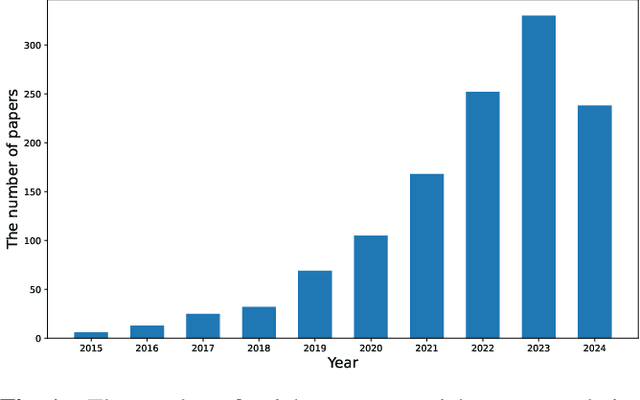
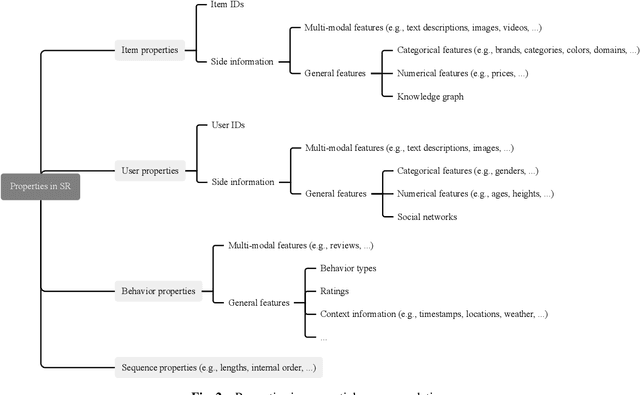

Different from most conventional recommendation problems, sequential recommendation focuses on learning users' preferences by exploiting the internal order and dependency among the interacted items, which has received significant attention from both researchers and practitioners. In recent years, we have witnessed great progress and achievements in this field, necessitating a new survey. In this survey, we study the SR problem from a new perspective (i.e., the construction of an item's properties), and summarize the most recent techniques used in sequential recommendation such as pure ID-based SR, SR with side information, multi-modal SR, generative SR, LLM-powered SR, ultra-long SR and data-augmented SR. Moreover, we introduce some frontier research topics in sequential recommendation, e.g., open-domain SR, data-centric SR, could-edge collaborative SR, continuous SR, SR for good, and explainable SR. We believe that our survey could be served as a valuable roadmap for readers in this field.