 Add to Chrome
 Add to Firefox
 Add to Edge
Artificial intelligence-driven improvement of hospital logistics management resilience: a practical exploration based on H Hospital
Mar 14, 2026
Hospital logistics management faces growing pressure from internal operations and external emergencies, with artificial intelligence (AI) holding untapped potential to boost its resilience. This study explores AI's role in enhancing logistics resilience via a mixed-methods case study of H Hospital, combining 12 key informant interviews and a full survey of 151 logistics staff, with the PDCA cycle as the analytical framework. Thematic and quantitative analyses (hierarchical regression, structural equation modeling) were adopted for data analysis. Results showed 94.7% staff perceived AI application, with the strongest improvements in equipment maintenance (41.1%) and resource allocation (33.1%), but limited effects in emergency response (18.54%) and risk management (15.23%). AI integration positively correlated with logistics resilience (\b{eta}=0.642, p<0.001), with management system adaptability as a positive moderator (\b{eta}=0.208, p<0.01). The PDCA cycle fully mediated the AI-resilience relationship. We conclude AI effectively enhances logistics resilience, dependent on adaptive management systems and structured continuous improvement mechanisms. Targeted strategies are proposed to form an AI-driven closed-loop resilience mechanism, offering empirical guidance for AI-hospital logistics integration and resilient health system construction.

Efficient endometrial carcinoma screening via cross-modal synthesis and gradient distillation
Feb 23, 2026Early detection of myometrial invasion is critical for the staging and life-saving management of endometrial carcinoma (EC), a prevalent global malignancy. Transvaginal ultrasound serves as the primary, accessible screening modality in resource-constrained primary care settings; however, its diagnostic reliability is severely hindered by low tissue contrast, high operator dependence, and a pronounced scarcity of positive pathological samples. Existing artificial intelligence solutions struggle to overcome this severe class imbalance and the subtle imaging features of invasion, particularly under the strict computational limits of primary care clinics. Here we present an automated, highly efficient two-stage deep learning framework that resolves both data and computational bottlenecks in EC screening. To mitigate pathological data scarcity, we develop a structure-guided cross-modal generation network that synthesizes diverse, high-fidelity ultrasound images from unpaired magnetic resonance imaging (MRI) data, strictly preserving clinically essential anatomical junctions. Furthermore, we introduce a lightweight screening network utilizing gradient distillation, which transfers discriminative knowledge from a high-capacity teacher model to dynamically guide sparse attention towards task-critical regions. Evaluated on a large, multicenter cohort of 7,951 participants, our model achieves a sensitivity of 99.5\%, a specificity of 97.2\%, and an area under the curve of 0.987 at a minimal computational cost (0.289 GFLOPs), substantially outperforming the average diagnostic accuracy of expert sonographers. Our approach demonstrates that combining cross-modal synthetic augmentation with knowledge-driven efficient modeling can democratize expert-level, real-time cancer screening for resource-constrained primary care settings.
GvT: A Graph-based Vision Transformer with Talking-Heads Utilizing Sparsity, Trained from Scratch on Small Datasets
Apr 07, 2024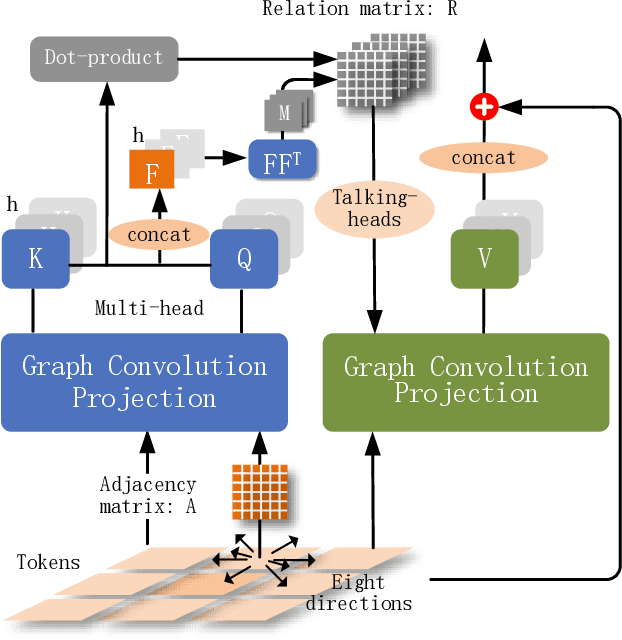
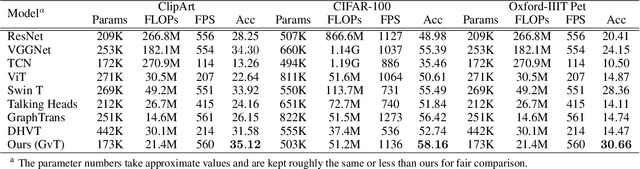
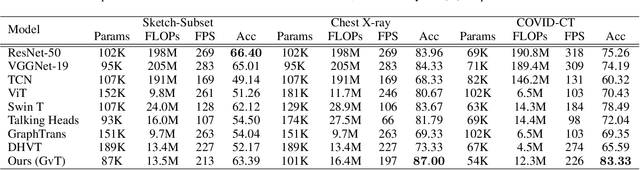
Vision Transformers (ViTs) have achieved impressive results in large-scale image classification. However, when training from scratch on small datasets, there is still a significant performance gap between ViTs and Convolutional Neural Networks (CNNs), which is attributed to the lack of inductive bias. To address this issue, we propose a Graph-based Vision Transformer (GvT) that utilizes graph convolutional projection and graph-pooling. In each block, queries and keys are calculated through graph convolutional projection based on the spatial adjacency matrix, while dot-product attention is used in another graph convolution to generate values. When using more attention heads, the queries and keys become lower-dimensional, making their dot product an uninformative matching function. To overcome this low-rank bottleneck in attention heads, we employ talking-heads technology based on bilinear pooled features and sparse selection of attention tensors. This allows interaction among filtered attention scores and enables each attention mechanism to depend on all queries and keys. Additionally, we apply graph-pooling between two intermediate blocks to reduce the number of tokens and aggregate semantic information more effectively. Our experimental results show that GvT produces comparable or superior outcomes to deep convolutional networks and surpasses vision transformers without pre-training on large datasets. The code for our proposed model is publicly available on the website.